

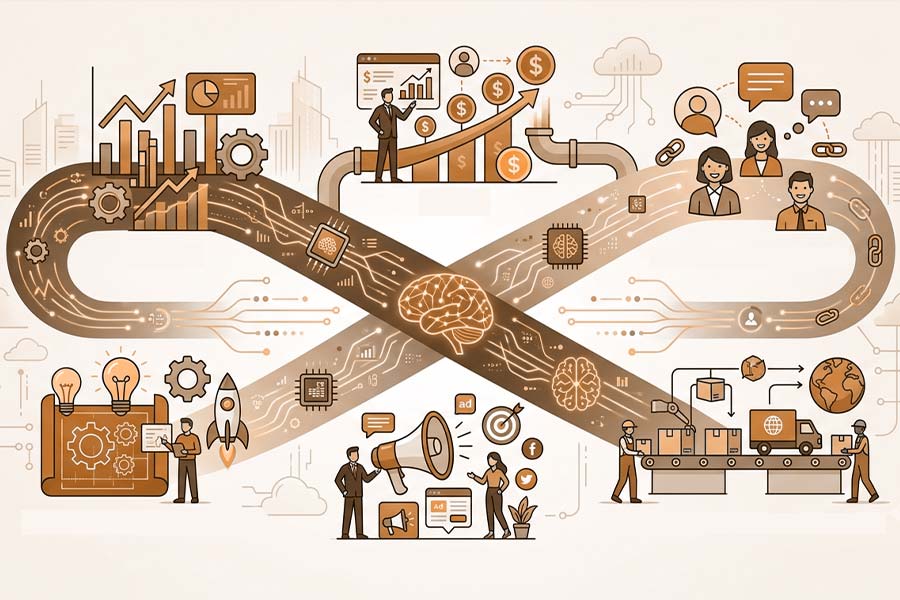
Enterprise technology is also going thru a major transition at this time. For many years, digital transformation initiatives focused on the introduction of high visibility technologies that fundamentally changed the way organizations operated. In many cases, large-scale ERP implementations, cloud migrations, customer relationship management platforms, collaboration tools and digital workplace solutions required extensive planning, employe training and organizational change. These efforts did bring business into the modern age but often interrupted the flow of work and took considerable effort on the part of employes to adapt to new systems. Organizations are now moving into a new era where technology will seem to be almost invisible, seamlessly embedding intelligence into everyday business activity without disturbing how people work.
Today’s businesses are more and more dependent on technologies that make operations work better without making them more complicated. In terms of the productivity of employes, less digital friction is better than more software as they already use a bunch of applications during the workday. Therefore, business leaders are turning to solutions that automate repetitive tasks, enable decision-making, improve operational efficiency and provide intelligent recommendations but are largely invisible to the end-user. Technology should fit in with existing business processes, not for employes to change their work processes to accommodate technology, according to organizations.
This change has accelerated the deployment of AI-powered business processes that work seamlessly across all enterprise functions. The rise of artificial intelligence, workflow automation, predictive analytics, real-time data platforms, and intelligent assistants is pervasive across finance, human resources, customer service, operations, supply chain management, and executive decision-making. These technologies are constantly analyzing enterprise data, automating routine tasks, identifying opportunities for improvement and providing contextual recommendations at the very moment they are needed. The result is a smart workplace where business processes can be faster, more accurate and more responsive without the employes having to directly interact with complex technology systems.
Yet such seamless intelligence is often a hard nut to crack for traditional digital transformation efforts. Many organizations continue to operate on fractured technology landscapes. Employes spend their time moving data between systems, toggling between multiple applications, and struggling with technology instead of delivering business results. Large transformation programs often include temporary operational disruption, extensive retraining requirements and resistance to change, all of which can inhibit the realization of business value. As the complexity of enterprise technology ecosystems continues to grow, organizations need a different kind of leadership approach that values intelligent integration over visible technology deployment.
This requirement resulted in the creation of Invisible CIO Leadership, a new methodology that focuses on the embedding of intelligence into all business processes while at the same time minimizing the impact on employes and operations. Invisible CIO Leadership measures success not by the number of new technologies deployed, but by the seamless digital experiences where AI, automation, analytics and intelligent workflows run naturally in the background. Organizations can boost productivity, decision-making, operational performance and client engagement without adding to digital complexity by making technology less visible and significantly increasing business impact.
The role of the Chief Information Officer is also evolving from a manager of enterprise technology infrastructure to an orchestrator of enterprise-wide intelligence. CIOs are being asked to think beyond individual IT projects to the development of a comprehensive ecosystem that integrates artificial intelligence, automation, cloud platforms, enterprise data, and intelligent workflows that are constantly aligned with business objectives. Organizations can build adaptive enterprises that learn, automate and optimize operations across the evolution from technology management to intelligence orchestration.
Embedded enterprise intelligence provides significant value to customers and employes alike. Employees can work on higher value-add activities thanks to simpler workflows, AI-powered support, faster access to knowledge and less admin effort. Clients benefit from better uniformity across digital channels, faster service delivery and more personalized interactions. Rather than layering on more technology, organizations may utilize intelligence to enhance productivity and satisfaction by weaving it directly into operational processes – creating seamless experiences.
The article discusses the basics of Invisible CIO Leadership, including the technologies that enable embedded enterprise intelligence, its business applications in modern organizations, the operational and strategic benefits it provides, the challenges of implementing it, and the future of intelligent enterprise leadership. It shows how artificial intelligence, workflow automation, analytics, cloud-native platforms, and intelligent orchestration are helping CIOs build frictionless digital enterprises—enterprises where technology silently powers smarter decisions, more efficient operations, and exceptional business outcomes without impacting the way people work.
Understanding Invisible CIO Leadership
The Chief Information Officer (CIO) role is going through a fundamental change as enterprises become more digital. Infrastructure deployment, management of IT systems, and enterprise applications were the hallmarks of traditional technology leadership. Today, organizations want technology to be invisible, enhancing each business process without interrupting the flow of work. This evolution has led to Invisible CIO Leadership, a leadership approach that emphasizes the seamless incorporation of intelligence, automation, and analytics into daily operations.
Employees are able to experience increased productivity without the burden of technology complexity. Invisible CIO Leadership means that technology is always improving business performance, working in the background rather than forcing employees to adapt to new systems or adding more software.
What is the concept of Invisible CIO Leadership?
Invisible CIO Leadership is a methodical approach to technology leadership that focuses on embedding intelligence into all business processes with minimal disruption to employees and operations. CIOs are focusing on delivering seamless digital experiences that embed automation, artificial intelligence, analytics, and workflow orchestration into the day’s work rather than measuring success based on the visibility of technology projects.
What you want to do is not eliminate technology but make it almost invisible to the end user. Employees get contextual insights, automated support, and intelligent recommendations without the burden of constantly interacting with multiple applications or navigating complex enterprise systems.
This leadership philosophy emphasizes the importance of embedded enterprise intelligence, which includes the continuous analysis of data, the identification of opportunities, the automation of repetitive activities, and the support for decision-making across all business functions. “Using technology as an enabler, not a roadblock, is a way organizations can reduce digital complexity and increase productivity.
The invisible technology experiences also drive user adoption, as employees can work with familiar workflows while intelligent systems work in the background. Rather than extensive retraining every time new technologies are introduced, organizations integrate innovation into their current business processes.
Core elements of Invisible CIO Leadership include:
- Making enterprise intelligence a part of the daily routine.
- Delivering technology experiences that are invisible and minimize user disruption.
- Ensuring smooth running of digital operations across the organization.
- The integration of AI and automation into existing business processes.
- Achieving better business results without an increase in technology complexity.
This approach shifts technology from the highly visible infrastructure to an intelligent operational capability that still allows for enterprise growth.
1. Evolution of Enterprise Technology Leadership
In recent decades, the role of enterprise technology leadership has changed dramatically. Initially, the main goals of CIOs were to guaranty system uptime, manage hardware, provide support for enterprise software, and sustain the IT infrastructure. Technology departments were generally perceived as operational support functions that maintained business systems.
The CIO’s responsibilities were expanded with the rise of digital transformation, which went beyond infrastructure management. Organizations invested heavily in enterprise applications, cloud computing, collaboration tools, ERP platforms and CRM systems meant to digitize business processes. CIOs turned into strategic leaders responsible for enterprise-wide modernization efforts.
With the maturity of cloud computing, organizations adopted cloud-first enterprise strategies focused on speed of innovation, scalability, and flexibility. CIOs are increasingly focused on cloud integration, legacy application modernization and hybrid work enablement.
Another major development has been the emergence of artificial intelligence, which enables organizations to automate decision-making, improve operational efficiency, and generate predictive business insights. Technology leadership is no longer about system deployment but orchestrating intelligent enterprise capabilities.
Today the next step in this evolution is called Invisible CIO Leadership. CIOs are focused on embedding enterprise intelligence directly into workflows, rather than just high-profile technology projects, to create environments where technology continuously improves operations without requiring employes to change the way they work.
The evolution can be summarized as:
- The focus of traditional IT management was on infrastructure and operational stability.
- Digital transformation leadership modernized the enterprises.
- Cloud-first enterprise strategies led to more flexibility and scalability.
- Intelligent automation powered by AI-driven operations.
- invisible enterprise intelligence seamlessly integrated into business processes.
This is evidence of the growing strategic importance of CIOs to the growth of enterprise intelligence, rather than simply the management of technology assets.
2. The Essential Qualities of Invisible CIO Leadership
Invisible CIO Leadership is characterized by a set of traits that enable organizations to create business environments that are intelligent, adaptive and frictionless.
The most important feature is embedded intelligence. AI is an ongoing process that resides within enterprise applications, actively analyzing information, spotting trends and offering recommendations without employes having to actively search for insights.
Continuous automation cuts down on manual, repetitive activities to boost operational efficiency. Employes can focus on strategic work, and routine approvals, administrative processes, reporting tasks, workflow coordination, and system monitoring are carried out automatically.
Context-aware decision support provides employes with the right information at the right time. Rather than bombarding users with dashboards or reports, intelligent systems provide recommendations based on live business activity, client engagement, operating conditions or organizational priorities.
Invisible CIO Leadership: Effortless employe experiences. Technology should make the job easier, not increase the cognitive load. AI supports employes in knowledge retrieval, task prioritization, workflow execution and collaboration thru intuitive systems.
Adaptive enterprise operations ensure that organizations remain responsive to changing market conditions. Intelligent systems are continually enhancing operations by optimizing workflows, dynamically allocating resources, and learning from data of the enterprise.
The main attributes are as follows:
- Embedded intelligence throughout enterprise processes.
- Continuous automation of routine business activities.
- Context-aware decision support powered by AI.
- Seamless employee experiences with minimal technology friction.
- Adaptive enterprise operations that continuously optimize performance.
These capabilities together allow organizations to run more efficiently and simplify technology.
3. The Importance of Invisible Intelligence
The modern organization is confronted with increasing digital complexity, with employes using a wide range of business applications on a daily basis. Constantly switching between systems leads to operational inefficiencies, slower decision making and reduced productivity.
Invisible intelligence overcomes these hurdles by embedding AI into business workflows rather than asking employes to work across disparate technology platforms. Smart systems work across departments, automate routine work and surface the right information—all without changing existing processes.
Reducing digital complexity increases organizational performance and employe satisfaction. Employes are spending less time managing software and more time on innovation, customer service and solving business problems.
This is because intelligent automation improves operational efficiency by eliminating redundant activities, enhancing the consistency of workflow across enterprise functions, and reducing processing delays.
Executives and employes receive real-time recommendations, supported by contextual business intelligence and predictive analytics, which greatly accelerates the decision-making process. Organizations get ongoing insight into changing business conditions, instead of just historical reporting.
Invisible intelligence also enhances enterprise agility by enabling organizations to respond rapidly to market shifts, customer demands, operational risks and new opportunities thru adaptive, data-driven processes.
Its strategic importance is:
- Reduce digital complexity to simplify enterprise operations.
- Increase operational efficiency with smart automation.
- Faster decision-making powered by contextual AI insights.
- Realigning business processes to enhance enterprise agility.
As organizations continue to embrace AI and intelligent automation, the Invisible CIO Leadership will become a defining capability for enterprises looking to improve productivity, simplify technology experience and create seamless digital operations where intelligence works naturally behind every business process.
Also Read: CIO Influence Interview with John Elliott, Cybersecurity Author Fellow at Pluralsight
Core technologies power embedded enterprise intelligence
The embedded enterprise intelligence must be a combination of technologies that can work across the existing business environments without adding additional complexity for employes.
Traditional business processes are transformed into adaptive and continuously evolving workflows thru the use of artificial intelligence, automation, real-time data, generative AI, cloud infrastructure and process intelligence. Rather than being standalone technology investments, these capabilities add an integrated intelligence layer to improve operational performance, automate activities and inform decision-making across the enterprise.
1. Artificial Intelligence and Machine Learning
Embedded enterprise intelligence is powered by artificial intelligence and machine learning. These technologies enable it to understand business data, recognize patterns, predict outcomes and make recommendations without requiring employes to manually analyze massive amounts of data.
CRM, ERP, HR, finance, supply chain and customer service applications can be directly integrated with intelligent decision support. This means employes receive recommendations based on their day-to-day work rather than having to access separate analytics programs. Moreover, standard ML models have the ability to identify evolving patterns and continuously improve their predictions as new data becomes available.
Predictive recommendations enable organizations to improve business outcomes, identify operational risks, optimize resources and predict customer needs. Artificial intelligence systems learn continually so they become better and more relevant over time.
The main features are:
- Smart decision support for existing workflows.
- Predictive recommendations powered by enterprise data.
- Continually purchasing new knowledge about business.
- AI-powered intelligence and insights for business optimization.
CIOs can embed AI into everyday applications to create intelligent environments that make it easier for employes to do their work, without constant interaction.
2. Workflow Automation and Process Orchestration
Workflow automation can turn repetitive business tasks into smart and automated processes for enterprises. Automation technologies orchestrate tasks, approvals, notifications and decisions across multiple applications, so employes don’t have to move information manually from system to system.
Intelligent workflows can automatically determine the next action based on business rules, customer information, operational conditions, or AI-generated recommendations. Robotic Process Automation (RPA) automates repetitive tasks like data entry, reconciliation, document processing and system updates.
Business process automation coupled with event driven execution is even more powerful. A particular event, like a customer placing a request, an invoice hitting a threshold, or a security alert being generated, can automatically trigger a series of actions across connected systems.
Key capabilities are:
- Smart workflows that react to business requirements.
- RPA automates tedious administrative processes.
- Business process automation across enterprise applications
- Event-driven execution which automatically triggers actions.
This lets technology do its job quietly in the background, while employes focus on the activities that require judgment, creativity and collaboration.
3. Real-Time Data Platforms
Embedded intelligence needs timely and reliable data from the enterprise to work. Real-time data platforms integrate data from multiple business systems for instant analysis and decision-making.
Enterprise data integration involves integrating data from different applications such as CRM, ERP, HR, finance, supply chain, customer service, and collaboration. Event streaming allows organizations to capture business activity in real time, as opposed to waiting for periodic data refreshes.
Live operational intelligence provides executives and employes with up-to-date information on how their businesses are performing. Continuous business monitoring can find new issues, operational bottlenecks, changes in customer behavior and opportunities for optimization.
Below are some key capabilities
- Connect enterprise data across disparate systems.
- Operational intelligence, in real time.
- Event streaming provides ongoing data availability.
- Steady oversight of business activities.
Operational enterprise processes are thus context-aware and reactive. They are based on real-time data.
4. Intelligent Assistants and Generative AI
Generative AI accelerates the development of invisible intelligence, so employes can converse with enterprise systems in natural language. AI copilots can help with writing, analysis, research, reporting, communicating with customers, coding and administrative work – without the need for employes to learn complex software interfaces.
They can retrieve information from authorized organizational sources, create summaries of documents, respond to questions, and provide contextual advice. Conversational workflows allow employes to start business processes by simply talking about what they need.
Also, the dependence on conventional dashboards and menus can be reduced using natural language interfaces. Rather than digging thru multiple applications to gather information, employes can ask an AI assistant to retrieve data, summarize activity or initiate an approved workflow.
Key features of the product include:
- Workplace apps have AI copilots built in.
- Knowledge assistants for enterprise information access.
- Business Process Conversation Workflows.
- Interfaces meant to allow interaction with technology thru natural language.
Consequently, CIOs can remove digital friction and democratize enterprise intelligence with Generative AI.
5. Cloud-Native Enterprise Platforms
Cloud-native infrastructure provides the scalability and flexibility needed to embed intelligence throughout the enterprise. Elastic infrastructure allows the computing resources to scale up or down with changing business demand so that intelligent applications can handle changing workloads.
API-first architecture allows for the efficient sharing of data and services between different enterprise systems. Microservices enable organizations to build and enhance individual capabilities without the need to redevelop entire applications.
Enterprises can also use hybrid cloud operations to integrate public cloud resources more deeply into private infrastructure and legacy systems. Such flexibility is particularly critical for organizations that cannot immediately replace their existing technology environments.
Key capabilities include:
- Elastic infrastructure that scales to demands
- An architecture focused on APIs enables enterprise connectivity.
- Microservices help to build technology in a modular way.
- Hybrid cloud operations support a broad range of enterprise environments.
The cloud-native platforms are the technical foundation blocks for smart systems that can grow on an ongoing basis without affecting the business.
6. Process Intelligence and Analytics
CIOs can gain visibility into how business processes are actually running thru process intelligence. Process mining is the method of analyzing event data from enterprise applications to identify compliance gaps, inefficiencies, unnecessary steps and bottlenecks.
Operational analytics can convert this data into useful insights that can help business leaders optimize resource allocation and workflow development. And performance optimization becomes a continuous effort, rather than a periodic transformation project.
The combination of automation and artificial intelligence can help organizations identify inefficient processes, understand what drives them, recommend improvements and automatically implement approved changes.
Key capabilities include:
- Process mining in enterprise workflows
- Operational analytics in order to enable real-time performance visibility.
- Business data based performance optimization
- Intelligent feedback enables continuous business evolution.
Collectively, these technologies form an embedded intelligence layer that continuously watches, understands and enhances enterprise operations.
Business Applications: The Invisible CIO Leadership
The most valuable aspect of invisible CIO leadership is the embedded intelligence that improves everyday business activities. Rather than isolating AI and automation into separate innovation efforts, organizations can choose to embed intelligence into employe productivity, enterprise operations, customer experience, finance, human resources and executive decision-making. The result is an integrated environment in which technology is continuously supporting business objectives, but is largely invisible to the users.
1. Intelligent Employee Productivity
One of the fastest areas for Invisible CIO Leadership to add value is employe productivity. Today employes spend much of their time in the following activities: preparing reports, co-ordinating activities with colleagues, administration, switching applications, searching for information.
AI workplace assistants can relieve this burden by providing contextual help within the flow of existing applications. Employes can query, summarize documents, prepare communications, retrieve information or identify next steps — all without having to search across multiple systems manually.
Automated task management can also prioritize tasks based on organizational priorities, customer requirements, business importance and due dates. Knowledge retrieval systems allow employes to retrieve institutional knowledge without searching thru disparate repositories.
Some examples of applications are:
- AI assistants that help with daily tasks at work.
- Automatic task prioritization and management.
- Knowledge Retrieval in the Intelligent Enterprise.
- Streamline workflows across multiple applications.
The result is a workplace where employes spend less time on technology management and more time on meaningful business activities.
2. Enterprise Operations
Enterprise operations consist of many intertwined processes such as finance, procurement, supply chain, IT, customer service, compliance and administration. Invisible CIO Leadership allows these processes to function as integrated workflows, not isolated departmental functions.
Intelligent process automation can automatically identify and perform repetitive tasks. Cross-functional workflow orchestration links disparate departments and applications to ensure information flows smoothly between stages of a business process.
Real-time information can also be used for operational optimization, for example to identify bottlenecks and automatically change workflows. For example, a procurement workflow could detect a delayed approval and automatically resend the request to a different authorized approver.
Intelligent systems detect operational disruptions and activate pre-defined response procedures. This strengthens business continuity.
Main applications are :
- Intelligent Automation of Business Processes.
- Cross-functional workflow coordination.
- Real-time operational optimization.
- Automated business continuity procedures.
This means a more responsive enterprise where departments work together thru intelligent, interconnected processes.
3. Customer Experience Management
Invisible CIO Leadership is another big application area, customer experience. Organizations are increasingly expected to understand their customers’ needs at every touch point without customers having to provide the same information repeatedly.
Personalized customer interaction: AI models which study customer history, preferences, behavior and current context can enable personalized customer interaction. Intelligent service delivery means that support systems can recommend relevant responses or actions based on the customer’s specific situation.
AI-enabled support can deal with routine requests, give summaries of past discussions, identify customer problems, and escalate complex cases to human employes with context attached as needed.
Omnichannel engagement ensures consistency of customer information across multiple channels including mobile apps, websites, email, and contact centers.
Uses include, but are not limited to:
- Personalized customer interactions.
- Intelligent service recommendations.
- AI-powered customer support.
- Consistent omnichannel engagement.
By bringing intelligence into customer-facing workflows, organizations can improve service quality without requiring employes to grapple with increasingly complex technology.
4. Financial and Business Operations
Finance departments handle a lot of transactions, approvals, reports, forecasts, and compliance activities. Embedded intelligence has the potential to automate many of these procedures while providing contextual information to finance professionals.
Smart financial workflows can automatically route invoices, flag unusual transactions, initiate approvals and reconcile information across enterprise systems. Expense automation can help automate the submission, validation, review and reporting processes.
Artificial intelligence can be applied in procurement optimization to spot spending patterns, compare suppliers, detect purchasing anomalies and suggest cost-saving opportunities. Operational forecasting can provide insight into cash flow, resource needs, costs and business performance by combining real-time and historical data.
Some of the more important applications include:
- Intelligent financial workflow automation.
- Automated expense processing and approvals.
- AI-driven procurement optimization.
- Predictive operational and financial forecasting.
These capabilities enable finance teams to move from transaction processing to strategic financial intelligence.
5. Human Resources and Workforce Enablement
HR can use Invisible CIO Leadership for improved workforce intelligence and reduced employe services. Employes are increasingly comfortable getting timely, personalized information about their benefits, policies, payroll, learning, performance, and career development.
Employe self-service assistants can respond to typical HR queries and guide employes thru processes without needing HR professionals to physically respond to each request. AI-powered HR workflows can automate onboarding, documentation, approvals, employe communications, and other administrative tasks.
Talent intelligence platforms can evaluate workforce skills, career histories, performance information and organizational needs to help with workforce development, mobility, succession planning and hiring.
Productivity of the workforce can be increased by providing employes with personalized recommendations for career progression, collaboration and learning.
Major applications are :
- Intelligent assistants enable employe self-service.
- Automation of HR processes with the help of artificial intelligence.
- Skills and talent intelligence analytics.
- Customized assistance to improve workforce productivity.
Bringing intelligence to HR processes creates a more agile employe experience and reduces the administrative burden on HR teams.
6. Enterprise Decision Intelligence
Invisible CIO Leadership is perhaps the most strategic use of Enterprise decision intelligence. Executives need timely information to make informed decisions on investments, customers, workforce planning, operations, risk and growth.” Common reporting systems generally provide historical information, but do not explain what is expected to happen in the future.
AI-enabled executive dashboards can provide a real-time view of business performance, as well as highlight emerging risks and anomalies. Predictive analytics can project potential outcomes and identify opportunities before they are visible thru traditional reporting.
Executive workflows can be augmented in real time with contextual recommendations to support decision-making. Instead of leaders having to go thru a lot of reports, intelligent systems can bring relevant information to their attention and tell them what is driving a business decision.
Strategic planning intelligence can also model various scenarios, enabling leadership teams to evaluate possible outcomes before committing resources.
The following are considered core applications
- AI-enhanced executive dashboards.
- Predictive analytics for business forecasting.
- Real-time decision support.
- Strategic planning and scenario intelligence.
Herein the CIO becomes an orchestrator of enterprise intelligence, leveraging these capabilities to make sure information, AI, automation and workflows work together to improve strategic outcomes.
Creating an Intelligent Enterprise Without Disruption
Business applications of Invisible CIO Leadership show that enterprise intelligence does not need to add more complexity. Existing workflows can be integrated straight into AI, automation, analytics and cloud technologies to make things easier for employes, not more difficult from a technology perspective.
Embedded technology can enhance business performance behind the scenes, from smart employe productivity and automated enterprise operations to personalized customer experiences, financial automation, workforce enablement and executive decision intelligence. This approach allows CIOs to gradually change organizations while keeping the lights on, helping companies become smarter, more agile, and more efficient without forcing workers to reinvent their work every few months.
The Business Benefits of Invisible CIO Leadership
Invisible CIO Leadership adds value by embedding intelligence into the work process, not by creating yet another layer of technology for employes to deal with. Running artificial intelligence, automation, analytics and intelligent workflows in the background, seamlessly, will enable organizations to drive productivity, speed up decision making, respond faster to change and deliver more intuitive employe experiences. The result is an organization where technology is less visible – but business impact is greater.
1. Higher Productivity of Workforce
One of the most immediate benefits of Invisible CIO Leadership is the improvement in workforce productivity. Employes waste valuable time on repetitive administrative work, searching for information, entering data into multiple systems, and toggling between applications. Embedded intelligence can help automate these activities, and provide contextual help to employes in their current workflows.
AI assistants can summarize documents, retrieve enterprise knowledge, draft communications, organize tasks, and recommend next steps. Automated workflows can also allow information to flow from one system to another without manual intervention.
The main advantages are:
- Reduces manual work for repetitive processes.
- Intelligent automation can speed up task completion
- Smart assistance is available in current workflows.
- Improved employe productivity and focus.
Reducing technology friction enables organizations to free up more time for employes to focus on strategic, creative and customer-centric activities.
2. Greater business flexibility
In an effort to remain competitive, modern companies are forced to respond timely to the changing market conditions, regulations, customer expectations and competitive pressures. Invisible CIO Leadership embeds adaptive intelligence into business processes to increase agility.
AI-driven systems can identify changes in business conditions and suggest changes to workflows, resources and priorities. The adaptive business processes are capable of reacting to events in a dynamic way, rather than based on static procedures alone.
With continuous optimization, organizations can use real-time performance data to make their processes better. Cloud-native infrastructure and intelligent automation scale to meet changing requirements, and also increase operational flexibility.
Some of the key benefits are:
- Quicker response to changes in the market and business.
- Business processes that are adaptive and responsive to real-time conditions.
- Ongoing enhancement of assets and processes.
- Greater operational flexibility across enterprise functions.
This enables organizations to stay competitive without the need to constantly introduce disruptive transformation projects.
3. Better Decision-Making
Invisible intelligence can dramatically improve the quality and speed of enterprise decisions. Instead of relying on historical reports, executives and employes may utilize AI-powered insights that blend real-time information, predictive analytics and contextual company data.
Artificial intelligence systems can detect trends that human analysts might not be able to see. Predictive models can forecast customer behavior, financial performance, operational risks and resource requirements.
Instead of generic reports, decision-makers are provided with context-relevant information thru context aware recommendations, based on the specific context of the business. This increases executives’ confidence and enables a quick response to emerging opportunities and threats.
Major advantages are:
- Business process-based AI insights.
- Predictive analytics helps in making forward-looking decisions.
- Context-aware recommendations in real time.
- Growing executive confidence in making strategic choices.
Thus, decision intelligence becomes an ongoing business capability instead of a periodic business review activity.
4. Enhanced Employee Experience
The work process should be made easier by technology, not harder. At Invisible CIO Leadership, we are committed to creating digital experiences that are seamless and intuitive, giving employes access to intelligent support without the hassle of having to navigate multiple complex systems.
Streamlined workflows can cut down the number of applications that employes have to use for routine tasks. Automation can cut out unnecessary approvals and repetitive steps, and AI assistants can provide information and support in natural language.
Decreasing this technological friction could also make the workforce more engaged and satisfied. Employes can communicate with digital systems more naturally and get faster access to information and services.
The resulting advantages are as follows:
- Seamless digital experiences across all apps in the workplace.
- It reduced the need to switch between applications and the friction of technology.
- Simplified employe procedures.
- Improved employe engagement and workplace satisfaction.
A more positive employe experience can ultimately lead to better organizational performance, retention and productivity.
5. Improved operational efficiency
Embedded intelligence can be used to achieve operational efficiencies in virtually every business function. AI learns how to optimize resources and streamline processes. Automation takes away repetitive work.
Organizations can automate finance processes, customer service workflows, HR operations, procurement activities, IT service management, and compliance processes. Intelligent orchestration ensures that individual departments and applications function as integrated systems, not stand-alone entities.
This can improve service quality and consistency and reduce operational costs at the same time.
The main advantages include the following:
- Automated operations across repetitive business processes.
- Lower operational costs through intelligent automation.
- Better resource optimization.
- Greater process consistency across departments.
That means companies can make themselves more effective without having to keep hiring more people or making their technology more complicated.
6. Sustainable Enterprise Innovation
Invisible CIO leadership creates an environment where innovation is continuous rather than project-based. Rather than waiting for a company-wide transformation initiative, organizations can take a phased approach to integrating AI capabilities into existing processes.
As business needs evolve, organizations may improve their intelligent capabilities with scalable AI. Digital improvement is ongoing, and workflows can be optimized based on changing customer expectations, employe feedback and new data.
Cloud-native platforms, APIs and modular technologies also accelerate innovation by allowing the integration of new capabilities without having to replace entire enterprise systems.
The following are the long term advantages:
- Continued digital enhancement.
- Implementing artificial intelligence at scale.
- Enterprise innovation, fast-tracked.
- Long term competitive edge.
The ultimate payoff is an organization that can improve its intelligence continuously without having to repeatedly disrupt its workforce or operations.
Challenges and Risks
Invisible CIO Leadership suggests enterprise technology will be more seamless, but there are significant technical, security, governance and organizational challenges for integrating intelligence into business processes.
CIOs must ensure AI and automation enhance business processes, and don’t harbor hidden risks or diminish employe autonomy. Successful implementation will require the right change management, transparent AI governance, strong cyber security, reliable data and careful integration with existing systems.
1. Legacy Technology Integration
Many organizations still function in complex technological environments that have been built up over a number of years or even decades. The crucial business information and processes embedded in legacy ERP systems, CRM platforms, HR applications, accounting systems, and custom software are not easily replaced.
Integration of these systems with modern AI and automation platforms could present significant integration challenges. Older applications may require custom interfaces, use incompatible data formats, or lack modern APIs. Technical debt can add to the complexity of developing intelligent enterprise architecture.
CIOs must therefore develop migration plans that upgrade infrastructure without disrupting mission-critical business functions.
The main obstacles are as follows:
- Integrating existing enterprise systems with modern AI platforms.
- Managing complex application and data dependencies.
- Reducing technical debt accumulated across legacy environments.
- Developing phased migration strategies that preserve business continuity.
Successful solutions often include incremental modernization, hybrid architectures, middleware and API layers instead of immediate replacement of legacy systems.
2. Data Quality and Governance
Embedded intelligence requires quality enterprise data. Artificial intelligence systems can’t reliably recommend when the data they process is incomplete, inconsistent, duplicated or out of date.
Typically, the organizations have customer, employe, financial, operational and product information located in different applications. Conflicting data definitions and ownership can result in unreliable analytics and conflicting information.
If you want standard enterprise records, then master data management is unavoidable. CIOs need to create governance frameworks that specify how data is gathered, validated, accessed, shared, and kept up-to-date.
The following are key areas:
- Keeping data sources consistent across the enterprise.
- Implementing an effective master data management system.
- Ensuring the use of high-quality data in AI models.
- Creating strong data governance frameworks for enterprise.
Strong data governance is particularly important when artificial intelligence systems influence strategic or operational decisions.
3. Cybersecurity and Privacy
As intelligence is incorporated into enterprise workflows, the number of systems, applications, APIs, and data environments that must be secured grows. Automated workflows might be allowed to take action across a range of enterprise platforms and AI assistants might be given access to sensitive business information.
Identity management is therefore necessary to guaranty that employes and artificial intelligence systems can only access the information and processes for which they are authorized. Zero Trust security models facilitate continuous validation across users, devices, applications, and automated agents.
Another major concern is data privacy. This is especially true when artificial intelligence systems are dealing with sensitive corporate information, financial information, employe information, or customer information. Organizations must ensure the proper management of data in line with privacy and regulatory requirements.
Key risks include:
- Weak identity and access management.
- Expanded attack surfaces created by interconnected systems.
- Unauthorized access to sensitive enterprise data.
- Data privacy and regulatory compliance risks.
Security therefore needs to be part of intelligent enterprise architecture from the outset, rather than being added in a later phase after deployment.
4. AI Transparency and Trust
As AI becomes more integrated into business processes, organizations must ensure employes and executives understand the process by which automated recommendations are created. Black-box decision-making can present serious risks when artificial intelligence (AI) impacts operational priorities, financial decisions, customer service, lending or hiring.
Thru the implementation of explainable AI, organizations can gain insight into the variables that influence automated recommendations. It is also necessary to consistently evaluate algorithmic bias to prevent unfair outcomes.
But there is still a need for oversight by humans, especially for decisions that have a big impact. Where appropriate, there should be systems for employes to challenge, review or override AI recommendations.
The following are important factors to take into account:
- Implementing explainable AI capabilities.
- Monitoring algorithms for potential bias.
- Maintaining appropriate human oversight.
- Establishing ethical AI governance frameworks.
Trust will become increasingly important as organizations move from AI experimentation to broad enterprise deployment.
5. Organizational Transformation
The end of the day. Intelligent systems may be resisted by employes if they feel that the automation threatens their job, increases surveillance or reduces their autonomy. Therefore, CIOs need to communicate the possible advantages of embedded intelligence to employes to improve their productivity.
There has to be leadership alignment to have a consistent enterprise vision. Organizations also need to invest in the development of digital skills to ensure that employes are able to work effectively with AI-powered systems.
Change management should be about gradual adoption, employe feedback, training and measurable improvements, not immediate transformation.
The following are the key organizational objectives:
- Achieving leadership alignment around intelligent transformation.
- Building employee confidence and adoption.
- Developing digital and AI-related skills.
- Establishing effective change management programs.
When organizations combine workforce readiness with technological innovation, Invisible CIO Leadership can reach its full potential: intelligent business processes that improve performance, while being intuitive, trusted and minimally disruptive to the users.
Future Outlook
The future of enterprise technology leadership will be increasingly shaped by intelligence that is always-on, contextual, and minimally disruptive to employes. As artificial intelligence, automation, real-time analytics, cloud computing and enterprise data platforms evolve, organizations will move away from technology environments where employes are actively working across multiple systems to complete everyday tasks.
Intelligent capabilities will increasingly work in the background, automatically anticipating requirements, coordinating workflows, optimizing resources, and supporting decisions. This evolution will strengthen the role of Invisible CIO Leadership as organizations seek to build digital enterprises where technology is less visible but more impactful.
1. Autonomous Enterprise Intelligence
One of the big developments that will shape the future of business will be autonomous enterprise intelligence. More and more standard artificial intelligence systems will be moving from simply providing recommendations to actively coordinating approved business processes and optimizing operational performance.
Self-optimizing business operations continuously evaluate performance data to identify opportunities to improve workflows, resource allocation, customer service and financial performance. Intelligent systems will find bottlenecks and suggest or take remedial action within defined governance boundaries, instead of waiting for employes to identify inefficiencies.
Enterprise orchestration with AI will link applications, workflows, data sources and business functions. For example, a shift in customer demand might set off automatic adjustments in inventory planning, procurement, staffing and financial forecasting.
Therefore, smart business ecosystems will become more interconnected, allowing organizations to operate as integrated systems rather than a collection of isolated departments.
Major developments will be
- Self-optimizing business processes.
- AI-powered coordination between enterprise apps.
- Efficient allocation of resources
- Detection of operational inefficiencies by yourself.
- Connected business ecosystems Learning.
The CIO will establish the architecture, policies and governance to allow autonomous intelligence to operate safely and effectively.
2. Ambient Artificial Intelligence
Artificial intelligence will become more and more ambient, which means it will be always on, and employes won’t have to turn it on or manage it. Rather than having employes open a separate AI application, intelligent capabilities will be embedded into the tools and workflows they already use.
Invisible AI assistants could predict what employes need based on what they are working on, the organizational context, and business activity. For example, an AI system could automatically summarize a meeting, identify action items, pull up relevant company information, and prepare follow-up actions – all without the need for multiple manual commands.
Context-aware enterprise computing will enable systems to understand the context of business activities and provide appropriate support at the right time. Always-on intelligent support could apply to collaboration tools, enterprise applications, customer service platforms and workplace environments.
Future capabilities are as follows:
- Invisible AI assistants embedded within existing applications.
- Context-aware enterprise computing.
- Always-on intelligent workplace support.
- Natural language interaction with business systems.
- Proactive recommendations based on employee activity.
That will make AI less of a separate technology and more of an invisible layer of enterprise infrastructure.
3. Hyper-Personalized Digital Workplaces
Future digital workplaces will be more and more individualized for employes according to their roles, responsibilities, skills, preferences and patterns of working. Rather than the same apps and interfaces for all employes, smart platforms will provide workplace experiences that are dynamically tailored to individual needs.
Adaptive employe experiences could automatically prioritize relevant information, recommend tasks, surface important communications and change workflows based on changing responsibilities. So a sales professional, financial analyst, engineer and HR manager could all interact with the same enterprise ecosystem but get a completely different intelligent experience.
Personalized workflows will also enable employes to automate repetitive activities in their own working style, but still in a framework of organizational governance.
Intelligent digital environments will use workplace analytics, AI assistants, enterprise knowledge, collaboration platforms and automation to deliver highly responsive work experiences.
Some key developments are:
- Adaptive employee experiences.
- Personalized digital workflows.
- Intelligent workplace environments.
- Role-specific AI assistance.
- Context-driven information delivery.
This change can lead to greater productivity and make enterprise technology feel more intuitive and human-centric.
4. Enterprise-Wide Intelligent Automation
Automation will no longer be confined to individual departments, but will become an enterprise-wide capability. Instead of automating individual tasks, organizations will build integrated workflows to synchronize activities across finance, HR, IT, sales, marketing, operations and customer service.
Cross functional automation means an event in one department will trigger smart actions in another. For instance, when a sales contract is signed, customer onboarding, billing, provisioning of accounts, training, and customer success workflows could all be automatically kicked off.
Self-managing workflows will monitor their own performance and find opportunities for improvement. Autonomous business execution will enable approved processes to run with low human intervention while still having the right controls and escalation mechanisms.
Some of the major developments include:
- Total automation in all departments and functions.
- Running business workflows on itself.
- Automatic execution of approved processes.
- Intelligent error handling.
- Ongoing workflow optimization.
Thus, the future enterprise will rely less on manually orchestrated processes across organizational boundaries.
5. CIO as Enterprise Intelligence Architect
CIOs will move from technology manager to enterprise intelligence architect as intelligence becomes embedded in all business operations. CIOs will take on more of the design work for the infrastructure, governance frameworks, data architecture and AI strategies that enable organizations to operate intelligently.
Strategic AI leadership will involve identifying where artificial intelligence can generate real value for the business, while making sure adoption is secure, ethical and aligned with company priorities. Intelligent systems are increasingly assuming responsibility for business decisions and operational execution, and enterprise intelligence governance will become a necessity.
The CIO will be primarily responsible for orchestrating innovation. CIOs will not be managing separate technology projects, but coordinating AI, cloud, data, automation, cybersecurity and enterprise applications as interconnected capabilities.
Organizations will no longer rely on periodic transformation programs but rather on continuous digital evolution as they will continuously improve their technology environments based on new data, emerging technologies, employe feedback and changing market conditions.
CIO priorities of the future will include:
Strategic leadership of enterprise AI adoption.
Enterprise-wide intelligence governance.
Orchestration of technology and business innovation.
Continuous improvement of digital operations.
Building trusted and adaptive intelligent enterprises.
The CIO will be ultimately accountable for ensuring intelligence is available wherever it can improve business outcomes, while being largely invisible to the people using it.
Conclusion
The next evolution of enterprise technology leadership is Invisible CIO Leadership, which moves the focus from highly visible transformation projects to intelligence built directly into everyday business processes. Organizations don’t need technology that makes employes change their established workflows or work thru more and more complex applications. Rather, they need smart capabilities that work seamlessly in the background to improve processes, provide relevant information, automate repetitive activities and support better decisions without disrupting the employe experience. This is where Invisible CIO Leadership comes in, making enterprise technology less intrusive and having a much bigger impact on business.
The technological building blocks for this transformation are AI, automation, analytics, cloud native platforms, process intelligence and intelligent workflows. AI is able to surface patterns and make contextual recommendations, while automation can run repetitive workflows and orchestrate actions across multiple business applications. Real-time analytics can give ongoing insight into how enterprises are doing, and cloud-native infrastructure enables intelligent services to scale to meet changing needs. Process intelligence can detect operational inefficiencies and aid in continuous optimization. Together these technologies provide frictionless enterprise operations, embedding intelligence into work processes rather than a separate destination employes have to go to.
The benefits for business are immense. Employes can spend less time on administrative tasks and more time on strategic, creative and customer-facing tasks. Information access is faster and AI-based recommendations can speed up decision making . Automated workflows can enhance operational efficiency and consistency . Seamless digital experiences can reduce technology friction and increase employe satisfaction. Adaptive processes and real-time intelligence also enable organizations to react more quickly to changing market conditions. Over time, continuous automation and scalable AI adoption can speed up innovation and build sustainable competitive advantage.
But invisible intelligence needs to be used responsibly. Good governance frameworks are necessary to guaranty that AI and automation align with business goals and ethical standards. Intelligent enterprise architectures need to include cybersecurity and privacy safeguards, especially when artificial intelligence systems can access sensitive organizational information or can execute business processes. Data quality and enterprise integration are equally important. Unreliable information will lead to unreliable recommendations. Organizations also need to invest in employe skills, leadership alignment and change management to ensure that intelligent technologies are trusted and adopted successfully.
At the end of the day, Invisible CIO Leadership is about building a company where technology is working for people, not where people are working around technology. CIOs can build frictionless business processes that boost productivity, improve decision making, enhance operational efficiency and improve the employe experience by embedding AI, automation, analytics and intelligent workflows into daily operations without disrupting existing workflows. The CIOs who can orchestrate this intelligence quietly, securely and strategically will be the most successful as organizations evolve to become more autonomous and intelligent in their operating models.” Invisible CIO Leadership will pave the way for enterprises that are not only smarter, but also more adaptive, productive, human-centered and able to continuously innovate in an increasingly AI-driven digital economy.
Catch more CIO Insights: How Are CIOs Aligning Technology with Workforce Agility?
[To share your insights with us, please write to psen@itechseries.com ]
