

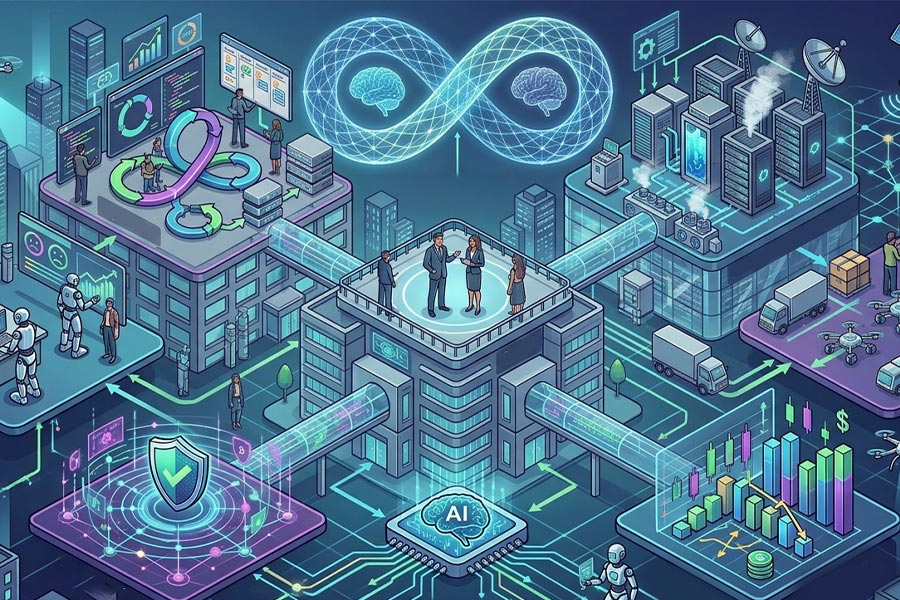
For over 20 years, organizations have been investing money into digital transformation initiatives to modernize operations, improve customer experience and increase productivity. The first steps in transformation were digitizing manual processes, moving workloads to the cloud, automating repetitive tasks, and integrating enterprise systems. These initiatives did deliver concrete benefits in terms of operational efficiency, but they were generally reactive. Inefficiencies arose, and companies still relied heavily on human intervention to detect problems, analyze performance and implement improvements.
Today, enterprises are entering a new phase of evolution in which the goal is intelligent business optimization rather than digital transformation. Organizations are not just digitizing the way they do business, but are building technology ecosystems that can track the business’s performance continuously, identify inefficiencies, predict future problems and automatically implement improvements. The modern enterprise is gradually becoming an organization that learns from its own work and improves every day.
The complexity of enterprise operations is increasing and this is driving the transformation. Today’s organizations are managing hybrid workforces across multiple geographies, cloud-native applications across multiple providers, highly interconnected c increasingly sophisticated cybersecurity threats, evolving customer expectations and rapidly changing regulatory environments. All business functions produce huge amounts of operational data that can’t be efficiently processed by traditional management techniques alone.
Artificial intelligence, machine learning, predictive analytics and intelligent automation are enabling continuous organizational improvement. AI-driven systems can detect anomalies, predict future performance, suggest corrective actions, and optimize business processes, rather than reacting to operational problems once they have occurred. Enterprises are leveraging intelligent technologies to move from reactive management to predictive optimization where continuous improvement is integrated into everyday operations instead of periodic transformation projects.
This evolution is greatly expanding the role of today’s technology leaders. CIO leadership has moved beyond managing IT infrastructure and delivering digital initiatives. Today’s CIOs are becoming architects of intelligent enterprises, charged with integrating technology, data, business strategy and operational intelligence into self-improving ecosystems. CIOs are aligning AI, cloud computing, automation, and enterprise data platforms with organizational goals, creating businesses that get smarter and more efficient with each operational cycle.
Self-optimizing organizations are the next generation of digital businesses. These organizations are constantly monitoring their operational performance, looking at their business results, automating improvements, and changing to suit evolving conditions, without being told. Today, continuous optimization is a sustainable competitive advantage because it allows organizations to improve productivity, build resilience, reduce costs, accelerate innovation and respond rapidly to market changes. “Organizations that continually improve themselves will outperform those that rely solely on transformation initiatives from time to time in a competitive digital economy.
What is a Self-Optimizing Organization?
A self-optimizing organization is a business that constantly observes its operations, measures its performance, identifies ways to improve, and implements changes with as little manual involvement as possible by using intelligent technologies. These organizations rely on artificial intelligence for ongoing improvement across business functions instead of relying on periodic reviews or leadership decisions.
The key theme is the concept of lifelong learning. Every transaction, customer interaction, operational workflow, employee activity, financial process and technology event creates valuable information. The AI then continuously analyzes this data for trends, predicts future outcomes, and suggests or makes improvements before operational inefficiencies impact business performance.
Unlike conventional organizations that implement periodic improvement programs to optimize their operations, self-optimizing enterprises integrate optimization into routine business processes. Operational intelligence is embedded in finance, supply chain management, customer service, human resources, manufacturing, sales, cybersecurity, and IT operations.
AI-powered operational intelligence gives decision-makers real-time visibility into enterprise performance and, where appropriate, autonomous optimisation. Intelligent systems dynamically modify resource allocation, workflow priorities, operational scheduling, infrastructure performance, and business processes to changing conditions.
This develops organisations that can get more and more efficient, adaptable, and resilient over time.
-
From Digital Transformation to Intelligent Enterprises
The idea of self-optimizing organizations is the next step in the digital transformation of enterprises.
The traditional approach to digital transformation was primarily about replacing manual processes with digital technologies. “Organizations are investing in enterprise resource planning systems, cloud migration, workflow automation, customer relationship management platforms, and digital collaboration tools. These initiatives greatly enhanced operational efficiency and allowed for connected business ecosystems.
The following phase was to automate the business operations. We used Robotic Process Automation (RPA), intelligent workflows, low-code platforms and business process automation to eliminate repetitive administrative tasks, while increasing consistency and reducing operational costs. Automation increased efficiency, but most systems still depended on pre-defined rules and human oversight to handle exceptions or changing business conditions.
Today, artificial intelligence is allowing continuous optimization rather than static automation. Machine learning models constantly monitor operational performance, detect emerging bottlenecks, forecast future business results and dynamically suggest or implement improvements. AI systems are no longer just following instructions, but are more and more involved in operational decision-making by modifying workflows to fit changing business environments.
This transformation moves enterprises from digitally enabled organizations to intelligent enterprises that are able to self-improve constantly.
-
Self-Optimization: The Growing Importance
Several powerful business trends are accelerating the emergence of self-optimizing organizations.
Enterprise complexity is increasing in every industry. Companies have many cloud environments, digital ecosystems, remote workforces, global supply chains, connected devices, AI-powered applications, and more demanding customer experiences. Managing this manually becomes increasingly complicated.
Market conditions also change much faster than the traditional planning cycles do. Consumer expectations, competitive landscape, economic conditions, regulatory requirements, cybersecurity risks, and technological innovations are always changing. Organizations need operational models that can adapt in real time, not react months later.
Now, operational agility is a key competitive advantage. Organizations that can quickly reallocate resources, simplify processes, enhance customer experiences, and seize market opportunities are consistently more successful than those that are encumbered by slower decision-making processes.
Self-optimization is becoming more and more important due to continuous innovation. The demand for operational systems that are stable and performant, and capable of supporting continuous experimentation grows as companies bring out new products, services, technologies and business models.
Self-optimizing organizations meet these challenges by building continuous improvement into day-to-day business, rather than treating optimization as transformation projects that happen from time to time.
-
The Evolving Role of CIO Leadership
The rise of self-optimizing organizations is radically redefining the scope of enterprise technology leaders.
Historically, CIOs were mainly concerned with technology infrastructure, cybersecurity, enterprise applications, and IT service delivery. System reliability, operational uptime, technology implementation, and cost management were often how they measured their success.
Today, CIO leadership is much more than just managing technology. Today’s CIOs are increasingly orchestrating enterprise-wide intelligence, connecting business strategy, operational data, artificial intelligence, automation, cybersecurity, cloud infrastructure and digital innovation into cohesive business ecosystems.
This wider scope requires CIOs to align technology investments directly with ongoing organizational change. CIOs are moving away from one-off digital projects to creating smart platforms that can learn from the operations of the enterprise, which enables predictive decision-making and self-optimization.
CIO leadership is important in breaking down organizational silos. Self-optimizing enterprises require seamless collaboration between finance, operations, supply chain, human resources, customer service, manufacturing and information technology. CIOs create the technological foundation that enables these business functions to share data, coordinate decisions and continuously improve all the time.
Equally important, CIO leadership offers responsible governance of intelligent technologies. As AI assumes more operational responsibilities, CIOs establish policies on AI transparency, cybersecurity, regulatory compliance, ethical decision-making, and human oversight. This trade-off allows organizations to achieve the maximum automation without giving up accountability and trust.
Looking ahead, the impact of CIO leadership will only grow stronger as enterprises become increasingly intelligent. CIOs won’t just manage the digital infrastructure; they’ll define how organizations learn, adapt, innovate and compete. CIO leadership uses cutting-edge technology and strategic business vision to transform enterprises into living systems that can continually improve, innovate over the long term, and remain resilient. Those organizations that embrace this new model will be better positioned to succeed in a world where continuous improvement is no longer an option but a defining characteristic of competitive success.
Core Components of Self-Optimizing Organizations
Self-optimizing organizations do not depend on a single technology or automation tool. They are built on an integrated eco-system of smart platforms, live analytics, AI-enabled decision-making, flexible workflows, and governance frameworks that continuously improve as the enterprise performs.
Combined, these elements enable organizations to monitor operations, pinpoint inefficiencies, suggest enhancements, and in many instances, execute optimizations autonomously. These foundational capabilities are becoming critical for organizations seeking long-term agility, resilience, and operational excellence as CIO leadership continues to push enterprise transformation.
1. Enterprise Intelligence Platforms
Enterprise intelligence platforms are the nervous system of a self-optimizing organization. They combine data from finance, operations, supply chain, customer service, manufacturing, HR, cybersecurity, and IT into one environment that offers enterprise-wide visibility.
Unified enterprise data breaks down the departmental silos that have traditionally prevented organizations from making coordinated decisions. Rather than storing information in siloed systems, organizations store operational data on a shared intelligence platform, where information is instantly available across the enterprise.
Real-time operational visibility gives executives and business leaders insight into the present state of enterprise performance, rather than delayed reporting. By continually monitoring vital operational metrics, organizations can spot potential problems before they affect productivity or the customer experience.
Cross-functional intelligence links business units together by showing how a decision made in one department has an impact on another. Share insights across finance, operations, procurement, HR, and customer service to improve the overall coordination of the enterprise.
Key capabilities are:
- Data integration at the enterprise level.
- Ongoing operational visibility.
- Sharing of intelligence between agencies.
- Quicker decisions in companies.
Enterprise intelligence platforms are the foundation of all self-optimizing capabilities.
2. AI-Driven Decision Engines
Today enterprises are increasingly relying on AI-driven decision engines to support operational, tactical and strategic decision making.
Instead of dumping huge amounts of raw data on executives, smart decision engines analyze enterprise data, assess possible actions, and recommend the best responses based on predetermined business goals and operational conditions.
Autonomous recommendations allow AI to find opportunities to reduce costs, optimize resources, allocate workforce, manage inventory, improve cybersecurity, engage with customers, and plan finances. Recommendations continue to change as business conditions change.
AI recommendations and advice remain aligned with organizational governance, regulatory requirements, compliance frameworks, and executive priorities through policy-based decision-making. Organizations set decision boundaries and let AI optimize inside the boundaries.
Continuous business optimization enables AI systems to assess enterprise performance on a daily basis rather than during periodic strategic reviews. This leads to organizations that develop slowly and predictably over time.
These decision engines allow enterprises to be managed faster and more consistently, with less reliance on manual operational analysis.
3. Intelligent Workflow Automation
Workflow automation has come a long way from automating simple, repetitive tasks. Intelligent workflow automation allows organizations to dynamically adjust business processes as operating conditions change.
Dynamic workflow orchestration enables AI to re-sequence activities, assign work smartly, set priorities and coordinate resources based on changing workload and business priorities.
Automated exception management identifies operational disruptions, analyzes root causes, and either resolves problems automatically or escalates them to the appropriate personnel. Intelligent workflows keep things running all the time, not waiting for someone to come and fix them.
Interdepartmental coordination moves workflows across organizational boundaries. Procurement, finance, logistics, customer service, HR, and manufacturing are embedded with connected processes that automatically exchange information and coordinate activities.
Benefits are:
- Speed up workflow execution.
- Less manual intervention.
- Intelligent prioritization of tasks.
- Better operational consistency.
Intelligent automation takes siloed business processes and turns them into adaptive enterprise workflows.
4. Predictive operational analytics
Self-optimizing organizations use predictive analytics to a great extent to foresee future business conditions before operational problems evolve.
Performance forecasting is the prediction of future organizational performance based on past data, current operational metrics, market conditions, customer behavior, and external variables. Leaders get early visibility into potential opportunities and risks.
By identifying bottlenecks, AI can continuously monitor the workflows of an enterprise and detect operational constraints that reduce productivity or increase costs. Organizations are proactive in addressing bottlenecks before performance begins to degrade.
This means aligning your anticipated demand with your employees, equipment, financial resources, inventory, and technology infrastructure, rather than making decisions based on historical assumptions. AI constantly re-evaluates allocation strategies as operational priorities change.
Predictive analytics changes the game of enterprise management from reactive problem solving to proactive operational planning.
5. Continuous Feedback Loops
Operational results are the basis for continuous improvement.
Performance monitoring enables organizations to measure every operational activity with real-time metrics, instead of periodic reporting cycles. Every workflow, customer interaction, financial transaction, production process, and technology event is a learning opportunity.
Operational learning enables AI systems to review what business decisions led to successful results and which ones need improvement. And those insights are continually fine-tuning future suggestions.
Adaptive process improvement allows organizations to automatically adjust workflows, operating procedures, customer experiences, resource allocation and technology configurations as business conditions change.
The continuous feedback loops create organizations that become increasingly efficient by everyday operational experience.
6. Autonomous Business Governance
As organizations adopt more automation and AI-driven decision-making, governance remains essential.
Intelligent policy enforcement means that business rules, regulatory requirements, cybersecurity policies, operational standards, and governance frameworks are automatically enforced across enterprise operations.
Monitoring compliance is the continuous assessment of organizational activities against regulatory and internal policy, identifying potential violations before significant risk is experienced.
Risk-aware optimization strikes a balance between efficiency gains and governance requirements. The AI recommendations take into account operational performance as well as cybersecurity, financial controls, legal obligations, ethical standards, and business continuity.
Some of the good governance priorities are:
- Automated enforcement of policy.
- Ongoing regulatory compliance.
- Smart risk management.
- AI governance that is responsible
Autonomous governance allows organizations to innovate with confidence and to be accountable and trustworthy.
Technologies Powering Self-Optimization
The advent of self-optimizing organizations is enabled by a set of advanced technologies that continuously observe the enterprise’s operations, produce insights, automate decisions and coordinate intelligent business activities. These technologies are not stand-alone but are embedded in a larger ecosystem that allows organizations to learn, adapt, and improve over time.
1. Artificial Intelligence and Machine Learning
Artificial intelligence is the key enabler for enterprise self-optimization.
As AI gets better at predictive analytics, it can predict the outcomes of operations, customer behavior, financial performance, supply chain failures, workforce needs, infrastructure utilization, and much more.
Operational intelligence is the practice of transforming enterprise data into actionable business intelligence that assists executives, managers and autonomous systems to make better operational decisions.
Adaptive optimization enables AI systems to get better through time as they learn from their operational results. Models self-evolve with new business conditions and enhance recommendation quality over time.
AI allows organizations to move from static automation to continuously learning enterprise operations.
2. Agentic Artificial Intelligence
Agentic AI is the next evolution of enterprise intelligence, with autonomous software agents that can independently pursue business objectives.
Discrete tasks such as procurement, scheduling, financial reconciliation, customer service, cybersecurity monitoring, and IT operations can be carried out by self-governing business agents without the need for constant human supervision.
Multi-agent collaboration allows specialized AI agents to communicate, coordinate decisions, share information, and collectively solve complex business problems across multiple departments.
The goal-oriented execution allows agents to follow strategic goals rather than execute predefined tasks. They review changing business conditions and adapt their operations to meet those conditions.
Agentic AI turns enterprise operations into intelligent collaborative ecosystems.
3. Process mining
Process mining gives organizations fact-based insight into how their business processes really work.
Workflow discovery aims at reconstructing operational processes by automatically analyzing digital event logs. Organizations get a real view of how workflows are being performed versus documented processes.
Bottleneck analysis pinpoints delays, inefficiencies, superfluous approvals, duplicated activities and operational constraints that hinder organizational performance.
Combined with process mining insights, AI can help with continuous process improvement by recommending ways to redesign workflows to improve productivity, reduce costs and improve customer experiences.
Process mining brings evidence for operational optimization.
4. Digital twins
Digital twins are virtual representations of enterprise operations that enable intelligent experimentation and optimization.
Enterprise simulations enable organizations to test strategic decisions before they are made. Leaders have the ability to demonstrate business expansions, workforce changes, infrastructure investments, or supply chain changes in virtual environments.
Operational scenario testing gives organizations a chance to explore different strategic options and to see the possible operational consequences and related risks.
This means organizations can digitally validate improvements before changes are introduced into live business operations and this makes performance optimization increasingly precise.
Digital twins reduce the uncertainty of enterprise transformation dramatically.
5. Cloud and Edge Computing
Self-optimizing organizations of today require scalable computing environments that can continuously process enterprise data.
Cloud computing offers a flexible infrastructure that helps enterprises with applications, AI workloads, analytics platforms, collaboration, and business services for organizations of any size.
Operational intelligence can analyze events as they are occurring, as opposed to waiting for scheduled batch processing.
Distributed intelligence via edge computing enables processing of information closer to operational environments such as manufacturing plants, retail stores, logistics networks, healthcare systems, and connected devices. – Response times are faster and latency is lower.
Cloud and edge computing together provide the infrastructure for intelligent enterprise operations.
6. Enterprise Data Platforms
Enterprise data platforms are helping to break down silos across all business functions while enabling smart enterprise decision-making.
Integrated operational data eliminates data silos by combining ERP systems, CRM platforms, HR solutions, financial systems, manufacturing platforms, cybersecurity tools, and customer touch points into a single, interconnected data environment.
Connected business systems facilitate information sharing among departments and help coordinate decision-making throughout the enterprise.
AI can analyze integrated operational data to provide intelligent enterprise insights that identify trends, predict outcomes, recommend improvements, and assist in strategic planning.
Some of the core capabilities of the platform include:
- Integration of enterprise-wide data.
- Connected operational ecosystems
- AI-powered business insight.
- Continuous organisational intelligence.
As organizations adopt artificial intelligence, automation, predictive analytics, digital twins, cloud infrastructure, and enterprise data platforms, CIO leadership will increasingly be about orchestrating these technologies into integrated intelligent ecosystems. Organizations that can successfully embed these core elements will move from digital transformation to self-optimizing enterprises that continuously improve operations, adapt to change, strengthen resilience, and sustain a long-term competitive advantage.
Business Applications
Self-optimizing organizations are no longer abstract ideas for highly digital businesses. Organizations are leveraging artificial intelligence, automation, predictive analytics, and intelligent enterprise platforms to constantly improve their business operations across industries.
These technologies do not just optimize individual processes but allow organizations to orchestrate multiple business functions in parallel, thus helping them to adapt quickly to changing operational conditions. With strong CIO leadership, self-optimization becomes an enterprise-wide capability that enhances productivity, resilience, customer satisfaction, and long-term competitiveness.
Also Read: CIO Influence Interview With Jake Mosey, Chief Product Officer at Recast
1. Intelligent IT Operations
Information technology is the operational backbone of any modern business, and it is one of the first areas to benefit from self-optimization.
AI can continuously monitor servers, cloud environments, applications, storage systems, and network resources by optimizing infrastructure. Intelligent platforms allocate computing resources automatically according to workload demand, thus reducing waste and maintaining high performance. IT teams use AI to optimize capacity in real time instead of manually configuring infrastructure.
Automation in incident management is changing the way IT support works. AI continuously monitors system logs, application performance, and security events to identify anomalies before they affect business operations. Smart systems can classify incidents, identify root causes, trigger corrective actions, or automatically escalate complex issues to specialists.
Predictive maintenance also enhances operational stability by identifying early indicators of hardware failures, software degradation, or infrastructure bottlenecks. Organizations don’t wait for systems to fail, but proactively schedule maintenance to decrease downtime and reduce operational risk.
Important applications include:
- Infrastructure optimization automation.
- Smart incident detection and response.
- Predictive maintenance forecasting.
- Ongoing service performance monitoring.
These capabilities enable IT departments to evolve from reactive support organizations to proactive strategic partners.
2. Finance & Business Operations
Finance has shifted from reporting on past results to ongoing optimization of organizational performance.
Through budget optimization, AI can be applied to simultaneously consider business priorities, operational costs, departmental performance, and strategic initiatives. Smart financial platforms don’t just do annual budgeting exercises but rather promote continuous adjustments based on what is of most value to the organization.
Financial forecasting accuracy is significantly improved by incorporating historical trends, customer demand, economic indicators, operational performance, and external market conditions into predictive analytics. Finance leaders get forecasts that are always up-to-date, which allows for faster executive decision-making.
Another major application is continuous compliance. AI constantly monitors financial transactions, procurement processes, regulatory compliance, and internal controls in real time, identifying potential compliance issues before they become significant operational or legal risks.
Organizations benefit from:
- Intelligent financial planning.
- Continuous forecasting.
- Automated regulatory monitoring.
- Real-time operational visibility.
Self-optimizing finance functions deliver not only operational efficiency but also strategic decision-making.
3. Human Resources
As organizations realize that employees are one of their most valuable strategic assets, human resources is becoming more data-driven.
Workforce planning has become more intelligent with the use of predictive analytics to evaluate hiring needs, workforce availability, retirement projections, employee turnover, and future skill needs. Organizations can anticipate talent gaps before they impact business performance.
Skills optimization allows AI to evaluate employee skills, learning progress, certifications, project experience, and career development opportunities. Smart systems recommend personalized training plans and assist in aligning workforce skills to changing business priorities.
Intelligent employee experiences drive engagement with personalized onboarding, career planning, performance management, internal mobility, and workplace support. AI-Driven HR Platforms are Constantly Evolving Employee Experiences Based on Preferences and Business Goals
Key HR applications are:
- Predictive workforce planning.
- AI-driven skills management.
- Personalized employee development.
- Intelligent workforce analytics.
These capabilities create organizations that are continually evolving and optimizing their human capital.
4. Supply chain management
Supply chain operations are incredibly complex across suppliers, logistics providers, manufacturers, warehouses, distributors, and customers. And this is where self-optimization plays a very big part in enhancing operational performance in these interrelated ecosystems.
Inventory optimization balances the costs of carrying inventory against product availability, using predictive demand models. AI constantly analyzes buying patterns, seasonal trends, supplier performance, and customer demand to advise the best inventory levels.
Predictive logistics is the use of prediction for transportation efficiency. Predictive logistics improves transportation efficiency by predicting delivery schedules, identifying potential disruptions, optimizing shipping routes, and allocating logistics resources on the fly.
Demand forecasting uses historical sales, market intelligence, consumer behavior, weather conditions, promotional activities, and macroeconomic indicators to develop more accurate demand predictions. Organizations plan better by reducing shortages and excess inventory.
Key supply chain enhancements include:
- Intelligent inventory management.
- Dynamic logistics optimization.
- Predictive demand planning.
- End-to-end supply chain visibility.
These capabilities improve customer satisfaction and increase operational resilience.
5. Customer Experience Management
Companies are competing more and more on experience, not just products, and customer expectations keep rising.
AI can analyze customers’ preferences, purchase behavior, digital interactions, and contextual information to deliver personalized recommendations and communications for continuous engagement.
Service optimization enhances customer support with smart case routing, automated issue resolution, predictive customer support, and AI-driven service agents that can handle routine queries without human intervention.
Intelligent support operations combine customer relationship management systems, communication platforms, operational data, and AI analytics to give service teams full customer context. And support reps make faster, more informed decisions, while raising overall customer satisfaction.
Organizations are looking to ever more:
- Personalized customer interactions.
- AI-assisted service operations.
- Intelligent customer support.
- Predictive customer engagement.
Customer experience is a continuously improved enterprise capability.
6. Enterprise Strategy Execution
Historically, strategic planning relied on periodic executive reviews and historical reporting. Self-optimizing organizations make strategy an ongoing, managed operational process.
KPIs give executives real-time visibility into the organization’s performance, including financial, operational, customer, workforce, innovation and sustainability metrics. Leaders identify emerging opportunities or risks in real time, not in the scheduled reporting cycle.
Strategic alignment is the alignment of operational activities with enterprise objectives. As initiatives are proposed in various departments, AI is continually benchmarking those initiatives against the strategic priorities and tracking which areas need to be shifted in terms of resource or leadership focus.
Performance optimization allows organizations to continuously monitor strategic execution. Executives receive continuous recommendations that support better investment decisions, resource allocation, operational improvements, and organizational performance instead of quarterly progress updates.
Enterprise strategy is more and more dependent upon:
- Real-time KPI monitoring.
- Continuous strategic alignment.
- Intelligent performance optimization.
- Data-driven executive decision-making.
Such capabilities enable organizations to execute strategy more precisely and agilely.
Business Benefits
The capability to self-optimize enterprise capabilities delivers significant business value in operational performance, financial results, customer experiences, innovation, and organizational resilience. With effective CIO leadership, intelligent optimization is a long-term competitive advantage, not just another technology initiative.
1. Enhanced Operational Efficiency
One of the most immediate benefits of self-optimizing organizations can be a significant increase in operational efficiency.
Automated optimization is making workflows better in real time, without waiting for manual intervention. AI identifies inefficiencies, reallocates resources, re-prioritizes, and optimizes processes based on changing business conditions.
Less manual intervention allows employees to focus on strategic work, rather than routine operational work. The routine decisions are taken care of by automation, while employees provide creativity, innovation, and complex problem-solving.
Faster workflows mean less latency in finance, procurement, customer service, manufacturing, logistics, HR, and IT operations.
Typically, organizations have:
- More productivity.
- Reduced process completion time.
- Reduced operation delays.
- Increased efficiency for the enterprise.
2. Increased Business Agility
The business environment is in a constant state of flux, and organizations have to respond more quickly than ever.
Once customer demand, competitive pressures, regulatory environments, or economic conditions change, enterprises can instantly change operations and respond immediately.
AI can move staff, budgets, inventory, computing power, and operational capacity around to meet changing priorities, thanks to dynamic resource allocation.
Organizations change every day through continuous change and not through large transformation initiatives every few years.
Self-optimizing organizations are much more responsive to change.
3. More Effective Decision-Making
Continuous operational intelligence leads to significantly better decision quality.
Real-time business intelligence provides real-time enterprise visibility across all business functions.
The AI-driven approach allows executives to explore a range of options and observe potential outcomes prior to decision-making.
Predictive insights help you identify future opportunities and emerging risks, resource constraints, changing customer behavior, and operational improvements before they show up in traditional reporting.
Organizations benefit:
- Faster executive decisions.
- Better strategic planning.
- Improved operational visibility.
- Higher confidence in decision-making.
4. Reduce Operational Costs
Financial performance is greatly improved through the reduction of the operational expenses that are not necessary.
Resource optimisation is the efficient distribution of employees, infrastructure, inventory, technology, and financial investment to match real-time business needs.
Waste reduction eliminates duplicate activities, excess inventory, inefficiencies, unnecessary approvals, and duplicated work.
Infrastructure efficiency allows organizations to get the most out of their cloud resources, enterprise systems, manufacturing equipment, and operational facilities, while using less energy and reducing maintenance costs.
These improvements result in sustainable financial savings and do not negatively impact performance.
5. Greater Capacity for Innovation
Innovation is increasingly reliant on intelligent enterprise operations capable of enabling fast experimentation.Organizations can experiment constantly to test new ideas against operational data before making big investments.”
AI speeds up market analysis, resource planning, customer insights, workflow coordination, and operational decision-making, enabling faster product development.
Data-driven innovation means that organizations can focus on initiatives that are supported by measurable evidence, rather than just assumptions.
Innovation is not a one-off strategic initiative but a permanent organizational capability.
6. Sustainable Competitive Advantage
Maybe the greatest long-term advantage of self-optimizing organizations is the creation of a sustainable competitive advantage.
Intelligent operations keep getting better, driving up organizational performance and outpacing competitors that rely on slower manual optimization.
With faster enterprise evolution, organizations can more readily adopt emerging technologies, respond to market disruptions, and seize new opportunities.
Intelligent enterprises learn from operational experience, strengthen decision-making, optimize resources, and adapt to changing business environments to build long-term organizational resilience.
The main competitive advantages are:
- Intelligent enterprise operations.
- Continuous organizational improvement.
- Greater adaptability.
- Long-term business resilience.
As enterprises increasingly adopt artificial intelligence, predictive analytics, automation, and connected digital ecosystems, CIO leadership will be a more strategic function for transforming organizations into continuously improving enterprises.
Self-optimizing organizations will incorporate intelligence into each operational process, leading to increased efficiency, enhanced innovation, improved customer experiences, and sustainable competitive advantage. Rather than reinventing themselves now and then, these organizations will learn, adapt, and evolve continuously, making continuous optimization a hallmark of future enterprise success.
Challenges and Risks
The move towards self-optimizing organizations offers major improvements in operational efficiency, business agility, and enterprise resilience. However, to achieve these outcomes organizations must overcome a host of technology, organization and governance challenges. Artificial intelligence, automation, predictive analytics and connected digital ecosystems enable self-optimizing enterprises, but they also bring new risks that go beyond traditional IT management.
CIO leadership must ensure innovation is matched with governance, security, transparency, workforce readiness and responsible decision making as organizations become more dependent on autonomous technologies. By actively addressing these challenges, organizations will be in a better position to build intelligent enterprises that are secure, ethical and sustainable over the long term.
1. AI Governance
A growing number of self-optimizing organizations are turning to artificial intelligence to drive decision-making. AI allows for faster analysis and self-execution, but organizations must put governance structures in place to ensure these systems are functioning in a responsible manner.
Building systems that make fair, unbiased and transparent decisions is where ethical AI starts. Enterprise AI is increasingly being used in workforce planning, financial recommendations, customer interactions, cybersecurity responses and operational optimization. If AI is poorly governed, it can inadvertently reinforce bias, pose compliance issues or make decisions that do not align with organizational values.
As AI becomes more autonomous, human oversight remains important. Self-optimizing organizations shouldn’t remove humans from the process, but reimagine their role. Executives and operational leaders need to keep tabs on AI systems, check out recommendations, sign off on decisions that could have a big impact and step in when something strange happens.
Accountability is another important governance principle. Organisations must be clear about responsibility for decisions, operational outcomes and actions generated by AI. AI should be a tool to support enterprise leadership and not an excuse to abdicate organizational accountability.
Good AI governance requires:
- Developing and using ethical AI.
- Human review of critical decisions.
- Clear accountability frameworks.
- Ongoing AI performance monitoring
- Business strategy aligned governance.
Smart technologies can improve business performance, but strong governance is needed to ensure that they don’t erode trust or compromise organizational integrity.
2. Data privacy and security
Self-optimizing organizations need constant access to data across the enterprise. As finance, HR, customer service, manufacturing, supply chain, and operational systems are constantly exchanging information, cybersecurity and privacy are foundational requirements.
Enterprise data protection starts with protecting sensitive business data throughout its lifecycle. Organizations have customer information, financial transactions, employee records, intellectual property, operational metrics, and strategic planning data that all need strong security controls.
As AI systems interconnect cloud platforms, IoT devices, APIs, enterprise applications, and autonomous workflows, cybersecurity becomes increasingly complex. Attack surfaces are multiplied exponentially, and intelligence security monitoring is needed to detect threats in real time.
Compliance with regulations adds more complexity. Global organizations must comply with privacy regulations, cybersecurity frameworks, industry standards and regional data protection laws, while maintaining operational agility.
The key security priorities are:
- Zero trust security architectures.
- End-to-end data encryption..
- Ongoing threat detection.
- Secure API Management
- Automated compliance tracking.
With strong cybersecurity, organizations can innovate confidently, protect the enterprise’s assets and earn the trust of its stakeholders.
3. Legacy System Integration
Many enterprises are still running mission-critical systems designed long before AI, cloud computing and intelligent automation were standard business technologies. One of the biggest challenges to building self-optimizing organizations is integrating these environments.
Upgrading legacy applications, aging databases, siloed workflows, and legacy hardware are common examples of infrastructure modernization. These systems may not be connected in real time, limiting the effectiveness of AI powered optimization.
Technology interoperability is also important. Self-optimizing organizations require seamless communication between ERP systems, CRM platforms, HR applications, financial software, manufacturing systems, cloud services and operational databases. API development, middleware solutions, and enterprise integration strategies are often required to achieve interoperability.
Migration complexity adds to the operational risks. Enterprise infrastructure modernization without business disruption means careful planning, staged rollouts, data validation and extensive testing. Poorly managed migrations can disrupt operations, increase costs and erode employee confidence.
Organizations should strive for:
- Incremental modernization strategies.
- Standardized enterprise architectures.
- API-first integration approaches.
- Cloud-native interoperability.
- Continuous migration testing.
The technological backbone for ongoing optimization is provided by modern infrastructure.
4. AI Transparency
As AI assumes more enterprise decision making, transparency becomes increasingly critical for executives, employees, regulators, customers and business partners.
Explainable AI allows users to understand the way intelligent systems are producing recommendations or operational decisions. Enterprise AI must not be an opaque “black box” but should be able to provide understandable reasoning to build confidence in automated processes.
Trust in autonomous decisions depends on reliable system performance and clear decision logic. Employees are more likely to adopt intelligent technologies when they understand how recommendations are created and how AI fits within organizational policies.
AI model validation helps ensure the systems are accurate, reliable and unbiased. Organizations should regularly evaluate models through operational performance metrics, fairness assessments, scenario testing, and regular performance reviews.
Good AI transparency includes:
- Explainable decision models.
- Continuous model validation.
- Performance auditing.
- Bias detection and mitigation.
- Transparent operational reporting.
Transparency builds organizational trust and enables responsible AI adoption in the enterprise.
5. Organizational Change Management
Technology alone will not make organizations self-optimizing. Success depends equally on organizational readiness, leadership commitment and employee engagement.
One of the biggest challenges of transformation is employee adoption. New AI systems tend to change everyday workflows, decision-making, and job responsibilities. If employees aren’t properly communicated with and trained, they may resist intelligent technologies or fail to deliver their full value.
It is equally important to align leadership. Executive teams need a shared vision on how AI helps business objectives, operational improvement, customer experience, innovation and organisational resilience. Leadership priorities are often misaligned, slowing enterprise transformation.
To transform digital culture organizations need to embrace continuous learning, experimentation, collaboration and data driven decision making. Employees should see AI as a strategic partner to augment human expertise, not a replacement for human contributions.
Initiatives for successful change management usually include:
- Executive sponsorship.
- Comprehensive employee training.
- Transparent communication strategies.
- Continuous learning programs.
- Cross-functional collaboration.
Organizations achieve more sustainable transformation results by investing in people as well as technology.
6. Balancing Automation with Human Judgment
Despite the rapid advances in artificial intelligence, many enterprise decisions continue to depend on human expertise, ethical reasoning, creativity, and contextual understanding.
Governance with a human in the loop strikes a good balance between automation and executive oversight. AI does the repetitive analysis, operational monitoring and optimization, while humans take care of strategic, ethical and high-impact decisions.
Strategic oversight implies that the organization leadership is still responsible for enterprise direction. AI can make recommendations for investment strategies, operational improvements, workforce planning or customer engagement initiatives, but it’s the executives who are responsible for making sure those recommendations are aligned with the broader business goals.
Responsible automation is about organizations deciding which decisions are okay to fully automate, which need human approval and which should always stay directly with humans. Big decisions such as investing money, reorganizing the staff, legal issues, customer conflicts and buying other companies often rely heavily on human judgment.
A balanced automation strategy should be focused on:
Human oversight for critical decisions.
- AI augmentation rather than replacement.
- Ethical operational governance.
- Strategic executive control.
- Continuous evaluation of automation boundaries.
Responsible automation enables organizations to maximize their efficiency without compromising human leadership, accountability, and organizational values.
The self-optimizing organization is one of the big breakthroughs in managing enterprises, but the innovation is not only technological. Successful CIO leadership needs to balance governance, cybersecurity, transparency, integration, workforce transformation and responsible automation all at once. Those organizations that harness intelligent technologies with strong governance frameworks will build enterprises that can improve continuously and remain resilient, compliant and worthy of stakeholder trust. As AI becomes more deeply embedded in business processes, it will be overcoming these challenges that will determine which organizations will successfully evolve into intelligent enterprises able to sustain long-term competitive advantage.
Final Thoughts
The introduction of self-optimizing organizations marks a major step in the development of enterprise management, changing technology from a mere facilitator of business operations to an engine of continuous improvement. The traditional digital transformation initiatives were aimed at digitizing processes, modernizing infrastructure and automating repetitive tasks. Although these efforts improved operational efficiency, they were largely anchored on periodic reviews and manual intervention to identify areas for improvement.
Today, CIO leadership enables organizations to move beyond one-off transformation projects and become intelligent enterprises that continuously monitor performance, learn from operational data, and optimize business processes in real time. Organizations are building operating models that become smarter, faster and more resilient with each business cycle by combining artificial intelligence, predictive analytics, automation and enterprise intelligence platforms.
Artificial intelligence is speeding up this change by allowing organizations to optimize operations on an ongoing basis rather than on a periodic basis. Intelligent systems analyze enterprise data, predict operational challenges, automate workflow improvements, and recommend strategic actions before problems affect business performance. Predictive operational intelligence empowers organizations to anticipate market changes, customer needs, supply chain disruptions and infrastructure issues and act proactively rather than reactively.
Autonomous workflow optimization minimizes manual effort, increases resource utilization, and enables employees to focus on higher-value strategic initiatives. As AI capabilities evolve, continuous business performance improvement will become an integral part of day-to-day enterprise operations rather than an occasional management objective.
Self-optimizing enterprises will also be much more resilient, agile and competitive. Organizations that can continuously adapt to changes in market conditions, regulatory requirements, technological advances and customer expectations will be better positioned to manage uncertainty and to take advantage of new opportunities. Intelligent resource allocation, real-time operational visibility and AI-driven decision support will enhance the organization’s resilience and improve productivity, customer satisfaction and innovation capacity. The future enterprise will no longer think of optimization as a project with an end but rather embed continuous learning and adaptation into all operational processes. This will create sustainable competitive advantages difficult for competitors to replicate.
The future of business success belongs to organizations that constantly learn, optimize and evolve with intelligent technologies. Companies will increasingly become self-directed, efficient and strategically agile, using artificial intelligence, automation, predictive analytics, digital twins and enterprise intelligence platforms.
As these technologies mature, CIO leadership will be a defining factor in designing intelligent enterprises that blend advanced technology with human expertise, ethical governance, and business vision. Those organizations that embrace self-optimizing capabilities today will lay the foundation for operational excellence, continuous innovation and sustainable competitive advantage, and position themselves to thrive in the increasingly intelligent and rapidly evolving digital economy.
Catch more CIO Insights: CIOs as Ecosystem Architects: Designing Partnerships, APIs, And Digital Platforms
[To share your insights with us, please write to psen@itechseries.com ]
