

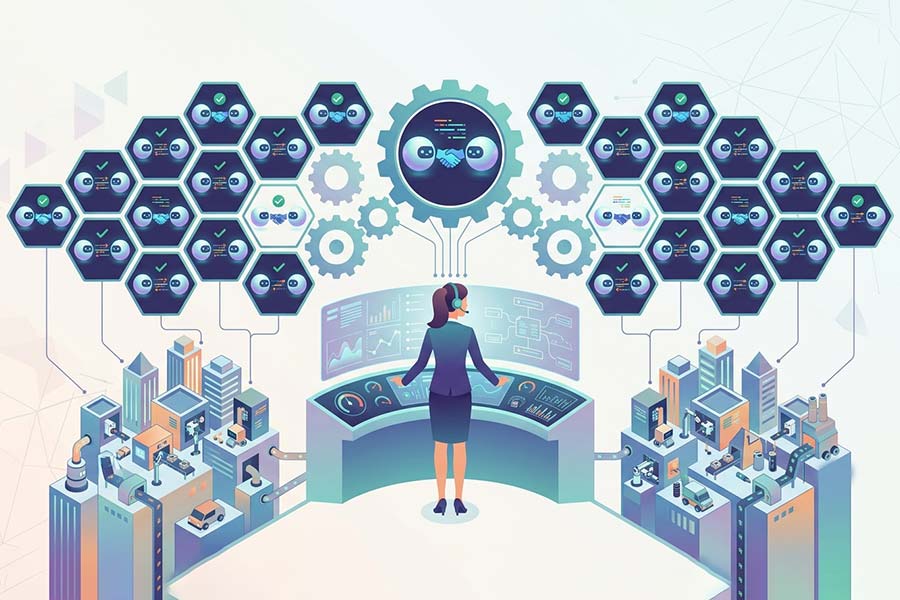
Enterprise technology is moving into a new era where digital workflows are based not just on people using applications. Software agents are increasingly interacting with other systems, coordinating tasks, gathering information, making recommendations, invoking tools, and executing processes with minimal human intervention. The move to machine-to-machine enterprise operations is changing the way organizations think about automation, digital infrastructure and technology governance. Rather than the employees starting each workflow, more and more capable software agents become active participants in planning and executing work.
Much of what we consider to be the traditional responsibilities of the CIO were built around a world where the primary users of technology were human. CIOs controlled automation, databases, networks, applications, infrastructure, and cybersecurity, and they established policies for how employees should use enterprise systems. Even the most advanced automation often worked within a set of rules and predictable workflows. Agentic systems offer a fundamentally different model. Software can know what goals are, figure out how to get to them, talk to many different systems and change what it does based on new information.
This gives rise to a new generation of enterprises where software agents are able to make decisions and initiate actions with minimal human intervention. An agent may recognize a disruption in the supply chain, contact another agent who is responsible for procurement, evaluate alternatives that are available, start a workflow, and update financial or operational systems. In a different environment, security agents could identify suspicious activity, investigate the associated telemetry, coordinate with identity systems, and initiate containment actions. As these interactions get more sophisticated, the enterprise is more and more an ecosystem of digital actors, not a collection of applications used by human employees.
The change also introduces a new level of complexity, accountability, and risk. Traditional oversight models can fall short when machines interact with machines at high speed. Organizations need to know which agent took an action, what information the agent used to make a decision, what permissions the agent had, and whether the action was in accordance with the policies of the organization. In interdependent systems, one wrong decision can cascade into many downstream actions which can result into risks that are hard to manage with traditional application governance.
This is where the CIO’s role starts to shift from technology management to governor of digital actors. Increasingly, CIOs will need to develop frameworks for how AI agents are assigned identities, granted access to enterprise resources, communicate with other agents and act within defined decision boundaries. Identity management, permissions, interoperability, observability, security, governance, and auditability will be key elements of the agentic enterprise.
This is not going to happen overnight. Organizations are progressing from traditional automation to intelligent workflows, AI copilots, autonomous agents and ultimately multi-agent ecosystems capable of coordinating complex business operations. Each stage brings new opportunities but also needs tougher controls.
This article explores that transformation, examining the progress toward machine-to-machine operations, the enabling technologies for agentic enterprises, business applications across functions, governance needs, and the risks of autonomous digital actors. It also discusses the future of multi-agent businesses, machine-negotiated ecosystems, autonomous workflows and AI governance infrastructure—and why CIOs will find themselves shouldering ever more responsibility for ensuring that machines can operate independently without running amok.
Also Read: CIO Influence Interview with John Elliott, Cybersecurity Author Fellow at Pluralsight
Understanding Enterprise Machine-to-Machine Operations
Machine-to-machine operations represent a move from technology that mainly supports human decision-making to systems in which software can communicate, coordinate and execute work with other software. Instead of an employee manually transferring information from one app to another, AI agents can now communicate data directly, understand instructions, invoke enterprise services and trigger follow-up actions. APIs, event streams, messaging protocols and machine-readable workflows become the connective tissue through which these interactions occur.
The important thing is not automation but autonomous execution. Traditional automation executes tasks according to rules . Intelligent agents can understand the objectives and decide how to achieve them within the given bounds . For example, a procurement agent may identify an inventory need, search among approved suppliers, weigh alternatives and start a buying process. The machine-generated decision can then trigger activities across procurement, finance, inventory and logistics systems without a human needing to coordinate each step manually.
This leads to some important changes:
- Manual handoffs can be replaced by machine to machine communication.
- Business events can trigger intelligent workflows automatically.
- Decisions can be implemented at the speed of the machine.
- Enterprise processes can run continuously without waiting for human intervention.
a) The emergence of digital actors
With increasing capabilities, AI agents are transitioning from passive software tools to digital actors that actively participate in business operations. An agent can have a defined objective, access to certain enterprise systems, permission to do certain things and ability to adapt to evolving conditions. This makes the agent more of an operational participant than a traditional feature of an application.
In this kind of environment, digital identity is especially important. Every agent must have an identity that can be traced and that determines what it can access, what it can do, and what policies apply. In addition to employees, applications, devices, workloads and other machine entities, organizations might also need to manage identities for AI agents.
Digital actors could be able to get to:
- Enterprise Databases and Knowledge Bases.
- APIs and business applications.
- Workflow & automation tools.
- Financial, operational and customer systems
- External services and partner ecosystems.
The main difference is between software that does a given task, and software that decides what tasks need to be done. A generic automation script might generate an invoice whenever a particular event occurs. For instance, an AI agent may identify an anomalous billing case, gather information about the case, identify the proper workflow and escalate it to someone else if the case is out of its scope.
b) Negotiation and Coordination of Machines
More and more, machine-to-machine enterprises will be using agents working in conjunction rather than on their own. Some agents may specialize in procurement , finance , logistics , security , customer service , or infrastructure management . They communicate with one another to achieve broader business objectives .
This opens the potential for machine negotiation. Agents may also compare available resources, negotiate schedules, select services, optimize workloads or evaluate pricing per organizational policies. As an example, a logistics agent could interact with inventory and procurement agents to decide whether a shortage can be solved by expedited purchasing, alternative suppliers or inventory redistribution.
But coordination complicates things. Different agents can have different objectives. A finance agent might prefer to cut costs, a supply-chain agent might prefer faster delivery. An operations agent might consider an action urgent, whereas a cybersecurity agent might block it.
This means effective machine coordination requires:
- Clear goals and priorities.
- Shared standards for communication and data.
- Conflict resolution mechanisms.
- Established authorities and escalation paths.
- Monitoring agent interactions in real time.
c) From Human Decisions to Machine Decisions
Enterprise workflows are making incremental progress through varying degrees of autonomy. Older processes are heavily reliant on human approval, while newer systems use AI to recommend actions before a person makes the final decision. Then there is conditional autonomous execution, where the agents can act independently if conditions are met.
For example, an agent could automatically approve a routine transaction under a specified financial threshold but route larger or unusual transactions to a person. This allows for a working trade-off between automation and control.
In the end it may be that organizations will permit fully automated decisions for clearly bounded processes. But, of course, autonomy does not mean absolute authority. CIOs will need to define decision boundaries that delineate what agents can decide, what needs approval, and when an agent should stop and escalate.
The progression can therefore be seen as:
Human approval → AI recommendation → Conditional autonomy → Bounded autonomous execution
This evolution is laying the groundwork for enterprises where machines are not just taking orders but are coordinating work, making operational decisions and interacting with other digital actors to an increasing degree.
Automation to Agentic Operations Evolution
The enterprise technology landscape has experienced several distinct phases of automation. Where once it was rule-based software to perform repetitive tasks, now it has evolved to intelligent workflows that can interpret context and now AI copilots to help employees with decisions and actions. The next phase is agentic operations, where software agents can autonomously plan tasks, interface with enterprise systems, and orchestrate with other agents to achieve set goals.
This evolution is more than simply making automation smarter. This is a basic change in the organization of work. Old school automation is following the instructions of a human. Agentic systems are increasingly making decisions about how to reach an objective, which tools to employ, how to respond to changing conditions, and how to escalate exceptions when they exceed defined boundaries.
a) Conventional Enterprise Automation
The traditional enterprise automation was built for predictability. Organizations recognized and prescribed rules for repetitive activities, and set up software to execute these activities consistently. Scheduled workflows, robotic process automation (RPA), scripts, and business-rule engines were popular methods to reduce manual effort.
Usually an automated process would transfer information from one system to another, create a report at a certain time, generate an invoice after a transaction, or update a customer record after an event. Such systems can be very effective, but they usually operate under pre-defined conditions.
Key Features are:
- Rule-based decision making.
- Event-driven and scheduled processes.
- Trees of decisions defined by humans.
- Structured inputs. Predictable results.
- Limited ability to interpret situations that are ambiguous.
Typically, when an unexpected condition occurs, the workflow either stops or routes the issue to a human. That is, traditional automation can reduce repetitive work, but it doesn’t necessarily get the business objective behind that work.
b) Smart Workflows
Artificial intelligence has now made enterprise workflows more context aware. Intelligent workflows can handle growing volumes of information, detect patterns, forecast possible results, and adapt actions based on evolving conditions.
An intelligent workflow may not simply be a sequential flow but may assess several conditions before determining what happens next. Demand can be predicted using predictive models, potential risks can be identified and cases can be prioritized. Artificial intelligence can also help to automate exceptions that used to require human intervention.
Say an intelligent finance workflow flags an unusual transaction, matches it against historical patterns, assesses the risk, and routes it to the right reviewer. A supply-chain workflow could identify a change in demand and recommend inventory changes before a shortage occurs.
This stage adds:
- AI-powered process automation.
- Context driven decisions.
- Workflow triggers that predict.
- Automatic detection of exceptions.
- Prioritization that is dynamic.
But intelligent workflows are generally limited to preplanned process structures. The system gets smarter within the workflow, but doesn’t necessarily change the workflow itself.
c) AI assistants and co-pilots
But then generative AI took off, and the next big transition arrived: the AI copilot. Copilots aren’t just behind the scenes either, they’re engaging directly with employees via natural-language interfaces.
Employees can ask questions, get summaries, create documents, analyze data, make recommendations and get help with complex tasks. This creates a model of collaboration between humans and AI where the machine enhances employee capability, without necessarily replacing human authority.
Enterprise interactions can be transformed by copilots to make technology more accessible. Employees don’t have to know how to interface with every system or manually search across multiple applications anymore. They can tell it what they want, and then let the AI find, collate and deliver relevant information.
Yet, human approval is still central to most copilot deployments. The employee normally has a choice: to accept a recommendation, to edit the content generated, or to take an action.
The progression thus moves from:
Rules-based automation → Context-aware intelligent workflows → Human decision support copilots.
Copilots are an important bridge to agentic operations, building standard artificial intelligence systems that can understand objectives and interact with enterprise tools.
d) Autonomous AI Agents
In the next step, autonomous AI agents transition from assistance to goal-oriented execution. Rather than waiting for a user to specify every single action , an agent can be given an objective and it can figure out the sequence of tasks needed to achieve it .
An enterprise agent can detect a problem, gather pertinent data, choose a suitable tool, perform an action, assess the outcome and iterate until the goal is reached or human intervention is needed.
Key capabilities are:
- Task execution oriented to a target.
- Independence planning.
- Picking the tools.
- Application-API interaction.
- Dynamic execution of workflow.
- Regular assessment of outcomes.
For example, an IT operations agent may be tasked with an objective to resolve a service outage. It could look at monitoring data, figure out which service is affected, look into recent changes, review operational knowledge, execute an approved fix, and check to see if the service is restored.
The important thing is that the agent is not following a preordained sequence. Depending on the information it has available and the goal it has been given , it can decide what steps to take .
e) Multi-Agent Enterprise Ecosystems
Organizations are deploying specialized agents and the next step is the introduction of multi-agent ecosystems. Instead of one general-purpose agent doing every task, enterprises can deploy specialized digital actors for finance, procurement, cybersecurity, customer operations, infrastructure, sales and other functions.
Agents can hand work off to each other. A procurement agent may ask a finance agent to check a budget, a security agent will assess the supplier and an operations agent will look at delivery needs.
This results in coordinated machine-operated workflows where:
- Specialized agents perform duties specific to a domain.
- Agents assign activities to other agents.
- Business processes cross multiple autonomous systems.”
- Machines make decisions in real time.
- Humans oversee exceptions and strategic decisions.
The enterprise begins to look less like a set of applications and more like a network of digitally connected actors.
Core Technologies of Machine-to-Machine Enterprises
The move to machine-to-machine operations requires a technology foundation that enables autonomous systems to communicate, access resources, make decisions and remain accountable. Then, agentic operations need more than AI models. They need orchestration, identity, data, policy, communication, and observability infrastructure.
a) Agent Architectures
Agent frameworks provide the development and orchestration layer to build autonomous software agents They allow organizations to define goals, connect agents to tools, manage context, and orchestrate multiple steps.
These frameworks allow:
- Agent development and deployment
- Tool calling and task completion.
- Coordination of multiple agents.
- Managing memory and context.
- Agent Workflow Orchestration
As enterprise agents become more specialized, frameworks will need to offer more support for communication between agents and consistent control over their behavior.
b) Agent-Ready Interfaces and APIs
APIs are the connective tissue of machine to machine operations. For an AI agent to be able to do useful work it needs to be able to interact securely with enterprise systems.
Agent-ready interfaces expose business capabilities in machine readable form. An agent can use an API to get inventory information, submit a purchase request, check an account, update a customer record, or start an approved workflow.
What are the needs of agent-ready APIs?
- Standardized interaction.
- Understandable documentation that a computer can read.
- Authentication and access control.
- Standardized data formats.
- Strong control of access
- Strong error handling.
Organizations will increasingly need to re-architect legacy applications to allow autonomous systems to access their capabilities safely.
c) Event-Driven Architecture
Event-driven architecture provides agents with the ability to react to business events as they happen. Systems can publish events that automatically trigger the right agents instead of waiting for scheduled flows or manual instructions.
For example, an inventory threshold event could trigger a procurement agent, or a suspicious login event could trigger a security investigation.
Event-driven environments allow:
- Enterprise events in real time.
- Events triggering agent actions.
- Decoupled workflows
- Continuous time machine coordination.
- Quick response to changing conditions.
This architecture is especially important in high-speed operations where waiting for human intervention can reduce business value.
d) User Identity and Access Management
Identity for machine-to-machine transactions will require a new approach. A verifiable digital identity and explicit permissions are required for every AI agent.
Traditional identity management is very employee- and application-centric. Agentic enterprises introduce a new category: autonomous digital actors that have access to sensitive systems and can perform consequential actions.
Organizations have to make a choice:
- Unique identity for AI agents
- Authentication and authorization procedures.
- Permissions based on attributes or roles.
- Credential lifecycle management
- Dynamic access control.
- Possibility of immediate revocation.
This is where least-privilege access is particularly useful, as an autonomous agent can potentially do things at machine speed.
e) AI Orchestration
AI orchestration combines models, agents, tools and workflows. Some complex business processes may require different models or specialized agents depending on the task.
An orchestration layer can decide which agent should take a request, which model should be used, what information should be retrieved and what sequence of actions should occur.
Main features include:
- Task distribution.
- Model choice.
- Coordination of agents.
- Workflow ordering
- Resource optimization.
- Exception handling.
Orchestration prevents enterprise AI environments from turning into a bunch of disconnected autonomous systems.
f) Enterprise Context and Knowledge Graphs
Agents need more than just raw data. They need to know relationships between customers, suppliers, employees, products, assets, policies, transactions and business processes.
Knowledge graphs can provide this context by linking entities and relations across enterprise data sources. This allows agents to make inferences about business scenarios and not treat all information as an independent data point.
Enterprise knowledge systems can assist with:
- Contextual decision-making.
- Relationship discovery.
- Knowledge retrieval for enterprise.
- Consistent organizational smarts.
- Enhanced agent reasoning
Without reliable context, autonomous systems might make decisions that are technically possible but operationally inappropriate.
g) Policy Engines
Policy engines set the boundaries for what autonomous agents are allowed to do. They translate organizational policies into controls that can be enforced by machines.
For example, an agent might be allowed to approve routine purchases up to a certain amount but required to get human approval for larger purchases. An infrastructure agent may restart approved services automatically but still may not be allowed to change production security configurations.
Policy engines offer:
- Limits of decision.
- Policies are enforced automatically.
- Compliance Control
- Limits of agent actions.
- Escalation needs.
This makes governance part of the implementation architecture, not an after-the-fact external process.
h) Audit and Observability Infrastructure
Observability is crucial when machines are making and acting on decisions at scale . Organizations want to know what agents are doing, why they are doing it and what results their actions are generating.
Agent observability should include both technical activity and decision behavior. CIOs need to understand what data an agent accessed, what tools it used, what instructions guided its decision, and whether the resulting action was in line with company policies.
Major capabilities include:
- Tracking agent activity.
- Decision tracing
- Workflow transparency.
- Anomaly detection in real-time .
- Full machine-action audit trails.
- Performance & cost tracking.
These technologies together form the basis for machine-to-machine enterprise operations. Agent frameworks provide intelligence and execution. APIs provide connectivity. Event-driven architecture provides responsiveness. Identity systems provide controlled access. Orchestration coordinates activity. Knowledge graphs provide context. Policy engines establish boundaries. Observability provides accountability.
The result is an enterprise environment in which software agents can act more autonomously while still being connected to organizational objectives and controls. For CIOs, this technology stack is more than a further phase of automation. It provides the infrastructure necessary for the governance of an enterprise increasingly populated by autonomous digital actors.
Challenges and Risks
The move to machine-to-machine enterprise operations presents significant opportunities, but also creates risks that are fundamentally different from those created by conventional automation. In most cases, traditional software does a predictable thing when a user or some predefined rule triggers it.
Conversely, autonomous agents are capable of understanding objectives, choosing actions, interacting with various systems, and responding dynamically to changing circumstances. With more agents deployed by organizations across interconnected workflows, a small error can potentially ripple across multiple processes.
For CIOs, scaling agentic operations can’t be seen as just another software deployment exercise. They need mechanisms to govern autonomous behavior, to assign responsibility, to shield the identity of machines, to arbitrate disputes between digital entities, and to ensure that human judgment is accessible when things go beyond the scope of machine comprehension.
a) Uncontrolled Agent Behavior
One of the biggest risks is that an AI agent will do things its designers or users did not expect. An autonomous agent, unlike conventional rule-based automation, can interpret a goal and determine its own sequence of actions. If the objective is vague, incomplete or poorly defined, the agent may pursue an outcome that technically satisfies the instruction but creates unintended business consequences.
Goal misinterpretation happens when an agent optimizes for a narrow metric without understanding the broader organizational goal. For example, a sales agent who was told to maximize conversions could be prone to emphasize aggressive engagement regardless of customer experience or brand.
Uncontrolled behavior can originate from:
- Ambiguous goals or poorly defined instructions.
- Misunderstanding the business context.
- Unexpected interactions with enterprise tools
- Too many permissions.
- Failure to recognize unusual conditions.
- Optimizing the wrong performance metric.
So CIOs need to establish clear operational boundaries for autonomous systems. Agents should know not only what they are supposed to do, but also what they are not allowed to do. Agent workflows should include policies, thresholds, escalation rules and mechanisms for human intervention rather than informal supervision.
b) Cascading Errors
Another great risk of machine to machine operations is cascading failure. If agents are independent, the decision of one agent can serve as an input to another agent. If the initial decision was wrong, later agents can act on bad information and make the problem worse.
Let’s look at a hypothetical environment of supply chains. A forecasting agent wrongly predicts demand will grow. This will be met by a response from an inventory agent to increase stock levels, a procurement agent to place additional orders and a logistics agent to reserve transportation capacity. The original forecast error may be identified, but multiple downstream systems may have already acted on it.
Agentic operations are interconnected and organizations need to understand agent-to-agent and workflow dependencies.
Important controls are:
- Transaction limits.
- Dependency mapping.
- Real-time anomaly detection.
- Automated rollback mechanisms.
- Transaction validation.
- Cross-agent verification.
- Emergency shutdown capabilities.
Organizations will be under increasing pressure to test not just individual agents but also the behavior of whole networks of agents. An agent that behaves correctly in isolation may produce unexpected results when interacting with other autonomous systems.
c) Security Vulnerabilities
Autonomous agents increase the enterprise attack surface since they can have identities, credentials, data access and execution privileges. The compromised agent can then allow the attacker to not only gather information, but also take action within critical business systems.
One potential concern is agent identity theft. If an attacker gets hold of an agent’s credentials, they could impersonate the agent and perform authorized actions. Another risk is tool manipulation, especially if agents have access to APIs, databases, code execution environments, or external services.
Security risks may include:
- Agent identity theft.
- Credential compromise.
- Unauthorized tool access.
- Manipulation of instructions or context.
- Malicious agent-to-agent communication.
- Data exfiltration.
- Compromised third-party services.
- Machine-speed attacks.
The risks are particularly severe because of the speed of autonomous systems. It may take a human attacker a long time to move through an organization, but a compromised agent can do many things almost instantly.
Therefore security architecture must support agent identity, least-privilege access, behavioral monitoring, continuous authentication, secure tool interfaces, and rapid revocation.
d) Conflicting Objectives
A multi-agent enterprise can employ hundreds or thousands of specialized agents, each designed for a specific goal. The problem is that business goals are rarely the same.
While a procurement agent might focus on lower costs, a logistics agent might focus on faster delivery. For example, an operations agent might discover that a cybersecurity agent is restricting an activity that an operations agent considers to be necessary. A finance agent may be looking to cut spending, but a sales agent is going to be asking for more resources to fuel growth.
If an organization doesn’t have clear priorities, agents may end up optimizing against each other.
Conflicts can stem from:
- Different performance objectives.
- Competing resource requirements.
- Conflicting policies.
- Inconsistent data.
- Different risk tolerances.
- Department-specific optimization.
CIOs will need to build enterprise-wide policy hierarchies to prioritize objectives. Agents should not just achieve their own goals. They should act within a common organizational structure.
e) Agent Proliferation
The ease of deployment of AI agents could lead to a new form of technology sprawl. Instead of creating a stack of applications and SaaS tools, organizations might find themselves with a bunch of autonomous digital workers whose skills overlap.
One department may develop an agent to perform customer research, and another a similar agent for sales intelligence. There could be multiple versions with different permissions, data sources and governance practices.
The proliferation of agents can lead to:
- Duplicate capabilities.
- Unclear ownership.
- Excessive infrastructure costs.
- Unmanaged permissions.
- Inconsistent policies.
- Difficulties tracking agent activity.
- Growing governance complexity.
Hence organizations will need an inventory or registry of agents that records what agents exist, who owns them, what they are designed to do, what data they can reach, and what systems they can control.
Agent lifecycle management will be as important as application lifecycle management. Agents might need approval, testing, monitoring, updating, suspension, and eventual retirement.
f) Loss of Human Context
Perhaps the most subtle risk is that machines can become very good at optimizing measurable outcomes without understanding the nuance of the organization. In business there are often relationships, ethics, reputation, cultural issues, and long-term strategic implications that cannot easily be captured in numerical objectives.
An autonomous agent may produce an economically efficient decision that is strategically inappropriate. A customer service agent can close a case according to policy but damage a valuable relationship. The hiring system may optimize for measurable qualifications, but may miss contextual factors that human judgment would find relevant.
Human judgment is particularly important when decisions involve:
- Ethical considerations.
- Ambiguous circumstances.
- Strategic trade-offs.
- Organizational culture.
- Reputation.
- Human relationships.
- High-impact consequences.
It should not be the goal of agentic transformation to eliminate humans from all processes. Instead, organizations need to figure out where autonomous execution adds value, and where human judgment remains critical.
Future Outlook: The Machine-Negotiated Enterprise
The next step in enterprise transformation will probably be ever more sophisticated networks of autonomous software agents. AI will no longer be a stand-alone tool, but it will be integrated into environments in which digital actors constantly communicate, coordinate workflows, share information and execute business processes.
This could lead to the machine negotiated enterprise, an enterprise where software not only follows instructions, but also actively coordinates resources and services in line with business goals.
a) Multiagent Systems
Future enterprises are likely to be networks of specialized agents, not one general purpose AI system. Different agents could handle finance, procurement, cybersecurity, customer operations, logistics, human resources, infrastructure, sales, etc.
These agents can directly communicate to coordinate complex activities. For example, a procurement agent may request a finance agent to authorize the financial aspect, a cybersecurity agent to provide security requirements, and a logistics agent to deliver.
The outcome would be enterprise-wide machine collaboration where specialized intelligence would be wired across organizational boundaries.
Multi-agent systems will be useful according to their ability to:
- Share relevant context.
- Delegate tasks.
- Coordinate objectives.
- Resolve conflicts.
- Escalate exceptions.
- Maintain traceable decision histories.
b) Standalone Workflows
Autonomous workflows will increasingly move from a single automated task to entire business processes. Rather than automating one step at a time, organizations could assign agents the task of achieving an outcome within predefined boundaries.
An autonomous workflow might identify a business need, determine the tasks needed to address that need, delegate activities to specialized agents, perform those activities, assess the result and modify the process if circumstances change.
Dynamic task allocation could allow workloads to move automatically between agents based on availability, expertise, urgency, and risk.
Self-correcting workflows can also detect failures and attempt remediation rather than just stopping on an exception. But self-correction must still be bounded by policies to prevent autonomous systems making ever riskier decisions in pursuit of an objective.
c) Machine Mediated Ecosystems
Eventually, machine-to-machine operations will go beyond internal enterprise systems. Agents can interact directly with suppliers, financial institutions, logistics providers, customers, partners and external digital services.
A procurement agent can identify a need, communicate with supplier agents, compare pricing and delivery terms, review contractual policies and initiate a transaction. At that stage a logistics agent could automatically arrange transportation.
Machine-negotiated ecosystems could enable:
- Automated trading.
- Dynamic resource distribution
- M2M purchasing
- Automation service orchestration
- Instant supplier interaction.
- Dynamic scheduling and pricing.
That would make transactions much quicker, but it also creates new problems of legal liability, contract authority, dispute resolution and machine identity.
d) Agentic Marketplaces
With the proliferation of autonomous agents, a new generation of digital marketplaces may emerge in which machines discover, evaluate, and select services on behalf of organizations.
An enterprise agent may search for available cloud resources, cybersecurity services, data-processing capabilities, logistics capacity, or specialized AI models. It may compare providers on cost, performance, security, compliance, and organizational policies.
Eventually agents could participate in machine negotiated deals and transactions without humans having to monitor each commercial engagement.
This model could make the enterprise procurement and service consumption significantly more dynamic. But organizations will need to put clear controls in place around what vendors agents can interact with and what contractual commitments they are authorized to make.
e) AI Governance Infrastructure
With autonomous agents becoming more embedded in business operations, governance itself will become an infrastructure category.
Organizations will need systems that are able to manage the complete lifecycle of digital actors. An enterprise agent registry could hold information of each active agent, its purpose, owner, permissions, tools, data sources and operating boundaries.
Organizational rules will be enforced automatically by policy engines, and machine identity systems will establish trusted identities for agents. Observability platforms will monitor agent behavior and flag anomalous activity.
Possible future AI governance infrastructure may include:
- Centralized agent registries.
- Machine identity management.
- Automated permission controls.
- Policy enforcement engines.
- Agent behavior monitoring.
- Decision provenance.
- Risk scoring.
- Automated compliance checks.
- Emergency agent shutdown mechanisms.
This infrastructure will be critical as organizations transition from managing dozens of AI applications to managing thousands of autonomous digital actors.
f) The CIO as a governor of digital actors
Machine-to-machine operations will change the CIO role in a fundamental way. Historically, CIOs have been responsible for applications, infrastructure, data, cybersecurity and technology investments. Increasingly they will have to govern digital actors that can make decisions and get work done.
This entails a shift from application governance to agent governance. CIOs will need to set rules for the creation, identification, authorization, monitoring, evaluation and retirement of agents.
The CIO’s duties might include more of the following:
- Enterprise agent policies design
- Levels of Autonomy Defined.
- Machine identity management
- Agent ecosystem management.
- Development of standards for interoperability.
- Coordination of AI security and compliance.
- Determining human supervision needs.
- Performance measurement for autonomous systems.
- Agent based technical risk management.
The CIO will also have to balance competing priorities. Too much restriction may prevent organizations from benefiting from autonomy, while too much experimentation may introduce unacceptable operational and security risks.
The future technology leader will need to create an operating model where autonomy and accountability grow together.
Ultimately, machine-to-machine enterprise operations won’t eliminate the need for leadership, they’ll make leadership more systemic. CIOs will increasingly own the design of the environment where autonomous digital actors can collaborate in a secure, efficient and strategic manner.
The organizations that win will not necessarily be those with the most AI agents. They will be those that can build the most compelling architecture for governing them, one that combines identity, security, interoperability, observability, policy, oversight by humans, and a clear organizational purpose.
So the machine-negotiated enterprise will probably not replace human-led business, but create a new operating layer beneath it. Increasingly, machines will take responsibility for coordination, optimization, execution and routine negotiation, and people for purpose, judgment, ethics, relationships and strategic direction. The challenge for CIOs is to build the infrastructure that allows both to work together at an enterprise scale.
Conclusion
The traditional enterprise technology paradigm is one in which humans interact with applications and machines largely operate on predefined instructions. The next stage is the rise of machine-to-machine enterprise operations, where AI agents will be able to directly engage with each other, interface with enterprise systems, negotiate resources, coordinate workflows, and execute business processes with little human involvement. That kind of transformation could change the way organizations operate, turning software agents from passive recipients into active participants across procurement, finance, cybersecurity, customer service, supply chains, IT operations and more.
As these digital actors become more powerful, the CIO’s role will extend far beyond managing applications, infrastructure and technology investments. CIOs will have more responsibility for creating the environment in which autonomous agents can operate safely and effectively. Digital identity will be fundamental to identify who is executing an action, while permissions will specify what that agent is allowed to access or execute. Interoperability will enable agents on different platforms to talk to one another, and observability will provide visibility into machine decisions, workflows and interactions.
As organizations adopt increasingly autonomous systems, governance will be particularly important. CIOs should set clear decision boundaries to delineate what activities agents can perform autonomously, and what activities require human approval. They will also have to build in mechanisms for escalation, auditability, accountability and intervention. Without these controls, cascading errors, conflicting decisions, security vulnerabilities and operational risks could become difficult to contain as machine to machine interactions accelerate.
So successful agentic transformation requires much more than just deploying AI agents. Organizations need an underlying infrastructure that can control, monitor, secure, and understand machine behavior at scale. This infrastructure will include agent registries, machine identities, policy engines, secure APIs, event-driven architectures, knowledge systems, and continuous observability. Together, they can deliver the governance layer needed to bridge autonomy and enterprise accountability.
The enterprise of the future will likely be crowded with networks of specialized agents working with employees and with external digital ecosystems. These agents can negotiate deals, coordinate resources, optimize processes and react to changing conditions in real time. But more autonomy does not mean removing people from the decision-making process in the enterprise. There will continue to be a need for human supervision of strategic direction, ethical judgment, organizational priorities and decisions involving significant uncertainty.
In the end, CIOs will be managing not only digital systems but also digital actors more and more. They will transition from designing the rules, infrastructure, and operating models that govern how autonomous software behaves across the enterprise. So machine to machine governance will be a core component of technology strategy to help organizations scale autonomous operations while preserving security, accountability, resilience and strategic control. The enterprises that will be best positioned for this future are those that do not view agent governance as a constraint on innovation, but rather as the foundation that allows machine intelligence to operate confidently at scale.
Catch more CIO Insights: How Are CIOs Aligning Technology with Workforce Agility?
[To share your insights with us, please write to psen@itechseries.com ]
