

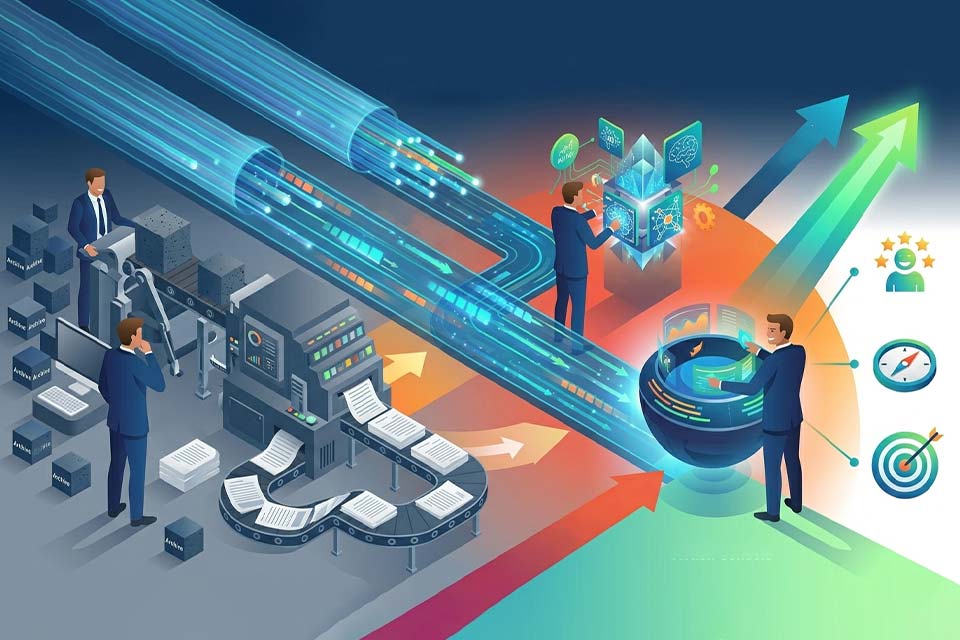
In today’s environment, speed, flexibility, and real-time responsiveness are critical competitive advantages for businesses. For years, companies relied on traditional business intelligence systems based on historical reporting, static dashboards, and periodic performance reviews. These systems were designed to help leadership teams analyze past performance, track operational metrics, and support strategic planning through periodic reporting cycles.
This approach was useful in a slower, more predictable business environment, but it is becoming less effective for organizations operating in today’s highly connected and rapidly evolving digital economy. This transition from static reporting to real-time, intelligent operational activity is reflected in the growing significance of CIOs and decision intelligence.
One of the biggest drivers behind this shift is the explosion of enterprise data. Today, organizations are producing large amounts of real-time information from cloud apps, IoT devices, enterprise platforms, customer interactions, AI, cybersecurity tools, and operational ecosystems. Today, every business function, from finance to supply chains, customer engagement, and workforce operations, is generating continual streams of data that, if analyzed correctly, can be used to provide valuable operational insights. But traditional reporting systems were not designed to operationalize this level of real-time information at scale.
Organizations are therefore increasingly moving from reactive analytics to predictive and real-time intelligence models. Businesses don’t want to know what happened yesterday or last quarter anymore. They need systems to identify new risks, anticipate opportunities, automate decisions, and provide real-time operational responses. Businesses need to be able to respond rapidly to market disruptions, changes in customer behavior, operational inefficiencies, cybersecurity threats, and competitive pressures. The increasing demand for smart responsiveness is what makes CIOs and decision intelligence so strategically important for today’s companies.
At the same time, enterprise leadership teams are coming to understand that disconnected data environments and siloed reporting systems are limiting organizational agility. Many traditional business intelligence environments are still heavily dependent on siloed systems, delayed analytics, and manual interpretation processes that slow decision-making. But modern intelligent enterprises require connected ecosystems that bring together AI, automation, analytics, and operational data to deliver business actions in real time. This evolution is radically transforming the way organizations think about enterprise intelligence and operational management.
CIOs and decision intelligence are more integrated today as technology leaders expand their influence from infrastructure management into strategic roles in business transformation. CIOs need to enable intelligent enterprise ecosystems driven by real-time analytics, AI-driven recommendations, predictive intelligence, and automated workflows. They’re not just running technology operations but helping organizations turn enterprise data into ongoing operational intelligence that can enhance business agility and accelerate decision-making.
This transition is facilitated by artificial intelligence and automation specially. AI-driven systems can instantly analyze large volumes of enterprise data, identify patterns, forecast operational outcomes, and trigger automated actions without requiring human intervention. Enterprises are moving from sporadic analysis to continually adaptive operational models powered by connected data platforms and intelligent automation systems. This convergence of AI, analytics, cloud infrastructure, and enterprise data ecosystems is accelerating how businesses operate in real time.
At the end of the day, CIOs and decision intelligence represent a major shift in enterprise strategy where organizations move away from static reporting to intelligent operational orchestration. Today’s CIOs are deploying decision intelligence systems that convert enterprise data into real-time actions, enabling organizations to become more agile, automate decisions, optimize performance, and build continuously adaptive enterprises that can dynamically respond to changing market and operational conditions.
Limitations of Traditional Analytics
While enterprises today are creating more data than ever before, many organizations still operate in legacy analytics environments built for slower, less-complex operational models. Conventional business intelligence systems were primarily built for reporting and retrospective analysis, not for real-time operational response.
As businesses increasingly operate in highly dynamic digital ecosystems powered by cloud platforms, AI systems, IoT devices, customer applications, and real-time workflows, older reporting models are struggling to keep pace with modern business demands. The widening gap between data availability and actionable intelligence is highlighting CIOs and decision intelligence in enterprise transformation strategies.
Organizations require systems today that can provide real-time operational awareness, predictive insights, and automated decision support. But many legacy analytics platforms are still heavily focused on historical reporting and static dashboards with little agility. This gap is forcing enterprises to re-evaluate how to manage enterprise intelligence and operational decision-making. CIOs and decision intelligence initiatives are increasingly critical elements of modern digital transformation efforts focused on improving speed, adaptability and operational intelligence.
Historical Reporting vs Real-Time Intelligence
Traditional analytics systems were, for the most part, built around periodic reporting cycles designed to help organizations assess past performance. Traditionally, dashboards, reports, and business intelligence platforms focused on monthly, quarterly, or annual metrics, which provided visibility into business activities that were already completed, not in real time.
While useful for historical insight, these systems were not designed for timely operational action. Business conditions had often already changed by the time reports were generated and assessed. Such a lag hinders organizational responsiveness in settings where customer behavior, supply chains, cybersecurity risks, and market conditions are constantly shifting.
Enterprises today require real-time operational intelligence that can drive immediate action. Organizations need to respond immediately to disruptions, performance issues, customer needs and competitive changes. Static reporting environments do not provide the continuous visibility or predictive capabilities that are needed to enable modern operational agility.
This limitation is why CIOs and decision intelligence strategies are gaining traction. CIOs are coming to the realization that enterprise intelligence systems must move from reporting on history to processing data in real-time and monitoring operations continuously.
Operational agility also suffers when organizations become too dependent on scheduled reporting cycles. Teams often postpone decision-making until they get reports, which slows down workflows and reduces the ability of the organization to respond quickly. In contrast, intelligent enterprise ecosystems driven by real-time analytics allow organizations to see risks, opportunities, and operational changes as they happen.
Companies are therefore moving from retrospective reporting environments to intelligent ecosystems where data continuously informs operational decisions.
1. Data Silos of Enterprise Systems
Another major limitation of traditional analytics environments is the continued existence of data silos across enterprise systems. Many organizations operate within siloed technology environments where customer data, financial information, operational metrics, workforce analytics, and supply chain insights are spread across disparate platforms and departments.
This fragmentation creates huge challenges to enterprise visibility and decision-making. Teams often work on different datasets, reporting systems, and operational metrics, resulting in inconsistent analysis and disconnected strategic priorities.
So, for example, marketing teams could be working with customer engagement platforms, while finance departments use different reporting systems, and operations teams use all different analytics environments. In the absence of integrated data ecosystems, organizations cannot create a coherent view of enterprise performance.
Enterprises today need connected intelligence environments that can bring together data across operational systems in real time. That’s why CIOs and decision intelligence are increasingly associated with enterprise-wide data integration initiatives designed to build unified operational visibility.
Fragmented data environments also prevent organizations from making the most of AI and automation. Intelligent systems need quality, connected data that provides contextual insights across the enterprise. Siloed data means less accurate and actionable recommendations and predictive analytics from AI.
This lack of unified visibility is also a contributor to inconsistent decision-making across departments. Teams working from different sources of information may have different interpretations of operational conditions, leading to inefficiencies and conflicting priorities.
To address these limitations, enterprises are increasingly investing in integrated data platforms, cloud-native architectures, API ecosystems, and real-time operational intelligence systems that can enable connected enterprise decision-making.
2. Reactive and manual decision processes
Traditional analytics systems also rely heavily on manual analysis workflows and reactive operational processes. In a lot of organizations, analysts and business teams have to manually gather data, prepare reports, analyze findings, and share recommendations before any actions can be taken.
The human-dependent approach significantly reduces the response capability of enterprises. Before organizations can take action in response to changing conditions, operational decisions are often filtered through multiple levels of analysis, approval, and coordination.
It is especially difficult to deal with reactive workflows in environments with rapid business disruptions. Growing threats of cybersecurity, operational outages, customer dissatisfaction, supply chain disruptions, and market volatility require rapid responses that cannot be efficiently handled through traditional manual processes.
This growing demand for operational speed is another factor driving CIOs and decision intelligence to the forefront of enterprise modernization efforts. More and more CIOs are using AI-driven systems that can automate analysis, spot anomalies, and launch operational actions without human intervention.
Also, traditional analytics systems are not good at proactively identifying emerging risks and opportunities. Many environments are designed for retrospective reporting. Therefore, many organizations respond to problems after the fact instead of predicting problems before they become major issues.
Modern decision intelligence ecosystems overcome this limitation by continuously analyzing streams of operational data in real-time. Organizations can deploy AI-powered analytics tools to detect patterns, anticipate disruptions, and generate recommendations in real-time, changing their approach from reactive management to predictive operational intelligence.
Automation also improves responsiveness by reducing the need for manual coordination and speeding up operational workflows. Intelligent alerts, automated recommendations, and event-driven systems help enterprises respond faster and more effectively to changing conditions.
3. Limited Predictive and Contextual Abilities
A major weakness of traditional business intelligence systems is their limited predictive and contextual intelligence capabilities. Legacy analytics environments were built mostly to visualize historical data and not to predict future outcomes or interpret operational context in real time.
Traditional reporting systems usually provide static metrics and isolated performance indicators without any knowledge of the wider operational relationships or business conditions. This limits their potential to support intelligent decision-making in complex enterprise environments.
Today’s businesses need systems that can result in:
- Predicting customer behavior
- Forecasting operational disruptions
- Identifying emerging risks
- Recommending strategic actions
- Continuously adapting to changing conditions
It’s dramatically expanding the role of CIOs and decision intelligence within enterprise technology strategies.
AI and machine learning-powered predictive analytics help organizations predict operational outcomes before they happen. Intelligent systems have the ability to analyze large volumes of enterprise data and uncover patterns, trends, and anomalies that traditional analytics systems will fail to identify.
The importance of context-aware decision support is growing, too. Today’s decision intelligence systems don’t look at one metric in isolation; they interpret operational conditions in the context of larger business environments. This contextual awareness allows organizations to make better and more adaptive decisions.
For instance, AI-enabled systems can generate recommendations for certain business scenarios based on data about customer behavior, operational metrics, financial performance and external market environment. Traditional BI environments do not have this level of intelligence and adaptability.
Automation also enhances contextual decision-making and allows changes to operations in real-time. Intelligent workflows can automatically trigger operational actions based on changing conditions without manual intervention.
As enterprises continue to modernize their operational ecosystems, predictive and context-aware intelligence will be integral to business agility and competitiveness.
Key Takeaway
Traditional analytics systems were built mainly for reporting results and reviewing past performance. But today’s enterprises increasingly want intelligent ecosystems that can offer predictive insights, real-time operational awareness, automated recommendations, and ongoing decision support. As organizations move from static reporting to intelligent operational action, this transformation is speeding the strategic significance of CIOs and decision intelligence.
What Is Decision Intelligence?
Decision intelligence is the next evolution of enterprise analytics and operational intelligence. Decision intelligence is different than traditional business intelligence systems that largely provide data visualization and historical reporting. Decision intelligence brings together AI, automation, analytics, and operational intelligence to enable real-time business decisions.
Organizations today are increasingly operating in environments where decisions must be made continuously across customer engagement, supply chains, cybersecurity, finance, workforce operations, and digital ecosystems. Static reporting environments are no longer sufficient to manage this level of operational complexity. Instead, enterprises need intelligent systems that can understand data on the fly and act immediately.
This growing trend is making CIOs and decision intelligence central to enterprise innovation and digital strategy.
Definition of Decision Intelligence
Decision intelligence is the use of integrated systems that combine artificial intelligence, advanced analytics, automation, and operational data to continuously support and optimize enterprise decisions.
Unlike legacy BI platforms that are focused on dashboards and reporting, decision intelligence systems are built to:
- Real-time operational incident interpretation
- Create predictive insights
- Recommendations
- Automate processes
- Make the enterprise more responsive
Today’s CIOs and decision intelligence initiatives are focused on turning enterprise data into actionable operational intelligence in order to allow continuous business adaptation.
These systems analyze data streams across cloud applications, IoT platforms, operational systems, customer interactions, and enterprise workflows to produce real-time recommendations and automated responses.
1. Evolution from Business Intelligence
Decision intelligence is a huge leap forward from traditional business intelligence environments. Old BI systems were all about the visibility of enterprise data through dashboards, charts, and periodic reports.
The enterprises of today need systems that can take visibility and turn it into intelligent operational action. This shift represents the transition from passive analytics to continuously adaptive enterprise intelligence ecosystems.
decision intelligence systems help enterprises determine: Instead of just helping organizations understand what happened before,
- What is happening now
- What is likely to happen next
- What actions should be taken immediately
This operational transformation is fundamentally reshaping the role of CIOs and decision intelligence in enterprise strategy.
Another difference between decision intelligence and traditional reporting systems is continuous operational decision support. Intelligent ecosystems continuously monitor operational conditions, customer activity, financial performance, cybersecurity risks, and business workflows to support ongoing enterprise adaptation.
2. Core Features of Decision Intelligence
To enable intelligent operational action, modern decision intelligence systems are built around several core capabilities.
Real-time analytics enables enterprises to analyze operational data on a continuous basis, not on delayed reporting cycles. Predictive and prescriptive analytics give organizations the ability to forecast results and identify recommended actions ahead of disruptions.
AI-powered recommendations also make the enterprise more agile by analyzing patterns in operations and auto-generating insights that are aware of context. These systems learn from enterprise data and gradually improve the quality of their decisions.
Another key capability is context-aware decision support. Based on the analysis of the relationships between operational conditions, customer behavior, financial performance, and external factors, intelligent systems are able to generate more adaptive recommendations.
The reason CIOs and decision intelligence are becoming foundational to modern enterprise transformation strategies is this growing intelligence capability.
3. Role of Automation in Decision Intelligence
Decision intelligence systems will only make the leap from analysis to operational execution through automation.
With intelligent automation, organizations can trigger workflows, approvals, alerts, and operational actions automatically, based on real-time conditions. That cuts down on the need for manual coordination and makes the enterprise more responsive overall.
Organizations can make better decisions and reduce operational delays with automation recommendations and smart alerts. Dynamic process optimization also allows companies to constantly adapt workflows to changing business conditions.
As organizations evolve towards intelligent operating ecosystems, automation will be key to scaling decision intelligence capabilities across complex digital environments.
Positioning
Decision intelligence transforms enterprise data into continuous operational awareness and intelligent action that enables organizations to become more agile, automate workflows, optimize business performance, and build continuously adaptive enterprises powered by AI, analytics, automation, and real-time operational intelligence.
Also Read: CIO Influence Interview With Jake Mosey, Chief Product Officer at Recast
The Role of CIOs in Decision Intelligence
The fast pace of enterprise technology is fundamentally changing the job of the CIO today. Today’s organizations see technology leaders as more than caretakers of infrastructure, networks, and enterprise systems. CIOs are now more and more serving as strategic architects of enterprise intelligence, operational agility, and AI-driven transformation.
As businesses operate in highly dynamic digital ecosystems powered by cloud computing, AI, automation, connected applications, and real-time data streams, enterprises need intelligent systems to support continuous decision making and operational responsiveness. This transformation is making CIOs and decision intelligence dramatically more strategic in the modern enterprise.
Today, organizations have to make decisions at an ever-quicker pace. Customer expectations are changing rapidly, operational conditions are in a constant state of flux, cybersecurity risks are evolving in real-time, and market disruptions are occurring with increasing frequency. These operational demands outgrow traditional business intelligence systems that are based on periodic reporting. Today’s businesses need intelligent ecosystems that can interpret data instantaneously, produce predictive insights, automate workflows, and activate adaptive operational action. Consequently, CIOs and decision intelligence are turning into essential parts of enterprise modernization strategies.
1. CIOs as Leaders of Enterprise Intelligence
The CIO’s role has grown from infrastructure oversight to enterprise intelligence leadership, which is one of the biggest changes in enterprise leadership. In the past, CIOs have been preoccupied with keeping the lights on, supporting enterprise applications, and managing IT budgets. These responsibilities are still important, but modern CIOs are increasingly expected to lead enterprise-wide intelligence transformation.
Today’s organizations expect CIOs to create digital ecosystems that provide continuous operational awareness, predictive decision-making and real-time business responsiveness. The change is indicative of an increased realization that enterprise competitiveness is increasingly contingent on how effectively organizations utilize data, AI and automation to optimize operations and customer experiences.
Hence, today’s CIOs and decision intelligence initiatives are aimed at aligning the technology strategy closer with the wider business agility goals. CIOs are empowering enterprises to move from reactive operational models to intelligent ecosystems where operational decisions are continuously informed by real-time analytics and AI-driven insights.
This shift also demands increased collaboration between technology leaders and business executives. CIOs are expanding their roles in supporting enterprise intelligence systems to collaborate with operations, finance, marketing, HR, cybersecurity, and customer experience teams to support broader organizational goals. CIOs are increasingly leading business transformation by linking technology strategy with operational performance.
2. Designing Data-Driven Enterprise Architectures
Data-driven enterprise architecture is another key responsibility for modern CIOs and decision intelligence strategies. Intelligent decision-making relies on connected, scalable and interoperable data ecosystems which provide continuous operational visibility across enterprise environments.
Many organizations still have fragmented systems with customer data, operational metrics, financial information, workforce analytics, and supply chain data siloed in different platforms. These disparate environments create barriers to enterprise visibility and reduce the efficacy of AI-driven analytic systems.
CIOs are increasingly asked to unify these disparate ecosystems into unified enterprise data architectures to support real-time intelligence which includes:
- Consolidate your enterprise data platform
- Broadening the API-based interoperability
- Constructing Cloud Native Infrastructure
- Enabling real-time data streaming
- Enabling operational visibility across functions
The exponential growth of data volumes within an enterprise makes scalable data infrastructure even more important. Today’s organizations produce constant data streams from IoT devices, enterprise applications, customer platforms, AI systems and operational workflows. CIOs should therefore make sure enterprise architecture can handle, analyse and operationalise large amounts of real-time information efficiently.
Real-time visibility across the enterprise is also a key part of modern infrastructure design. Intelligent enterprises need systems that can continuously monitor operational conditions, customer interactions, security environments, and business performance without waiting for delayed reporting cycles.
This increased focus on connected enterprise architecture is one reason why CIOs and decision intelligence are becoming critical to long-term digital transformation strategies.
3. Fast Track AI and Automation Adoption
Artificial intelligence and automation are now core parts of modern enterprise intelligence systems. The CIO is at the center of the deployment of AI-enabled operational platforms that can deliver predictive analytics, intelligent automation, and real-time operational recommendations.
Today’s CIOs and decision intelligence initiatives are less about deploying AI systems that can:
- Identify operational irregularities
- Predict business results
- Identify new risks
- Tailor customer experiences
- Streamlining workflows
- Optimization of enterprise operations
The importance of predictive analytics is emphasized by the growing interest of organizations in having systems that can predict problems in advance. AI-led analytics engines can analyze operational patterns, identify performance trends, and predict disruptions faster than their traditional manual analysis methods.
Automation increases enterprise responsiveness by reducing reliance on human-dependent workflows. Intelligent automation frameworks enable organizations to start operational activities automatically based on real-time situations. This includes automated approvals, workflow routing, fraud detection, supply chain changes, and customer engagement actions.
CIOs also have responsibility for bringing predictive analytics into broader enterprise workflows. Organizations are moving away from using AI as discrete technology projects, and instead are increasingly embedding predictive intelligence directly into operational systems and decision-making processes.
The shift to AI-native operational ecosystems is dramatically increasing the significance of CIOs and decision intelligence in enterprise strategy and innovation.
3. Governance, Security and Data Trust
As organizations rely more on smart operational systems, governance and data trust are rapidly becoming critical priorities. Decision-making driven by AI relies on data quality, transparency, security, and ethical governance.
In this context, modern CIOs and decision intelligence strategies require robust governance frameworks that can assure:
- Data accuracy
- Regulatory compliance
- Ethical AI usage
- Cybersecurity protection
- Operational transparency
Poor or fragmented data can greatly reduce the effectiveness of AI-driven decision systems. CIOs are more accountable for defining enterprise governance policies that improve data consistency, accessibility, and reliability across operational ecosystems.
As organizations increasingly rely on automated recommendations and predictive systems, the need for ethical AI management is increasing. Enterprises should ensure intelligent systems are transparent, bias is minimized, and explainable decision-making processes are supported.
Security and compliance responsibilities are increasing as well. Intelligent enterprise ecosystems are constantly processing vast quantities of sensitive customer, operational and financial information. This means CIOs must implement secure data architectures, identity management systems, and cybersecurity frameworks that can protect enterprise intelligence environments.
And just as important is building organizational trust in intelligent systems. Employees and business leaders need to trust that AI-driven recommendations are accurate, secure and aligned to operational goals. Thus, CIOs are an important component of the governance structures that will enhance enterprise trust in decision intelligence systems.
4. Building Agile Decision Cultures
Technology transformation by itself is not sufficient to build intelligent enterprises. Organizations need to develop operational cultures that facilitate real-time responsiveness, data-driven decision-making, and ongoing adaptation.
Today’s CIOs and decision intelligence strategies are increasingly centered on creating agile decision cultures where employees and operational teams can react quickly to intelligent insights.
It means enabling real-time operational responsiveness across the enterprise functions, not slow, hierarchical decision processes. To compete in digital markets, organizations need to be more adaptive, collaborative, and data-driven.
Connected enterprise visibility is critical to intelligent decision-making, so cross-functional collaboration is especially important. Finance, operations, customer experience, HR, marketing, and cybersecurity teams will increasingly need to work together across common operational ecosystems, underpinned by shared intelligence systems.
CIOs are also helping to embed intelligence directly into business workflows. Intelligent operational environments are increasingly delivering insights directly within enterprise applications and operational processes, rather than having employees manually analyze reports or access separate analytics systems. The embedded intelligence approach enhances responsiveness and enables organizations to scale decision-making capabilities across distributed digital ecosystems.
Key Point
CIOs are emerging as architects of intelligent enterprises, where data, AI, automation, and real-time operational visibility are continuously driving enterprise decision-making, business agility, and operational optimization.
Key Components of Decision Intelligence Systems
Decision intelligence systems are based on a constellation of interconnected technologies that function together to provide continuous enterprise awareness and intelligent operational action. Traditional analytics environments were built to support historical reporting, while today’s decision intelligence ecosystems are built to continuously consume data, generate predictive insights, automate workflows, and support real-time and adaptive business operations.
As the emphasis on operational agility and AI-enabled responsiveness increases, the importance of CIOs and decision intelligence is more and more vital to digital transformation strategies.
1. Real-Time Data Infrastructure
The foundation of modern decision intelligence ecosystems is a real-time data infrastructure. But the intelligent enterprise demands continuous operational visibility, which only streaming data environments can provide by processing enterprise information on the fly.
Streaming data ecosystems enable organizations to analyze operational events as they happen rather than waiting for the slow reporting cycles. This allows for faster identification of disruptions, changes in customer behavior, cyber threats, and operational inefficiencies.
Event-driven architecture improves responsiveness by triggering workflows and operational actions automatically in response to real-time business conditions. Continuous monitoring systems provide enterprises with continuous insight into their operations, finance, customer engagement, cybersecurity, and supply chains. This infrastructure is critical to enable modern CIOs and decision intelligence strategies for continuous enterprise responsiveness.
2. Artificial Intelligence & Machine Learning
AI and machine learning provide the predictive and adaptive capabilities in decision intelligence systems. AI-based analytic engines analyze enterprise data continuously to find patterns, predict outcomes, and make smart recommendations.
Pattern recognition enables enterprises to proactively identify anomalies, emerging risks, customer trends, and operational inefficiencies. Forecasting (predictive) Forecasting helps organizations predict what the future will look like and plan accordingly.
In addition, operational recommendations via AI enhance enterprise agility as organizations can respond more quickly and intelligently to changing business environments.
3. Data Integration and Interoperability
Visibility across the connected enterprise depends largely on data platforms and operational systems that work together. The data that today’s CIOs and decision intelligence ecosystems need must flow seamlessly across departments, applications, cloud platforms, and operational workflows.
API-driven connectivity allows organizations to coalesce customer data, operational metrics, financial information, and enterprise intelligence into unified ecosystems that can support cross-functional visibility. Integrated enterprise environments improve decision quality by enabling more accurate AI-powered analytics and operational recommendations.
4. Smart Automation
Automation allows decision intelligence systems to go beyond analysis and into operational execution. Automated workflows, AI-triggered actions, and autonomous orchestration systems increase responsiveness while reducing manual intervention.
Organizations are increasingly using intelligent automation to support:
- Customer engagement
- Operational approvals
- Fraud prevention
- Workflow management
- Incident response
- Process optimization
This automation capability dramatically boosts enterprise agility and operational scalability.
5. Visualisation and Decision Interface
Modern decision intelligence systems must also use intuitive interfaces that can effectively deliver operational insights. Interactive dashboards, natural language querying, and a context-aware analytics environment enable users to interpret enterprise intelligence quickly and efficiently.
Natural language interfaces enable business users to conversationally access operational insights without requiring deep technical expertise. Context-aware visualization also helps decision-making by dynamically highlighting relevant operational conditions and suggested actions.
Strategic insights
Decision intelligence systems utilize real-time data infrastructure, AI, machine learning, automation, interoperability, and integrated enterprise visibility to accelerate intelligent operational action and continuously adaptive enterprise decision-making.
Use Cases of Decision Intelligence
More and more businesses today are deploying intelligent operating systems that can turn enterprise data into real-time action. Decision intelligence is emerging as a core capability across industries as organizations face increasing pressure to improve agility, customer responsiveness, operational efficiency, and risk management. The rising prominence of CIOs and decision intelligence highlights the shift of enterprises away from static analytics toward intelligent ecosystems powered by AI, automation, and continuous operational visibility.
Today, CIOs and decision intelligence strategies are helping companies optimize customer engagement, streamline operations, strengthen cybersecurity, improve workforce management, and enhance financial forecasting through intelligent decision-making systems.
1. Customer Experience Optimization
One of the most effective applications of decision intelligence is to improve customer experience. Customers today want highly personalized, seamless, real-time experiences across digital channels and enterprise platforms. Traditional customer analytics systems often failed to react quickly enough to changing customer behavior, limiting engagement effectiveness.
Today’s CIOs and decision intelligence efforts enable organizations to leverage AI-driven systems to provide real-time personalization and predictive customer engagement. Intelligent platforms analyze customer behavior, preferences, transaction pattern and engagement history to recommend products, personalize communications and dynamically enhance customer journeys.
Decision intelligence systems also help organizations anticipate customer needs before issues arise by providing intelligent service recommendations. This proactive approach enhances customer satisfaction and loyalty and enables organizations to build more responsive customer engagement environments.
2. Supply Chain and Operations Management
Supply chain and operation ecosystems generate huge volumes of real-time enterprise data. To cope with this complexity, intelligent systems are needed that are capable of continuous monitoring of the operational conditions and dynamically reacting to disruptions.
Predictive analytics and automated decision support provide modern CIOs and decision intelligence frameworks to help organizations improve logistics optimization, inventory management, and operational coordination. AI-powered systems can predict changes in demand, spot supply chain bottlenecks and improve inventory distribution in real-time.
Operational intelligence systems also allow automated operational adjustments across production, logistics and distribution environments. Organizations can identify inefficiencies, optimize resource utilization and respond more quickly to changing business conditions by continuous analysis of streaming operational data.
3. Financial, Workforce, and Risk Intelligence
Financial operations are another major area where decision intelligence is changing how enterprises perform. Intelligent systems now enable fraud detection, dynamic financial forecasting, and real-time compliance monitoring in highly connected digital ecosystems.
AI-powered analytics engines monitor financial transactions and operational data in real time, identifying anomalies, reducing the risk of fraud, and improving the accuracy of forecasts. This enables enterprises to enhance financial governance and operational responsiveness.
Simultaneously, CIOs and decision intelligence are also increasingly influencing workforce and HR operations. Companies use intelligent systems to analyze workforce productivity, predict future talent needs, improve employee experiences, and optimize workforce planning. Predictive talent management systems help organizations to identify retention risks, improve recruitment strategies, and customize employee engagement initiatives.
Intelligent decision ecosystems also deliver meaningful benefits for IT operations and cybersecurity. AI-powered threat detection systems can detect suspicious activity patterns in real time and automated incident response capabilities enhance enterprise resilience against ever-evolving cyber threats. Infrastructure performance optimization tools constantly monitor operational environments to improve uptime, scalability and operational stability.
As enterprises continue to modernize digital operations, CIOs and decision intelligence are critical to enabling intelligent enterprise ecosystems that support adaptive, automated and continuously optimized business operations.
Placement
Decision intelligence is emerging as a core capability across enterprise operations, customer engagement, financial management, workforce optimization, cybersecurity, and IT infrastructure. As digital ecosystems become more interconnected, today’s CIOs and decision intelligence strategies are enabling organizations to transform data into ongoing operational awareness and intelligent action to increase agility, automation, predictive capabilities, and real-time decision-making.
Decision Intelligence – Business Impact
The rise of intelligent enterprise ecosystems is changing the way organizations operate, compete, and react to market changes. Today’s enterprises are applying AI-based operational systems, predictive analytics, automation, and real-time data visibility to improve decision-making and enterprise performance. The growing importance of CIOs and decision intelligence reflects how organizations are moving from traditional reporting environments to continuously adaptive operational models.
Decision intelligence enables organizations to reduce response times, improve operational agility, and optimize strategic execution across business functions. Businesses no longer need to depend on delayed analytics and manual workflows; they can now leverage real-time intelligence to make faster and more accurate decisions in dynamic digital environments.
One of the biggest business benefits of decision intelligence transformation is operational efficiency. Intelligent automation reduces reliance on manual labor and improves workflow optimization for finance, customer service, supply chain management, HR, and IT operations.
Business enterprises can now monitor in real-time to understand inefficiencies and drive continuous process improvement without having to wait for periodic operational reviews. Modern CIOs and decision intelligence strategies are enabling organizations to increasingly build adaptive operational environments that can support intelligent orchestration and predictive business management at scale.
Decision intelligence boosts business agility, allowing organizations to react faster to market disruptions, customer expectations, and operational risks. AI and automation-driven adaptive enterprise systems constantly analyze operational conditions and dynamically suggest adjustments. This allows companies to continuously optimize performance and increase resilience in rapidly evolving digital markets.
Simultaneously, smart systems improve the customer and employee experience through personalized engagement, predictive support, accelerated problem-solving, and context-aware operational assistance. Intelligent customer interaction systems and workforce analytics environments enable organisations to build more responsive and connected enterprise ecosystems.
Ultimately, competitive advantage will be determined by decision intelligence and CIOs. Companies that are better at putting predictive analytics, automation, and intelligent workflows to work have a big edge when it comes to innovation, scalability, and how quickly they can respond operationally. Decision intelligence enables organizations to be more predictive, agile, and continuously adaptive while enabling long-term growth and strategic resilience across complex digital ecosystems.
Challenges in Implementing Decision Intelligence
Decision intelligence is becoming more and more strategically important, but there are several big challenges to implementing it across enterprise environments. Many organizations are still hamstrung by disjointed operational systems, inconsistent enterprise data, and legacy infrastructure that stand in the way of effectively operationalizing real-time intelligence.
As CIOs and decision intelligence assume an increasingly prominent role, organizations will need to modernize their technology ecosystem and their organizational operating models to facilitate intelligent decision-making at scale. But such a transformation usually requires a fair amount of complexity, investment, and cultural change.
Data quality and fragmentation continue to be the biggest barriers to decision intelligence adoption. Many organizations still operate in disconnected data environments where operational, customer, workforce, and financial information is siloed across departments and systems. The reduced effectiveness of AI-driven analytics and predictive operational systems is being caused by inconsistent data structures, poor governance frameworks, and limited interoperability.
Implementation challenges are compounded by the complexity of governance as organizations need to ensure compliance, data security, and operational transparency in highly distributed enterprise environments.
Modern CIOs and decision intelligence initiatives also face significant hurdles due to legacy infrastructure constraints. Traditional enterprise systems were typically built for static reporting rather than real-time analytics, AI-driven automation or continuous operational orchestration. Older platforms may lack the scalability, integration, and cloud-native functionality that intelligent enterprise ecosystems require. Substantial investment in cloud infrastructure, API ecosystems, streaming architectures, and interoperable data platforms is needed to upgrade these environments.
With organizations relying more and more on automated recommendations and predictive intelligence, AI trust and explainability are becoming increasingly important. The need to address issues of transparency of algorithms, ethical use of AI, and trust in automated operational decisions of enterprises. Employees and leadership teams may be resistant to intelligent automation if they lack trust in the way AI systems create insights or recommendations.
Another big problem is organizations’ resistance to change. Many enterprises still run on traditional management structures and workflows that are not optimized for real-time operational intelligence. Successful transformation requires strong change management strategies, collaboration across functions, and data-driven cultures across the enterprise.
Finally, enterprises are experiencing growing skills and talent gaps in AI, analytics, automation and data engineering. More and more organizations are seeking cross-functional intelligence leadership that can lead highly integrated operational ecosystems. So CIOs and decision intelligence transformation is more than just technology modernization, it’s also about organizational alignment, workforce development, and enterprise-wide operational maturity.
Future Outlook: CIOs as Enablers of Intelligent Enterprises
The future enterprise will increasingly operate in intelligent ecosystems where AI, automation, real-time analytics, and connected operational data are continuously driving business decisions. What this signifies is the evolution of enterprise leadership to intelligent operational orchestration and predictive business management — the growing importance of CIOs and decision intelligence. Today’s CIOs are evolving into architects of adaptive digital enterprises that can respond dynamically to changing market conditions, operational risks, customer behavior, and emerging opportunities.
Autonomous enterprise operations are probably one of the most important developments in future business environments. AI-driven orchestration systems will increasingly automate operational workflows, continuously optimize enterprise processes and enable autonomous decision-making across finance, supply chains, customer engagement, cybersecurity and workforce management. Self-optimizing enterprise systems will diminish the need for manual coordination and will improve operational speed, scalability, and resilience. These smart ecosystems will enable organizations to be more proactive, predictive, and always adaptive.
Real-time enterprise intelligence ecosystems will also grow considerably. Continuous operational visibility through event-driven architectures, streaming data platforms, and intelligent digital command centers will power organizations of the future.
Modern CIOs and decision intelligence strategies will heavily focus on enabling enterprise-wide awareness where operational conditions, customer interactions, security environments, and business performance can be monitored and optimized in real time. Context-aware systems that can dynamically adapt to user behavior and operational conditions will further enhance customer and employee experiences in hyper-personalized operational environments.
The convergence of AI, analytics, automation, and intelligent orchestration platforms will continue to redefine enterprise infrastructure. More organizations will adopt unified operational ecosystems in which intelligent workflows, predictive analytics, and AI-native business platforms work in concert. CIOs will take on an even more strategic leadership role for enterprise intelligence governance, digital transformation, and competitive business innovation as the tempo of this transformation accelerates.
Ultimately, the future of CIOs and decision intelligence will be about creating intelligent enterprises that are capable of turning real-time data into constant operational action. CIOs will transition from infrastructure managers to orchestrators of enterprise-wide intelligence ecosystems that fuel predictive business strategies, operational agility, and always-adaptive digital operations.
Conclusion: CIOs Transitioning from Reporting to Real-Time Intelligence
Enterprise decision-making is experiencing a significant shift as organizations transition from static reporting environments to intelligent operational ecosystems driven by AI, automation, analytics, and real-time enterprise visibility. Traditional business intelligence systems were designed for historical analysis and periodic reporting, which limited the ability of organizations to react in the rapidly evolving digital markets.
Today, enterprises need intelligent systems to provide predictive insights, continuous operational awareness and real-time decision making. The rise of CIOs and decision intelligence is a symptom of this broader shift from reactive enterprise management to always-on adaptive operational orchestration.
In today’s digital transformation initiatives, CIOs are becoming key architects of intelligent enterprise ecosystems. Their responsibilities now extend far beyond infrastructure management and IT operations. Today, CIOs and decision intelligence go hand in hand with enterprise agility, operational optimization, AI governance, and strategic business innovation. CIOs are at the forefront of developing connected data ecosystems, intelligent automation architectures, predictive analytics platforms, and real-time operational intelligence systems that can change the way organizations operate and compete.
AI, automation, analytics, and operational intelligence are converging to redefine enterprise infrastructure itself. Increasingly, organizations are seeking intelligent systems that can predict how their operations will behave, identify new risks, optimize their workflows, personalize customer experiences, and automate their business processes on the fly. Real-time enterprise intelligence is becoming critical for industries to improve decision speed, scalability, resilience, and competitiveness. As digital ecosystems grow, the importance of CIOs and decision intelligence will continue to rise.
Today’s CIOs are not just managing enterprise tech environments; they are building intelligent decision ecosystems that convert enterprise data into real-time operational action. Organizations are progressing from reactive decision-making models to continuously intelligent operational ecosystems that enable faster decisions, operational agility, strategic innovation, and long-term business resilience with the help of AI-driven intelligence, automation, predictive analytics, and adaptive enterprise architecture.
Catch more CIO Insights: CIOs as Ecosystem Architects: Designing Partnerships, APIs, And Digital Platforms
[To share your insights with us, please write to psen@itechseries.com ]
