

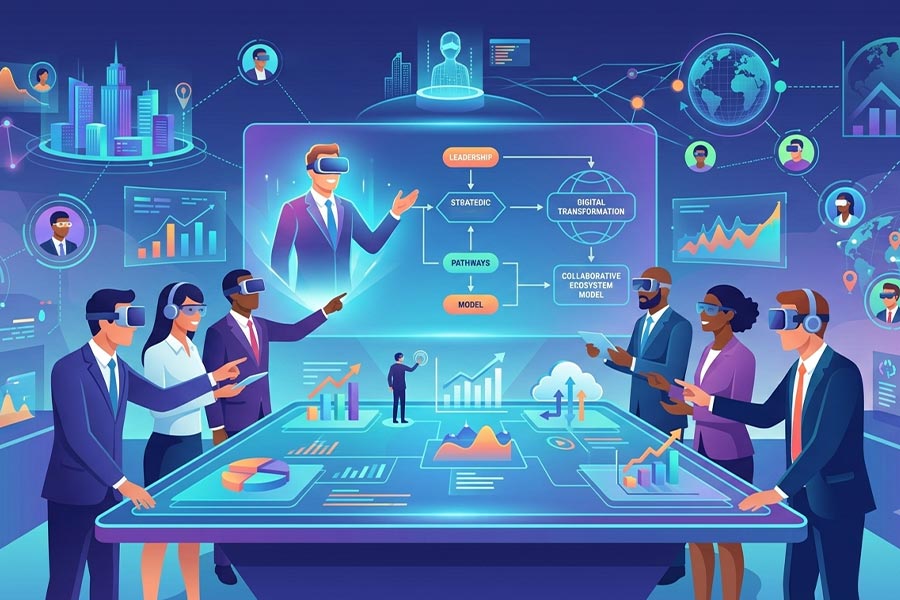
The digital workplace has undergone dramatic change over the last decade. What started as basic video conferencing and cloud-based collaboration tools has evolved into a new wave of immersive enterprise technologies designed to change the way organizations work, communicate, and innovate. Companies are flocking to virtual environments that blend physical and digital, creating new opportunities to connect employees, streamline operations, and engage customers.
The rise of hybrid work models and evolving workforce expectations is driving the growth of virtual collaboration environments. At the same time, technologies such as Artificial Intelligence (AI), Augmented Reality (AR), Virtual Reality (VR), and Mixed Reality (MR) are being increasingly integrated into business processes. Companies have started using these technologies to create digital workspaces for real-time collaboration, immersive training, virtual product design, remote assistance, and complex operational simulations. As these capabilities mature, businesses are transitioning from stand-alone technology deployments to interconnected digital ecosystems that support a broad array of enterprise functions.
This evolution is driving increasing interest in connected workplace experiences, where employees, customers, partners, and systems interact in persistent digital environments. The Enterprise Metaverse concept has emerged as a reference model for integrating immersive technologies, intelligent automation, and digital collaboration into a single operating model. Enterprise Metaverse: This is more of a holistic view of digitally connected business environments that enable greater productivity, innovation, and decision-making — beyond just virtual reality experiences.
Transitioning to these immersive ecosystems requires strategic leadership and alignment with organizational goals. This is the place where the importance of CIO Leadership is increasing. Technology leaders must evaluate new platforms, build enabling infrastructure, establish governance frameworks, and ensure that immersive technologies deliver tangible business value. As organizations make investments in digital transformation initiatives, CIO Leadership is a critical component of how organizations leverage immersive environments as part of broader enterprise strategies.
Modern CIO Leadership embraces innovation leadership, workforce transformation, and long-term business planning, as well as technology management. CIOs have a crucial role in navigating the opportunities and challenges that immersive technologies offer organizations while balancing security, scalability, and operational needs. The choices they make will dictate the extent to which enterprises can adopt and embed these new digital ecosystems.
The Enterprise Metaverse is emerging as the next phase of workplace transformation as organizations continue to experiment with new ways to work, collaborate, and serve customers. Strong CIO Leadership enables organizations to move beyond experimental virtual tools and build immersive environments that support real business outcomes. The future of work could be increasingly dictated by how well companies integrate physical and digital realities to create seamless experiences that drive productivity, innovation, and growth. In this changing environment, CIO Leadership will continue to be a crucial ingredient in shaping the next generation of enterprise operations.
What is the Enterprise Metaverse?
The idea of an Enterprise Metaverse is picking up steam, with companies looking for new ways to involve their staff, improve operations and develop immersive digital experiences. While consumer-focused virtual worlds garnered early interest, businesses are now turning to more practical uses that can enhance productivity, collaboration, and innovation.
With organizations pouring billions of dollars into next-generation workplace technologies, CIO Leadership is more important than ever to influence strategy, develop infrastructure, and drive enterprise-wide adoption.
What is the Enterprise Metaverse?
The Enterprise Metaverse is defined as persistent, interconnected digital worlds where employees, partners, customers, and systems interact in real time. Consumer metaverse platforms tend to be more about entertainment, gaming, and social interaction, whereas enterprise metaverse environments are built to enable business activities and operational objectives.
The Enterprise Metaverse is a converged platform that consists of immersive technologies, digital collaboration tools, AI-powered systems, and enterprise applications. They enable organizations to create virtual work environments, conduct meetings, train employees, simulate operations, and collaborate across geographic boundaries.
Some of the main characteristics:
- Sustainable digital work environments.
- User interactions in real time.
- Shared virtual spaces.
- Integration with the business systems of the enterprise.
- Digital representations of people, assets, and processes.
With adoption increasing, CIO Leadership is helping organizations understand how these technologies fit into longer-term digital transformation objectives and business priorities.
Evolution from Digital Workplaces to Immersive Ecosystems
The enterprise metaverse didn’t happen overnight. This is the next step in the evolution of digital workplaces.
The first wave of workplace digitization was all about email, enterprise software, and cloud-based productivity tools. In subsequent times, organizations adopted video conferencing platforms, collaboration applications, and remote work technologies to facilitate distributed teams.
Several developments sped up the evolution:
- Widespread adoption of remote/hybrid working.
- Rise of cloud-based collaboration platforms
- Greater need for instant digital interaction.
- Progress in immersive technologies.
- Growth in the capabilities of intelligent automation.
Businesses today are moving away from traditional collaboration tools into immersive ecosystems that provide richer interactions and more engaging experiences. In many cases, virtual offices, digital workspaces, and interactive environments are becoming feasible alternatives to physical locations for many activities.
Enterprises are balancing these opportunities with CIO Leadership, driving investments to deliver measurable business outcomes.
Key Features of Enterprise Metaverse
The Enterprise Metaverse offers interactive environments and ongoing engagement, and enables a variety of business functions that diverge from conventional digital workplaces.
1. Persistent Virtual Environments
Traditional apps are things users log into and use for a period of time. Enterprise metaverse platforms, on the other hand, are persistent digital worlds. Employees can enter virtual workspaces, collaborate with colleagues, and access resources within a continuous digital ecosystem.
These environments allow teams to maintain continuity across projects, meetings, and workflows, no matter the physical location.
2. Real-time Collaboration
The Enterprise Metaverse is all about real-time interaction. Employees communicate, share information, and collaborate in these immersive digital spaces.
Benefits:
- Enhanced team engagement.
- Faster decision-making.
- Improved knowledge sharing.
- Reduced geographical barriers.
- More natural collaboration experiences.
With strategic CIO leadership, organizations can establish platforms that enable effective collaboration while ensuring security and operational efficiency.
3. Digital Identity and Presence
Users can form digital identities, which are virtual profiles that permanently represent them in metaverse environments.
These identities underpin:
- Robust authentication.
- Customized user experiences.
- Uniform access controls.
- Professional collaboration.
Digital presence creates a sense of continuity and responsibility in virtual workplaces.
4. Interoperable Business Systems
Enterprise Metaverse environments must be integrated with existing business applications such as CRM, ERP, HR, and collaboration platforms.
Interoperability allows organizations to:
- Share information across systems.
- Automate workflows.
- Improve operational visibility.
- Create unified user experiences.
Strong CIO Leadership is needed for effective integration to make sure technology strategies are aligned across different departments and platforms.
The Business Case for Metaverse Technologies
Organizations are investing in Enterprise Metaverse initiatives as they see opportunities to improve workforce performance, operational efficiency, and innovation capabilities.
1. Workforce Transformation
The nature of work is rapidly changing. Distributed teams, hybrid work models, and global collaboration have become more common.
The Enterprise Metaverse provides new opportunities to:
- Connect remote employees.
- Enhance workforce engagement.
- Support virtual teamwork.
- Create immersive training experiences.
- Strengthen organizational culture.
These capabilities allow organizations to adapt to changing workforce expectations.
2. Digital Innovation Initiatives
Businesses of all kinds are looking for new ways to improve how they operate and the experience they provide to customers. The enterprise Metaverse technologies provide opportunities to transform traditional business processes through immersive digital environments.
Examples are:
- Virtual product development.
- Digital simulations.
- Interactive customer experiences.
- Collaborative innovation spaces.
- Remote operational management.
CIO Leadership is central to identifying actionable use cases and aligning with business strategy as organizations pursue innovation objectives.
3. Call for Increased Collaboration and Productivity
Traditional collaboration tools can’t match the engagement and efficacy of in-person interactions. The Enterprise Metaverse offers more immersive environments that can enhance communication, teamwork, and productivity.
Organizations are looking to metaverse technologies to:
- Reduced friction for collaboration.
- Make meetings more effective.
- Improve employee experiences.
- Encourage creative problem solving.
- Facilitate participation of the global workforce.
Strong CIO Leadership can help ensure that these investments are targeted at measurable business outcomes, not just technology experimentation.
Technologies Powering the Enterprise Metaverse
The Enterprise Metaverse is enabled by a combination of sophisticated technologies working in concert to create immersive and intelligent business environments. Such technologies enable virtual collaboration, digital operations, and next-generation workplace experiences.
1. Artificial intelligence and intelligent automation
Artificial Intelligence is one of the most critical enablers of Enterprise Metaverse environments.
AI capabilities allow:
- Virtual assistants.
- Automated workflows.
- Intelligent recommendations.
- Personalized user experiences.
- Predictive decision support.
AI-based systems can help organizations build more responsive and adaptive virtual environments with less manual administrative effort. As adoption matures, CIO Leadership is increasingly focused on embedding AI into enterprise metaverse strategies to maximize productivity and business value.
2. Augmented Reality (AR)
Augmented Reality overlays digital information on the real world and lets users find the information they need without leaving their physical environment. +966 53 0860362
Enterprise AR apps are:
- Remote technical assistance.
- Maintaining equipment.
- Training of staff.
- Field service activities.
- Industry surveys.
AR helps to bridge physical and digital workplaces and thus improves the efficiency of workflows.
3. Virtual Reality (VR)
Virtual Reality creates complete digital environments that can be interacted with within simulated spaces.
Examples of VR applications are:
- Virtual meetings.
- Employee onboarding.
- Safety training simulations.
- Product design collaboration.
- Remote learning experiences.
Through VR, organizations can create immersive experiences that enhance knowledge retention and collaboration effectiveness.
4. Mixed Reality (MR)
Mixed Reality combines AR and VR, enabling interaction between digital and physical objects.
Benefits are:
- Interactive streams.
- Improved visualization.
- Better collaboration.
- Providing information in context.
- Higher employee engagement.
Many experts believe MR will have an important role in the future enterprise metaverse environment.
5. Digital Twin Technology
Digital twins: Virtual replicas of physical assets, systems, and operations.
Digital twins are used by organizations to:
- Real-time monitoring.
- Operational simulations.
- Predictive maintenance.
- Tuning performance.
- Evaluation of risk.
These capabilities offer valuable insights that enhance decision-making and operational efficiency.
6. Edge infrastructure and cloud computing
Cloud and edge computing offer the scalable infrastructure that is required to support immersive enterprise environments.
Some of the important capabilities are:
- High-performance processing.
- Real-time data management.
- Global accessibility.
- Scalable storage.
- Distributed computing resources.
Modern CIO Leadership teams are investing heavily in cloud and edge strategies to enable future metaverse initiatives.
Blockchain and Digital Identity Systems
Trust and security are at the heart of the Enterprise Metaverse. Blockchain and digital identity technologies allow for the secure architecture of virtual environments.
These technologies assist with:
- Verifying identity.
- Control of access.
- Ownership of digital assets.
- Transactions are secure.
- Data integrity.
As virtual business ecosystems evolve, CIO Leadership will continue to focus on secure identity management and governance frameworks to ensure safe and compliant enterprise operations.
The Enterprise Metaverse is nascent, but today the groundwork is being laid with the convergence of AI, immersive technologies, digital twins, cloud infrastructure, and secure identity systems. Organizations that successfully integrate these technologies under CIO Leadership will be better positioned to deliver innovative, connected, and resilient digital workplaces of the future.
The Role of CIO Leadership
Organizations are moving beyond experimentation and beginning to deploy immersive technologies at scale, and the success of the Enterprise Metaverse is increasingly reliant on strong CIO Leadership. The modern Chief Information Officer is no longer just the person in charge of IT infrastructure. Instead, CIOs are becoming the strategic architects of digital transformation, leading the emerging technologies that are transforming the way businesses operate, employees engage and customers experience.
The Enterprise Metaverse offers tremendous opportunities but presents major challenges in infrastructure, security, governance, integration and workforce readiness. Effective *CIO Leadership ensures that immersive technologies are aligned with organizational goals and deliver measurable business value.
1. Defining Enterprise Metaverse Strategy
The first responsibility of CIO Leadership is to develop a clear strategy around Enterprise Metaverse adoption. Organizations should not adopt immersive technologies for the sake of being innovative. But investments need to be tied to wider business goals and long-term transformation efforts.
A successful metaverse strategy rests on:
- Linking immersive technology to organizational priorities.
- Support productivity goals of the workforce.
- Expanding customer engagement programs
- Speeding up innovation programs
- Driving improvements in operational efficiency.
CIOs must create digital transformation roadmaps that describe the evolution of immersive technologies in the organization over time. These roadmaps help prioritize, allocate resources and manage risk, while keeping technology investments aligned with business results.
And the evaluation of investment opportunities is just as important. Not all metaverse applications will deliver meaningful value, and **CIO Leadership** needs to assess the use cases, expected returns and implementation requirements before committing resources.
2. Driving Technology Convergence
The Enterprise Metaverse cannot be a single technology environment. To create business value, immersive platforms need to be integrated seamlessly with existing enterprise systems.
A key mission for CIO Leadership is to ensure metaverse environments are integrated with critical business applications. This includes platforms that embed like:
- ERP (Enterprise Resource Planning) system.
- Customer Relationship Management (CRM) systems.
- Human Resource Management systems.
- Tools for collaboration and communication.
- Business intelligence and analytics solutions.
With seamless integration, employees will have access to relevant data and workflows directly in immersive environments. Instead of switching back and forth between multiple systems, users can engage with enterprise information in a single digital workspace.
Strong integration strategies also enhance operational visibility and allow for more effective decision making across the departments.
3. Digital Infrastructure Management
The Enterprise Metaverse places heavy demands on technology infrastructure. High-performance networks, scalable computing resources and reliable connectivity are needed for immersive environments to allow real-time interactions.
CIO Leadership** is critical to helping organizations get ready for these infrastructure needs. This includes: network readiness, bandwidth capacity, latency issues and system resilience.
The key infrastructure priorities are:
- Gigabit networking.
- Cloud computing scalability
- Edge computing support.
- Space efficiency of data storage.
- Real time processing capability.
Cloud and edge computing technologies are particularly important as they offer the flexibility needed to support dynamic virtual environments. As enterprise metaverse initiatives grow, CIOs must ensure that infrastructure can scale efficiently without sacrificing performance.
Long-term scalability planning allows organizations to anticipate future growth, manage costs and maintain operational stability.
4. Governance and Security Frameworks Development
Security and governance in immersive digital environments is more complex. The Enterprise Metaverse brings new ways for users to interact, share data, and manage digital assets and needs oversight across many areas.
Strong CIO Leadership is critical to creating governance frameworks that protect organizational assets, but also provide room for innovation.
Key priorities of governance are:
- Data protection policy.
- Identity and access management
- privacy settings.
- Managing digital assets.
- Regulatory compliance management.
Identity management is particularly relevant, because people interact through digital representations and virtual identities. And so, companies have to balance the need for secure systems with the desire to deliver seamless experiences to users.
Immersive technologies also collect and process more and more user data, which makes it more difficult to comply with regulations. CIOs need to partner with legal, compliance and risk management teams to make sure that enterprise metaverse efforts comply with changing regulatory requirements.
Also Read: CIO Influence Interview With Jake Mosey, Chief Product Officer at Recast
5. Leading Change in Organizations
Technology adoption is rarely successful unless an organization is ready for it. But even the most sophisticated immersive platforms won’t deliver value if employees don’t adopt them.
One of the most important aspects of CIO Leadership is leading workforce transformation and change management efforts. CIOs play a vital role in explaining to employees how immersive technologies can help them do their jobs and support the organization’s goals.
Common strategies for successful adoption are:
- Workforce development programs.
- Employee Onboarding Program.
- Opportunities for developing skills.
- Resources for further support.
- Collaboration with cross-functional teams.
Training plays a vital role in making employees feel comfortable with new technologies. Organizations must also give users the opportunity to develop the skills needed to work effectively in immersive environments.
Change management programs should also consider usability, privacy, and concerns about workflow disruption. **CIO Leadership** Involving employees through the process of implementation can increase adoption rates and success overall.
6. Business Value Measurement
Technology investments should deliver measurable business results. As Enterprise Metaverse initiatives mature, organizations need strong frameworks to assess performance and return on investment.
CIO Leadership will define success metrics and establish measurement processes that are aligned with the organization’s objectives.
Typical areas for evaluation include:
- Gains in productivity.
- Employee engagement scores.
- Effectiveness of collaboration.
- Improvements in operational efficiency.
- Innovation results.
You should measure ROI in terms of both quantitative and qualitative metrics. The financial benefits could be cost reductions, efficiencies, and revenue expansion while the qualitative benefits could be improved employee experiences and improved organizational collaboration.
Ongoing performance measurement helps CIOs to fine-tune their metaverse strategies and ensure investments remain aligned with business goals.
Enterprise Metaverse Business Applications
The Enterprise Metaverse is no longer a concept. Organizations across all industries are already exploring practical applications that enhance productivity, innovation and customer engagement. Strong CIO Leadership identifies high-value use cases and supports successful implementation.
1. Virtual Collaboration and Meetings
Immersive collaboration is one of the most visible use cases of the Enterprise Metaverse. Traditional video conferencing can be less engaging and interactive than face-to-face meetings.
Virtual environments allow:
- Intense team involvement
- Collaborative digital workspaces.
- Improved brainstorming sessions.
- Co-editing in real time.
- Global workforce connectivity.
Avatars enable employees to communicate, control shared content and collaborate in persistent virtual spaces that mimic physical workplaces.
2. Employee Training and Development
Training is one of the fastest growing Enterprise Metaverse applications. Hands-on experiences are the key to immersive learning environments, which enable employees to learn skills instead of just being lectured at.
The advantages are:
- Learning through simulation.
- Interactive training exercises.
- Realistic workplace situations.
- Better retention of knowledge.
- More secure learning environments.
Organizations can prepare workers for complex procedures, equipment operation, and emergency situations without exposing them to real-world danger.
3. Product Design and Engineering
Product development teams are turning to immersive environments to stimulate innovation and collaboration.
Virtual design environments aid:
- Virtual prototyping.
- Design reviews with others.
- Engineering simulation.
- Interdisciplinary collaboration.
- Accelerated development cycles.
These capabilities help shorten development timelines while allowing teams to identify potential issues earlier in the design process.
4. Production & Operations
Enterprise Metaverse technologies are being used by manufacturing organizations to enhance operational efficiency and process visibility.
Uses include:
- Settings for digital factories.
- Production simulations
- Equipment monitoring
- Planning of maintenance
- Operational optimisation.
Digital twins and immersive visualization tools offer real-time insights to make better decisions and manage resources.
5. Customer Experience and Engagement
Customer interactions are becoming more immersive. Organizations can build virtual spaces that spark engagement and offer one-of-a-kind brand experiences.
Examples are:
- Demonstrations of virtual products.
- Interactive customer service.
- Digital service ecosystems
- Immersive brand experiences
- Customer interactions tailored to the customer’s needs.
These features enable companies to differentiate themselves and enhance customer satisfaction.
6. Healthcare & Life Sciences
Healthcare organizations are leveraging Enterprise Metaverse technologies for improved training, collaboration and patient engagement.
Use cases include:
- Medical training simulations.
- Virtual surgical planning.
- Remote specialist collaboration
- Patient education interaction.
- Improvement in clinical workflow.
These applications enhance healthcare outcomes and workforce readiness.
7. Retail and Commerce
Retailers are diving into immersive commerce experiences that combine physical and digital shopping environments.
Applications include:
- Virtual shopfronts.
- Interactions with digital products.
- Personalised shopping experiences.
- Interactive product discovery.
- Deep brand engagement.
As consumer expectations change, these experiences may become an increasingly important part of retail strategies. The Enterprise Metaverse is opening new opportunities in almost every industry. Through strategic CIO Leadership, organizations can identify applications that truly matter, reduce implementation risks, and build immersive ecosystems to deliver meaningful business outcomes and long-term digital transformation aspirations.
Future Perspective
The Enterprise Metaverse is moving from an early-stage concept of technology to a strategic business platform with the potential to transform how organizations operate, collaborate and innovate. With advances in artificial intelligence, extended reality, cloud computing, digital twins and intelligent automation, immersive digital ecosystems will become more embedded into day-to-day business operations.
The future will be about creating intelligent environments where physical and digital work co-exist seamlessly, not just about adopting new virtual tools. During this transformation, CIO Leadership will continue to be key in ensuring that immersive technologies deliver measurable business value and support long-term organizational goals.
1. The Rise of Persistent Digital Workplaces
The future workplace is expected to be a permanent digital environment in which employees can collaborate, communicate and access enterprise resources regardless of their physical location. The future digital workplaces are always on, not only for scheduled meetings like the collaboration platforms we are familiar with today. Employees will be able to access shared workspaces whenever they need to.
Organizations will be able to take advantage of persistent virtual environments to create always-on collaboration ecosystems that imitate many features of physical offices, but with far greater flexibility. Employees can switch from one virtual department to another, join projects in progress, review shared documents, and collaborate with colleagues in real time, no matter where they are.
These digital-first enterprise operations will also enhance organizational continuity. Teams working in different time zones can work on projects in the same virtual environment, creating a continuous workflow that extends beyond regular business hours. The change helps with global collaboration, reduces delays in communication, and improves knowledge sharing.
With organizations transitioning to an always-on digital workplace, CIO Leadership will need to choose scalable platforms, define governance standards, and make sure immersive work environments can seamlessly integrate with existing enterprise systems.
2. AI-Powered Immersive Workspaces
Artificial intelligence will supply the intelligence layer that will power future Enterprise Metaverse environments. AI will not only help to create virtual meeting spaces, but will also help employees by automating administrative work, coordinating workflows, and offering personalized recommendations based on the business context.
Immersive environments will be home to virtual assistants that will schedule meetings, retrieve enterprise information, summarize discussions, recommend experts, and guide employees through complex business processes. These smart assistants will reduce time spent on repetitive administrative tasks and allow employees to spend time on more valuable work.
AI will also choreograph enterprise workflows by connecting multiple business systems in immersive environments. Instead of switching back and forth between multiple ERP solutions, CRM applications, collaboration tools, and analytics dashboards, employees will interact with AI-powered interfaces that can aggregate relevant information in one virtual workspace.
Context-aware collaboration will further enhance decision-making by delivering real-time business intelligence, predictive insights, and automated recommendations to meeting and project participants during meetings and discussions. These capabilities will deliver more responsive and productive digital workplaces and enable faster organizational decision-making.
As AI capabilities expand, CIO Leadership will be essential to ensuring that intelligent workplace technologies are transparent, secure, and aligned to enterprise governance policies.
3. Digital Twins of Organizations
Digital twins have been traditionally connected to industrial assets and manufacturing equipment. In the future, organizations will create digital twins of their entire business operations, allowing leaders to test decisions in a virtual environment before implementing them in the real world.
Throughout the enterprise, digital twins will simulate workforce behavior, operational processes, supply chains, financial performance and customer interactions in virtual environments. The models will allow organizations to model strategic initiatives, assess risks, and optimize business performance rather than trial and error.
Workforce modeling will be more sophisticated as organizations gain more visibility into employee collaboration trends, productivity trends and resource allocation. Managers will be better able to identify operational bottlenecks, evaluate organizational structures, and forecast workforce requirements.
Digital twins will constantly ingest operational data from enterprise systems, enabling real-time optimization of business operations. AI algorithms will analyze changing conditions and recommend improvements that will increase efficiency, reduce costs, and improve customer outcomes.
Successful deployment of enterprise-wide digital twins will require comprehensive infrastructure planning, data governance, and integration strategies. The CIO Leadership will be critical in building these capabilities while ensuring that digital twins are accurate and secure and that they align with organizational goals.
4. Convergence of Physical and Digital Work
Physical offices are not likely to be fully replaced in the future workplace. Instead, organizations will embrace hybrid models where physical and digital environments will work more and more as one ecosystem.
Staff can enter meetings from traditional offices, home workspaces, or immersive virtual environments and interact seamlessly with colleagues across multiple locations. Advances in augmented reality, virtual reality, and mixed reality will allow employees to move seamlessly between physical and digital experiences without breaking their workflow.
As digital information is projected into physical workspaces and physical activities are simultaneously represented inside virtual environments, cross-reality collaboration will happen more often. This convergence will make it easier for engineering, healthcare, manufacturing, education, and customer service teams to work together regardless of location.
Such developments will also be of benefit to flexible workforce models. This will enable organizations to tap larger talent pools by enabling people to work effectively from anywhere and stay meaningfully engaged through immersive collaboration technologies.
With hybrid work models evolving, CIO Leadership will be key to helping organizations balance technology innovation with workforce well-being, operational efficiency, and long-term business strategy.
5. Industry-Specific Enterprise Metaverses
Instead of a single global Enterprise Metaverse, it is more likely that industries will develop their own immersive ecosystems, customized to their specific operational needs.
Manufacturing organizations will continue to build digital factories. Engineers will be monitoring production systems, simulating equipment performance, and optimizing industrial operations with digital twins. These environments will lead to improved operational visibility and reduced downtime, while also increasing production efficiency.
Virtual clinical collaboration, medical training simulations, and remote patient engagement platforms will grow with healthcare providers. Surgeons, specialists, and researchers will work together in immersive environments that improve the sharing of knowledge and speed up medical innovation.
Financial services firms will use virtual ecosystems to enhance customer advisory services, employee training, compliance monitoring, and risk analysis. Also, immersive financial environments can enhance collaboration between global teams managing complex financial processes.
Similarly, retail, logistics, education, energy, and professional services will create metaverse environments tailored to their industries and aligned to their business priorities. As these ecosystems grow, CIO Leadership will ensure that industry solutions are integrated, scalable, and aligned with changing business objectives.
6. CIO Leadership as the Architect of Immersive Enterprises
The more the Enterprise Metaverse technologies advance, the more the burden increases on the technology leaders. CIO Leadership will evolve from infrastructure management to the chief architect of immersive enterprise ecosystems.
Future CIOs will lead strategic technology stewardship through a process of evaluating emerging technologies, prioritizing investments, and ensuring immersive platforms make a direct contribution to organizational performance. They will need to balance innovation and governance as they navigate increasingly complex digital ecosystems.
Modern CIOs will also be known for their leadership in enterprise-wide innovation. They will work collaboratively across IT, operations, human resources, finance, cybersecurity, and business units to ensure that immersive technologies support transformation across the enterprise rather than isolated technology initiatives.
Long-term management of the digital ecosystem will require ongoing monitoring of infrastructure, security, interoperability, workforce adoption, regulatory compliance, and business outcomes.CIO Leadership will put governance frameworks in place that enable organizations to innovate with confidence, while protecting enterprise assets and ensuring stakeholder trust.
As the Enterprise Metaverse develops, CIOs will be strategic business leaders charged with connecting technology innovation to organizational value.
Final Thoughts
The Enterprise Metaverse is the next big leap in digital transformation, integrating artificial intelligence, immersive technologies, digital twins, cloud computing, and intelligent automation into connected business ecosystems. As organizations continue to explore new models for collaboration, innovation, customer engagement, and operational excellence, immersive environments are likely to become an increasingly important part of enterprise strategy.
CIO Leadership will be a key determinant in the creation of immersive enterprise environments through this transformation. CIOs will drive technology adoption, create governance structures, oversee infrastructure modernization, and ensure Enterprise Metaverse projects are aligned with long-term business objectives. How well organisations are able to balance innovation with security, compliance, and operational resilience will prove key to how well they capture the value of immersive technologies.
Ultimately, the Enterprise Metaverse could evolve into a new operational layer connecting people, customers, assets, and business systems in intelligent digital ecosystems. These environments will not be isolated virtual experiences but will be embedded directly into everyday workflows, enabling more informed decisions, more collaboration, and greater organizational agility.
The workplaces of the future will blend the physical and digital worlds, enabling employees to work across immersive environments without sacrificing productivity or engagement. Artificial intelligence, augmented reality, virtual reality, mixed reality, and digital twins will all help to make enterprise operations smarter and more connected, and will open up new opportunities for innovation.
Organizations that strategically invest in immersive technologies today will be better placed to compete in the digital economy of tomorrow. As these technologies mature, CIO Leadership will continue to be the catalyst for the creation of secure, scalable, and business-focused Enterprise Metaverse ecosystems that redefine the future of work and deliver sustainable competitive advantage across industries.
Catch more CIO Insights: CIOs as Ecosystem Architects: Designing Partnerships, APIs, And Digital Platforms
[To share your insights with us, please write to psen@itechseries.com ]
