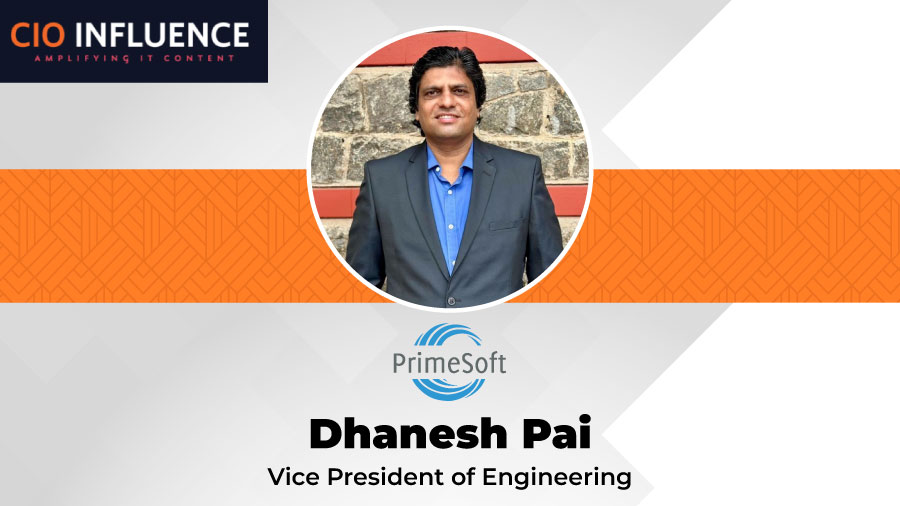
Dhanesh Pai, VP of Engineering at PrimeSoft Solutions, highlights insights about distributed systems, cloud-native applications, AI and ML in financial modeling, cloud and DevOps trends, and more about AI and automation in this quick chat:
———–
Hi Dhanesh, you have extensive experience in Fintech, enterprise applications, and cloud-native solutions. How does your role at PrimeSoft align with these evolving tech trends?
I’ve been fortunate to witness the evolution of fintech and enterprise technology over the past two decades. In my role as VP of Engineering at PrimeSoft, I focus on aligning our work with the latest industry trends across finance and cloud computing. This means guiding our engineering teams to build solutions that are both innovative and grounded in real-world needs. For example, we leverage cloud-native architectures for financial applications, ensuring that our platforms are scalable and agile enough to adapt to new trends. My background in fintech and enterprise software helps me anticipate these shifts and position our projects to take advantage of them. It’s a continuous learning process – staying updated on everything from digital banking innovations to the newest cloud services – and I channel that knowledge into our engineering roadmap.
One key area is fintech’s rapid growth in areas like digital payments, lending, and data analytics. The industry is embracing technologies such as real-time data processing and AI-driven services to enhance customer experiences and manage risk. I ensure that our solutions at PrimeSoft incorporate these advancements. For instance, we design microservices-based financial systems that can handle real-time transactions securely and efficiently. This cloud-native approach not only supports emerging fintech models but also provides the flexibility to integrate with evolving open banking APIs and regulatory requirements.
At the same time, enterprise applications are undergoing a transformation with the move to cloud and service-oriented designs. Organizations are breaking down monolithic legacy systems into distributed, modular services that can be updated quickly. In practice, this means I lead my teams to adopt cloud-native solutions—using containers, Kubernetes orchestration, and DevOps automation—to develop enterprise software. We focus on building robust backend services that can scale on demand and integrate seamlessly with other systems, which is crucial as enterprises increasingly operate in hybrid and multi-cloud environments.
Another critical trend is the heightened emphasis on security and compliance in both fintech and enterprise domains. Given my background in security-focused projects, I’ve instilled a “secure by design” mindset across our engineering teams. This involves integrating strong encryption, access controls, and compliance checks into our systems from the ground up. Fintech solutions handle sensitive financial data, so we align with trends like Zero Trust security models and rigorous data privacy practices.
Also Read: CIO Influence Interview with Gregg Rowe, Chief Channel Officer at Globalgig
You have deep expertise in backend services, distributed systems, and cloud-native applications. What key innovations are driving the future of these technologies?
The future of backend and distributed systems is incredibly exciting – it’s a landscape being shaped by innovations that make systems more scalable, intelligent, and resilient than ever before. One major trend is the evolution of architecture patterns. We’ve moved from monolithic systems to microservices, and now we’re pushing further into serverless computing and event- driven architectures. Serverless platforms allow developers to deploy code without managing the underlying servers, which greatly simplifies scalability.
Another key innovation is the integration of AI and automation into system operations. The rise of AIOps (Artificial Intelligence for IT Operations) is transforming how we manage distributed services. Machine learning algorithms can analyze logs and performance metrics to predict issues before they occur. Predictive capability means fewer outages and smoother performance. When an issue is spotted, automation can trigger healing actions instantly. This level of automated decision-making is a game-changer: systems become self-tuning and self-healing, significantly reducing downtime and operational effort.
Cloud-native innovations are also central to the future of distributed systems. Over the next few years, practically every organization will be leveraging multi-cloud and hybrid cloud environments. Technologies that ensure portability and consistency across clouds, like container orchestration platforms and service meshes, are gaining traction. Service mesh technology improves how microservices communicate securely and reliably, providing built-in security, traffic management, and observability across distributed services.
Security and reliability innovations are pivotal too. Zero Trust security assumes no part of the network is implicitly trustworthy. We’re building systems with this in mind, segmenting services and applying strict authentication. Additionally, practices like chaos engineering and advanced observability are helping manage the health of complex microservices deployments. All these innovations are converging to drive a future where backend systems are highly adaptive, intelligent, and secure.
AI and machine learning are reshaping Fintech. How is PrimeSoft leveraging these advancements, particularly in financial modeling and predictive analytics?
AI and machine learning have indeed become the backbone of modern fintech, and at PrimeSoft, we are actively exploring how these technologies can make financial systems smarter and more predictive. One of our current focus areas is on financial modeling and predictive analytics, where machine learning algorithms can uncover patterns in large volumes of financial data that might otherwise go unnoticed. We are working on building models that can help forecast credit risks, optimize cash flow predictions, and support better investment strategies. These predictive tools are designed to adapt and improve continuously, helping institutions become more proactive and agile in their decision-making.
We are also researching the application of AI in real-time analytics for fraud detection and anomaly recognition. Fintech platforms handle high volumes of transactions, and it’s crucial to spot irregularities as they happen. We are looking into how AI can monitor financial activities in real time and raise alerts for any unusual patterns, enhancing both the speed and accuracy of fraud detection. This shift from reactive to predictive security measures is something we see as transformative for financial institutions.
Another area where we are making progress is in developing tools for predictive analytics in financial markets. These initiatives involve using time-series analysis and deep learning techniques to simulate market behavior, test scenarios, and help financial analysts make informed decisions. Our goal is to support data-driven decisions through intelligent models that can analyze historical market data, news sentiment, and customer behavior trends.
Moreover, we are in the early stages of exploring the potential of generative AI to simplify and enhance user experiences in fintech applications. This could include AI systems that generate clear, human-readable summaries of complex financial insights or assist users through conversational interfaces. While these technologies are still evolving, we see a lot of promise in their ability to personalize financial services and improve accessibility. At PrimeSoft, our approach is to carefully experiment with these tools, focusing on transparency, ethical use, and user empowerment.
Scaling teams for high-growth engineering environments can be challenging. We’d love to hear your approach to hiring, mentoring, and retaining top engineering talent.
Scaling an engineering team isn’t just about hiring more people; it’s about building a strong culture and support system so that talented engineers can thrive. In my experience, the first step is being very thoughtful about hiring. I look for engineers who not only have solid technical skills but also the right mindset – curiosity, adaptability, and a collaborative spirit. In a fast-growing environment, things change quickly, so we need people who are eager to learn and can handle ambiguity. I often say that we hire for potential and cultural fit as much as for current expertise.
Mentoring and coaching are at the heart of my leadership approach, especially as the team scales. I believe in cultivating leaders from within. That means identifying promising engineers early and giving them opportunities to take on more responsibility. We have a culture of knowledge sharing – through code reviews, tech talks, and design sessions – so that everyone grows together. As a leader, I also try to be very accessible. I regularly do one-on-one check-ins with team members to understand their challenges, goals, and feedback.
Retaining top talent, in my view, comes down to creating an environment where engineers feel challenged, valued, and aligned with a vision. Top engineers love to solve hard problems, so I try to make sure our teams are always working on interesting projects with modern tech, rather than getting stuck in a stagnant maintenance mode. Recognition is another key factor: when someone does great work, we make it a point to acknowledge that – sometimes in team meetings, sometimes in company newsletters. Feeling appreciated goes a long way.
Finally, I believe culture and team spirit are what truly keep people together for the long run. We work hard to preserve a supportive, open culture even as the team expands. This involves transparency from leadership and creating a safe environment where anyone can voice ideas or concerns. We also do things to strengthen team bonds – from technical brainstorming sessions to informal activities. When engineers feel they are part of a community that respects and inspires them, they are more likely to stay.
Also Read: CIO Influence Interview with Daniel Spurling, SVP, Product Management at Teradata
What emerging cloud and DevOps trends do you see shaping the next decade of enterprise software?
The next decade of enterprise software is going to be heavily influenced by developments in cloud and DevOps that are happening right now. One major trend is the move towards everything-as- code and automation in the DevOps realm. We’re seeing an expansion of Infrastructure as Code to encompass Platform as Code, Policy as Code, and even “Everything as Code.” This means that every aspect of the IT environment – from network configurations to compliance policies – can be defined in code and thus automated and version-controlled.
Another significant trend is the integration of AI into DevOps – often referred to as AIOps or AI- driven automation. As systems grow more complex, traditional monitoring and manual tuning won’t scale. AI and machine learning are increasingly being used to analyze application performance data, logs, and user patterns to make real-time decisions in operations. Predictive analytics in DevOps can significantly improve reliability by preventing incidents before they happen.
DevSecOps – the blending of security into the DevOps pipeline – is also going to be a defining trend of the next decade. With the frequency of cyber threats and the stringent compliance requirements, security can no longer be an afterthought. It has to be baked in from code commit to deployment. The DevSecOps movement is gaining a lot of momentum, and we’ve integrated tools to perform static code analysis and security testing as part of CI/CD.
Finally, on the cloud side, we will see trends like multi-cloud and FinOps shaping enterprise strategies. Many companies are already using multiple cloud providers to leverage the strengths of each. FinOps (Financial Operations for cloud) is emerging as a practice to address this – bringing together engineering, finance, and management teams to optimize cloud spending. Enterprises will likely have dedicated FinOps teams or tools that ensure their cloud usage is efficient and cost-effective.
Talk about the role of engineering leadership evolving in the age of AI and automation.
The age of AI and automation is fundamentally changing what it means to be an engineering leader. Traditionally, engineering leadership focused on project management, technical guidance, and team coordination. While those remain important, today’s leaders also need to be technology navigators and culture shapers in an AI-driven world. One big shift is that engineering leaders must become champions of AI integration within their teams. As AI tools and automation become available – whether it’s AI-assisted coding tools, automated testing, or intelligent monitoring systems – it’s up to leadership to drive their effective adoption.
Another evolution in leadership is the emphasis on ethics, empathy, and human-centered skills in an automated world. With AI systems making more decisions, sometimes affecting users or business outcomes, engineering leaders have to ensure these systems are used responsibly. I see it as my duty to ask questions like: Are our AI models making fair and unbiased decisions? Are we maintaining user trust and privacy? Leaders today must be conversant not just in tech, but in the ethical implications of tech.
The role of engineering leadership is also evolving to become more of a visionary coach for a blended workforce of humans and AI. We often talk about human-machine collaboration these days. As a leader, I envision part of the team as not just the engineers and designers, but also the automated systems and AI assistants we have in place. Managing this “team” means setting up the right workflows where humans and AI complement each other.
Finally, engineering leadership in the age of automation means continuous learning and adaptability at an unprecedented pace. With AI, the tech landscape is changing so fast that leaders must keep educating themselves and their teams. I actively encourage a mindset of lifelong learning. The leader’s role becomes one of a facilitator for growth, ensuring the team has the resources and time to upskill.
Finally, what’s next for PrimeSoft Solutions? Are any new technologies or innovations on the horizon that you’re particularly excited about?
At PrimeSoft Solutions, we are continuously looking ahead and exploring emerging technologies that will shape the future of our industry. One area we are particularly excited about is the advancement of AI and machine learning. We are actively working on how generative AI and intelligent automation can enhance our financial solutions. This includes experimenting with AI- powered assistants that can support financial analysis by summarizing trends or anomalies in
data. We are also exploring how natural language interfaces can make digital financial tools more accessible and intuitive for end users.
Security remains a top priority for us, and we are researching how Zero Trust architectures and advanced encryption methods can be integrated into our future systems. We are paying close attention to developments in post-quantum cryptography to ensure long-term security for our clients’ data. Our focus is to build solutions that are resilient, trustworthy, and prepared for the evolving threat landscape. These initiatives are part of our commitment to delivering future-ready, secure software.
We are also investigating the intersection of multiple technology domains, such as IoT with fintech and the rise of edge computing. These areas present opportunities to build faster, more responsive systems that operate in real time. We are assessing how real-time financial services can be powered at the edge, especially as 5G and connected devices become more widespread. Another direction we are keeping a close watch on is the space of decentralized finance and blockchain. While still maturing, these technologies may redefine how financial transactions and digital identities are managed.
Lastly, we are focused on improving how we build and deliver software internally. We are implementing hyperautomation across our development processes—from intelligent test automation to smart CI/CD pipelines. These enhancements aim to boost our team’s productivity and product quality, ultimately helping us serve our clients better. What excites us most is not just adopting new technologies, but combining our engineering strengths with these innovations to deliver meaningful, forward-thinking solutions. We see this as a journey of continuous evolution, and we are fully committed to staying ahead of the curve.
[To share your insights with us as part of editorial or sponsored content, please write to psen@itechseries.com]
Dhanesh Pai, Vice President of Engineering at PrimeSoft Solutions, comes with a background in Digital Fintech, Enterprise app development, and Cloud Native solutions, and brings over two decades of expertise in driving impactful projects. Specializing in backend services and cloud-native applications.
PrimeSoft Solutions offers Product Development, Cloud, Quality Assurance and Consulting services to clients from venture-funded startups to publicly traded companies in E-Commerce, Healthcare, Networking, Telecom, and Banking.