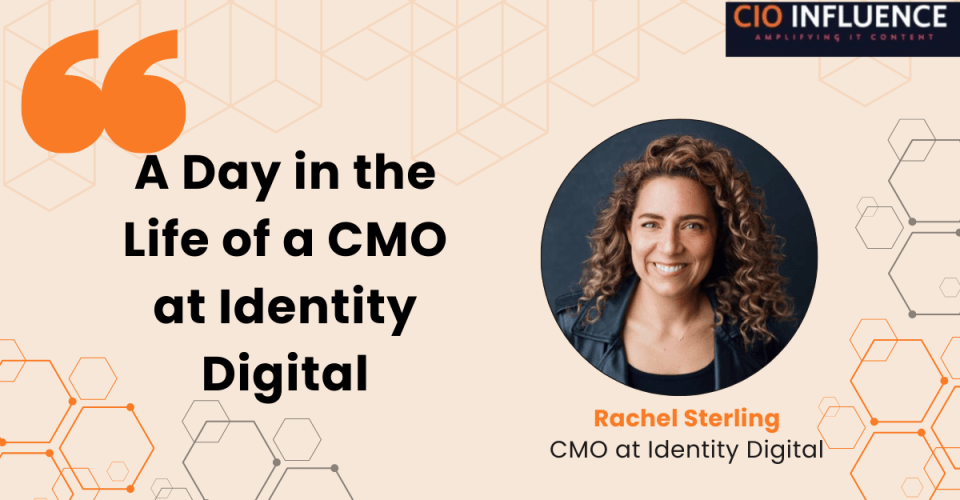
In a world where digital presence defines brand value, identity, technology, and storytelling are the building blocks of lasting connections. Rachel Sterling, Chief Marketing Officer at Identity Digital, operates precisely at this crossroad. With a career rooted in Silicon Valley’s most influential tech companies—Google, Twitter, and Instagram—Rachel brings a wealth of experience in combining data-driven marketing with authentic brand storytelling.
But what does a typical day look like for a CMO steering an organization dedicated to helping brands own their digital identities? And how does a leader like Rachel stay ahead in an era of generative AI, purpose-driven branding, and identity-first digital experiences?
Let’s dive into a comprehensive look at her world.
Also Read: A Day in the Life of an EVP of Global Cyber Operations at DeepWatch
The Early Morning Ritual
Rachel’s day often begins before sunrise. Early mornings are her strategic “quiet hours,” free from meetings and the digital noise that can overwhelm a CMO’s schedule. With a hot coffee in hand, she carves out time to review inbound marketing data—an essential habit she swears by.
“Starting with inbound data offers me a true pulse of how well our messaging, positioning, and value propositions are resonating,” she explains.
Inbound analytics are more than vanity metrics for Rachel; they reveal product-market fit indicators, audience behavior shifts, and the early signs of emerging market trends. Reviewing inbound and outbound campaign effectiveness side-by-side ensures that Rachel doesn’t just respond to market trends—she anticipates them.
Shaping the Brand Trust
At its core, Identity Digital is redefining how brands and individuals manage their online presence. They are not just selling top-level domains (TLDs); they are building the foundation for a new kind of digital authenticity.
Rachel’s leadership role places her right at the center of a conversation happening across industries:
-
How do companies ensure brand trust when consumer skepticism is at an all-time high?
-
How can new digital identifiers (like specific TLDs) enhance brand authenticity in an era of fake news, AI-generated content, and rampant impersonation?
“Driving awareness and adoption of unique domains is a powerful step toward allowing brands to control their own narrative,” she notes.
Rachel frequently collaborates with product development teams, BI analysts, and external researchers to understand not just current market demands but also the psychology behind digital behavior. She believes that trust is the new currency of the digital age—and marketing leaders are its primary custodians.
Mid-Morning
One of the most high-impact periods of Rachel’s day typically falls mid-morning: a 60-minute focus block spent navigating cross-functional alignment.
During these sessions:
-
The finance team shares budget forecasts and financial impact projections.
-
The business intelligence team updates on key KPIs tied to marketing performance.
-
The creative agencies brainstorm how to turn numbers and audience insights into powerful storytelling assets.
These strategic meetings are designed to ensure that every marketing campaign, no matter how creative, is tightly aligned with business outcomes.
“I learned at Twitter that you cannot afford to operate in silos. You need shared metrics of success that everyone believes in,” she emphasizes.
The ability to seamlessly move between creative ideation and data-backed business planning is a hallmark of Rachel’s leadership style.
Also Read: A Day in the Life of a VP Product and Design at IBM Cloud
Long-Term Strategy vs. Rapid Execution
Today’s marketing environment is defined by constant technological upheaval, and nowhere is this more evident than in Rachel’s approach to brand building.
Drawing from her fast-paced experiences at companies like Twitter, she acknowledges an uncomfortable truth:
The internet can both delight and disappoint you instantly. You have to build strategies that are resilient to immediate feedback loops.
For Identity Digital, this means:
-
Real-time tracking of digital trends across platforms like TikTok, Instagram, and emerging Gen Z networks.
-
Deploying AI-powered content intelligence tools to spot early behavioral patterns.
-
Continuous A/B testing of messaging tailored to different digital tribes.
Rachel insists that marketers preferences are secondary.
“What matters is the voice of the customer. Validate everything—every creative direction, every tagline—through both qualitative insights and hard data.”
By weaving agility into Identity Digital’s marketing DNA, she ensures that even long-term brand narratives can adapt at the speed of culture.
Maintaining Creative Alignment Across Global Teams
With Identity Digital’s teams spread across different time zones and regions, Rachel has embraced a hybrid work leadership philosophy grounded in transparency, communication, and empowerment.
To maintain cohesion:
-
She utilizes real-time collaboration platforms like Slack and Asana.
-
She prioritizes weekly team syncs where cross-functional updates and ideation sessions happen without hierarchy.
-
Clear brand playbooks and content guidelines ensure that every regional team understands the brand voice while still allowing for localized creativity.
“Hybrid work demands intentional leadership,” Rachel shares. “You have to over-communicate the vision and under-manage the process.”
In doing so, Rachel ensures that Identity Digital’s marketing engine remains agile, innovative, and globally synchronized.
Inspiration in the Everyday
Despite operating in a high-pressure environment, Rachel finds daily inspiration from the creativity and community that the digital world fosters.
“It’s easy to criticize social media,” she says, “but it’s also one of the most creative ecosystems we’ve ever built as a society.”
Seeing grassroots brand building, viral storytelling, and identity innovation across platforms fuels her passion for making digital identity more authentic and accessible.
Rachel believes that content democratization—where anyone can be a creator, a brand, or a thought leader—underscores why digital identifiers matter more than ever. In a noisy, saturated internet, owning your name, your identity, your brand narrative is paramount.
Leadership Philosophy
The CMO seat comes with intense performance demands: ROI targets, CAC optimization, attribution modeling, and endless competition for attention.
Rachel combats this pressure by:
-
Setting clear and actionable goals for her team.
-
Creating a culture where small wins are celebrated just as much as major milestones.
-
Prioritizing mental clarity through mindfulness techniques and protecting focus time.
-
Investing in team bonding activities that humanize remote work experiences.
“A happy team is a high-performing team,” she says, quoting advice from one of her early mentors at Google.
By focusing on sustainable performance, Rachel ensures her team doesn’t just survive the marketing grind—they thrive within it.
Also Read: A Day in the Life of a VP & CISO at Zscaler
Looking Ahead: The Future of Marketing in a Generative AI World
Rachel is acutely aware that the convergence of generative AI and identity innovation is going to reshape the marketing landscape dramatically over the next 5 years.
Emerging trends she is closely tracking:
-
Descriptive domains (.live, .social, .tech) are becoming mainstream identifiers for personal and brand storytelling.
-
AI-generated search results are transforming SEO strategies from keyword stuffing to narrative-building through domain identity.
-
Personalized online identities acting as “narrative anchors” for brands looking to break through digital noise.
Just as hashtags redefined how we organize conversations, descriptive domains are poised to redefine how we express identity in the digital economy
Rachel’s vision for Identity Digital is clear: to empower brands and individuals alike to own their story, control their narrative, and build unshakeable trust in an increasingly decentralized internet.