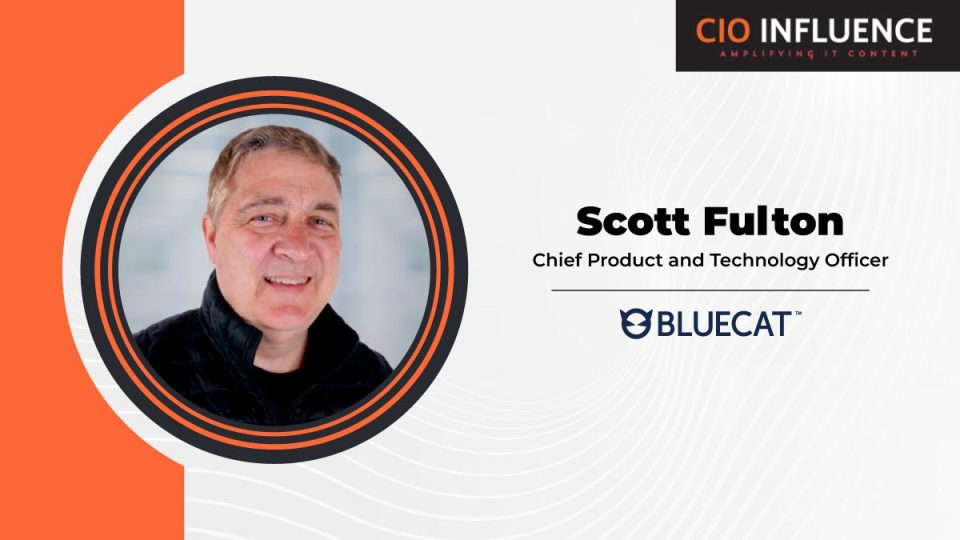
Scott Fulton, Chief Product and Technology Officer, BlueCat highlights the growing benefits of cloud-first, hybrid environments and how IT infrastructure teams should optimize better for a cloud-first future in this CIO Interview:
_________
Hi Scott, tell us about yourself and a little about BlueCat’s journey over the years?
I’ve spent more than 25 years in product management and engineering leadership. Prior to BlueCat, I founded OpsCruise, a startup that built a patented observability SaaS product that focused on troubleshooting performance and security issues in cloud native applications for Fortune 500 customers. Before that I had executive roles at Infoblox, BladeLogic, BMC Software, and Hewlett-Packard. I’ve worked on everything from ITSM platforms to networking software and cybersecurity.
I focus on turning operational challenges into strategic advantages. Early on, I saw how fragmented infrastructure can create a gulf between a company’s ambitions and its ability to deliver on them. Real growth and transformation at scale happen when business priorities are connected to deep technical insight.
Networks aren’t just plumbing. They’re strategic assets. That’s what brought me to BlueCat. It started as a scrappy Canadian startup focused on DNS, DHCP, and IP address management (together known as DDI). It’s not glamorous, but it’s essential. When core network services fail, everything above them fails. BlueCat used DDI to solve network challenges that others overlook. That approach guided BlueCat, creating steady, disciplined growth.
Today, we support more than 2,000 global customers. We give organizations the visibility, control, and intelligence they need to change, monitor, and secure their networks with confidence. As cloud and AI adoption accelerate, that foundation or core network services has become even more strategic.
We’d love the top highlights and benefits of BlueCat’s latest launch, BlueCat Horizon.
We built Horizon around a pattern that everyone can spot. Networks are more distributed and more critical than ever. But operations remain fragmented.
CIOs manage hybrid environments across data centers, multiple clouds, SaaS, edge, and AI workloads. But network, security, and cloud teams operate in silos without shared context. Further, one team might be responsible for monitoring, another for IPAM and a third for configuration management. That slows decision-making and increases risk.
Horizon offers a shared control plane with a unified data layer. Instead of network discovery, automation, observability, and remediation operating independently, they share common platform services. We make it easier to coordinate action. Horizon unifies insight and enforcement to reduce response times.
There are a few key takeaways:
1. Modernization shouldn’t mean disruption
No one wants to rip and replace their core network services. Layer orchestration and governance over existing infrastructure, including legacy and cloud-native environments. Enable evolution without disrupting operations.
2. Observability must move beyond dashboards
More telemetry is only part of the problem. Correlating network signals with ownership, location, and service criticality allows teams to connect incidents directly to business impact and prioritize accordingly.
3. Security response must be closed loop
Exposure lurks in the gap between detection and enforcement. Pairing DNS threat intelligence with automated containment and policy-driven controls reduces response times, particularly in highly regulated environments.
We see a shift toward Intelligent NetOps: moving from reactive, ticket-driven processes to policy-based automation and, over time, self-healing systems. For CIOs, the real benefit isn’t a new tool. It’s the operational confidence to innovate.
How are cloud-first, hybrid environments making everyday operations easier for IT and network teams?
They can make operations easier, but they need the right architecture. Here are four things CIOs should do to simplify operations:
1. Focus on decision intelligence, not just data
Hybrid environments generate a massive amount of telemetry. You don’t need more alerts. You need to correlate signals across environments so you can identify root causes faster. You need AI-assisted analytics that compress hours of investigation into minutes.
2. Design for adaptability, not just uptime
Resilient organizations are the ones that can make controlled changes quickly and safely. You need policy-driven automation and centralized governance to reduce the risk of cloud migrations, AI initiatives, acquisitions, and regulatory changes.
3. Use cloud-managed delivery where scale matters
LLM-powered analytics and real-time correlation require cloud-scale processing. Shifting to a continuous delivery model removes the burden of upgrades and appliance management and frees your team to focus on higher-value work.
4. Simplify before you automate
If every new environment adds another silo, automation accelerates complexity. Improve operations by unifying visibility and governance. Simplified architectures are easier to debug and more resilient.
When done right, cloud-first strategies provide clarity, speed, and flexibility rather than additional noise.
Also Read: CIO Influence Interview With Jake Mosey, Chief Product Officer at Recast
What are some of the foremost networking challenges modern IT teams need to brace for?
Fragmentation across hybrid and multicloud environments
Many organizations still rely on siloed DDI systems and disconnected tools. In recent research, more than a quarter identified fragmentation and too many management tools as their biggest operational barrier. You need a unified source of truth. Without it, troubleshooting slows and risk compounds.
Manual processes that don’t scale
Manual change workflows are killing productivity. DNS changes can take one to two days. DHCP changes can take hours. And nearly 60 percent of outages are attributed to human error. Teams cannot keep pace without intelligent automation.
Complexity as operational risk
Layering tools and scripts without simplifying your architecture creates complexity and fragility. That complexity can lead to outages and longer recovery times. Reduce technical debt, eliminate inconsistent configurations, and shrink your maintenance overhead.
DNS as a security attack surface
DNS is a primary vector for data exfiltration and command-and-control activity. Scattered logging, inconsistent access controls, and weak change management make compliance difficult and put your network at risk. Treat core network services as security infrastructure.
The shift from uptime to adaptability
The old metric was “no outages.” The new metric is safe, rapid change. Organizations must enable infrastructure to adapt without disrupting operations. Teams that modernize visibility, automation, and governance at the foundational layer can support AI and multicloud strategies without increasing risk.
What trends will shape the future of IT and networking teams?
Foundational infrastructure becomes a board-level concern
Core services like DNS and IP management are directly tied to business risk and resilience. Leadership teams have connected the dots and will demand stronger governance of core services.
Observability becomes AI-driven diagnosis
Alerts are worthless without insight. Observability needs to correlate signals across environments and surface likely root causes, shifting engineers from chasing symptoms to validating recommendations.
Automation becomes governed, not autonomous
Totally removing humans from the loop isn’t realistic. The model to mimic is human-in-the-loop automation, where people have authority over important decisions. Balance speed with accountability.
AI literacy becomes foundational
Infrastructure teams will need shared AI fluency and governance guardrails to ensure innovation doesn’t outpace security or governance.
Success will be measured not just by uptime, but by how confidently infrastructure adapts to constant change.
What thoughts would you share with CIOs?
Prioritize AI governance now. Adoption is accelerating, and guardrails must keep pace with innovation.
Second, don’t separate AI strategy from network modernization. AI increases data movement and unpredictability. Strengthening the network foundation must happen in parallel.
Third, focus on identity and control. Zero Trust is becoming practical. Strong authentication, tighter DNS controls, and unified visibility will define resilient organizations.
Innovation only moves as fast as the foundation allows. Strengthen the core, govern AI wisely, and you will shrink the gulf between your ambitions and your ability to realize them.
Catch more CIO Insights: Why CIOs are becoming chief risk orchestrators?
[To share your insights with us, please write to psen@itechseries.com ]
BlueCat’s Intelligent Network Operations (NetOps) provides the analytics and intelligence needed to change, monitor, secure, automate, and self-heal network infrastructure in support of business goals. The Intelligent NetOps portfolio provides key foundational technologies, including unified core network services, multicloud management, security, and network observability and intelligence solutions with AI-enabled analytics to reduce alert fatigue, help network teams determine root causes, and enable faster decision-making.
Scott joined BlueCat as Chief Product and Technology Officer in 2024. He drives innovation and oversees BlueCat’s product management, user experience, and engineering teams. Scott brings more than 25 years of enterprise software product management and engineering leadership experience, most recently as founder and CEO of cloud observability start-up OpsCruise.