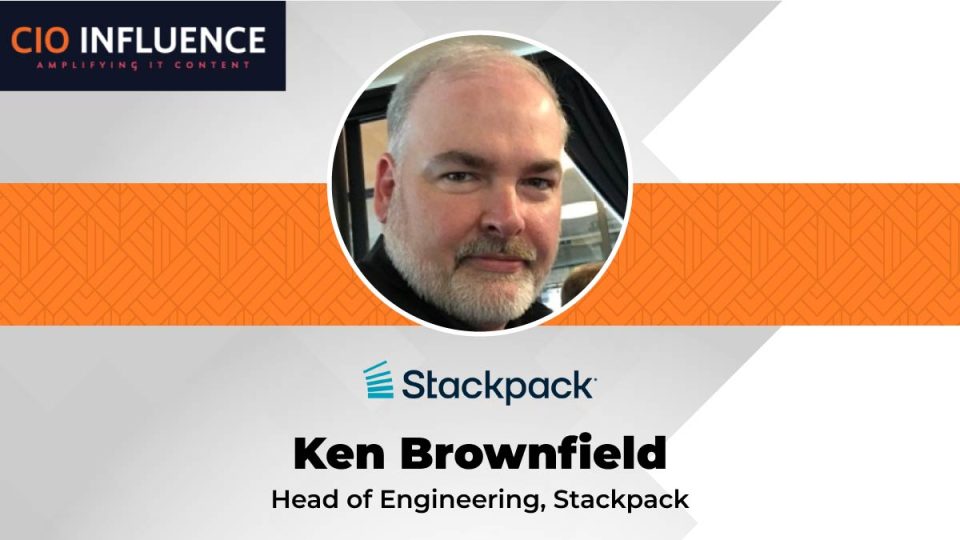
Ken Brownfield, Head of Engineering at Stackpack talks about the future of SaaS and vendor management in this catch up with CIO Influence:
_____________
Hi Ken, tell us about Stackpack and the platform’s journey so far?
Stackpack was born from the idea that bringing people closer to the ultimate value of their software & service vendors, and the companies who are behind those vendors, will dramatically reduce corporate spend and overhead, and bring increased value for these investments.
Our journey started by addressing the pervasive visibility gap of vendor spend, where most teams don’t know what they’re actually spending on software until it’s too late. Our platform now enables finance, operations, and IT leaders to not just track spend, but to actively manage it. From contract renewals to vendor consolidation, we’re reducing the manual overhead tied to managing complex SaaS environments and maximizing the ROI of these investments.
Also Read: CIO Influence Interview with Duncan Greatwood, CEO at Xage Security
What are some of the challenges IT and finance teams face when it comes to SaaS vendor management?
One of the largest issues is the fragmentation of ownership, tracking, and documentation. Spend data lives in finance tools, usage data lives in IT systems, and contract terms live in someone’s inbox. That disconnect makes it hard to make informed decisions – whether it’s about renewals, budget forecasting, or vendor consolidation. For IT in particular, tracking details about the broad range of vendors with a large organization has historically been nearly impossible: IT needs to maintain the provisioning and security of an array of software solutions that fall well outside its experience.
Another challenge is the lack of shared accountability between teams. Finance might want to cut costs, while IT wants to maintain stability. Without a unified system or single source of truth, priorities often clash with no means of resolution.
A unified platform that can give these teams adequate data in real time to help manage vendor and IT contract costs is essential in today’s tech-driven environment. Yet, when trying to build processes around this, most IT teams still face drawbacks. Can you highlight more on this?
Absolutely. Even when teams have tools in place, they often lack actionable insights. You might know what tools are in use, but not who’s using them, or most importantly whether they’re being used effectively. Many IT teams also rely on manual workflows: spreadsheets for tracking renewals, Slack messages for approvals, endless back-and-forth during budgeting season.
They’re also reliant on the disparate documentation and tracking systems that may exist across all of the relevant departments in the organization. These manual processes introduce risk-missed renewals, unnecessary renewals, and wasted time. Without a platform to centralize both knowledge and evaluation, these processes inevitably break down without providing any true value to the company.
How are AI-powered platforms enabling finance and IT teams to better optimize these processes?
AI’s real strength isn’t just automation – it’s context. For example, AI can flag under-utilized tools before renewals hit, suggest contract renegotiation opportunities based on usage patterns, or forecast spend across all departments using historical behavior. Instead of being reactive after chaos has already set in, finance and IT can become proactive, guiding process and efficient value from the beginning – instead of being surprised by a ballooning SaaS bill over the last quarter, teams get nudges and predictions they can act on early-before it’s too late.
How can IT and other teams reduce the problem of redundant tools more effectively today?
Start with visibility – you can’t cut what you don’t know exists. Once you have a clear map of tools by usage, owner, spend, and terms, the next step is driving alignment across teams. Sometimes what looks redundant to finance is critical for a specific workflow in engineering. The goal isn’t just to reduce spend – it’s to rationalize based on value. Rationalizing the big picture requires a unified and informed top-down view. One quick win we’ve seen: auto-flagging tools with overlapping functionality and facilitating conversations directly between solution owners.
A few thoughts on how the future of IT will shape up as new evolving tools are impacting how IT typically functions?
IT organizations of the future won’t just be at break/fix service desks or implementing an endless queue of new SaaS solutions. IT can become a strategic enabler of efficiency, innovation, and enablement. As AI and automation take over repetitive workflows, IT teams must focus more on governance, vendor strategy, and cross-functional enablement. And they need to be empowered with the information they need to fully empower the company to quickly and efficiently adopt new technology-particularly AI. To become empowered, they need tools that work as a bridge built on data and curated decision-making, enabling the adoption of tech stacks that not only work, but drive measurable ROI.
Catch more CIO Insights: The CIO’s Role In Data Democracy: Empowering Teams Without Losing Control
[To share your insights with us, please write to psen@itechseries.com ]
Stackpack is a platform purpose-built for vendor intelligence – giving finance, operations, and IT teams the clarity, control, and automation they need to eliminate wasted spend, drive ROI, and scale their business without extra headcount.
Ken Brownfield is Head of Engineering at Stackpack, bringing over 25 years of experience designing and scaling enterprise software architecture. He’s built high-performing technical teams across startups, acquisitions, IPOs, and Fortune 500 environments.