

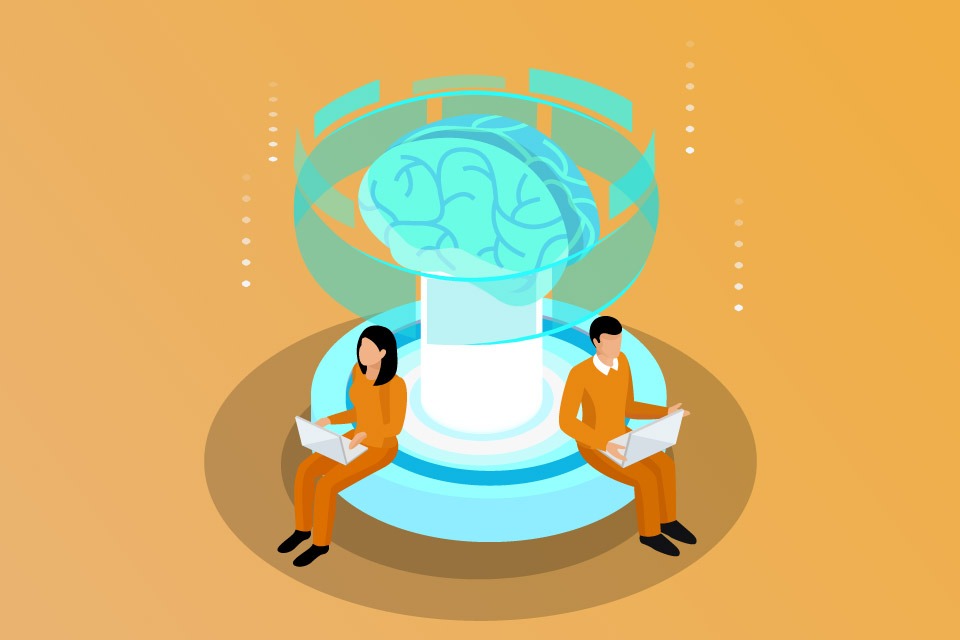
From traditional IT leaders, CIOs must transition into cognitive CIOs, who know to integrate strategic leadership with AI and digital transformation. CIOs who embrace this new shift and participate in Gen AI growth are likely to experience 79% success rate leading digital transformation.
Generative AI isn’t a mere tool for organizations; it is the core to IT leadership. And to ensure your organization treads through the way, the CIO must take the lead. We understand the race to drive growth with generative AI is fierce, but the success is interlinked with the involvement of CIOs in the digital decisions.
Hence, it is time to CIOs to reshape their traditional role to the one with cognitive powers, wherein they build systems that think, leader, and adapt. While traditional CIOs have long been tasked with maintaining infrastructure and aligning IT with business goals, today’s Cognitive CIO is a hybrid. They are not just technologists, but strategists, storytellers, and system thinkers who understand how generative AI transforms enterprise DNA.
Also Read: CIO Influence Interview with Ev Kontsevoy, CEO at Teleport
Generative AI: a core to your IT leadership
The difference in 2025 is stark. Generative AI is not just another software upgrade or automation toolkit. It creates, iterates, predicts, and personalizes in real time. From co-pilots in developer environments to dynamic content generation in marketing, GenAI has moved beyond hype and is now at the core of enterprise strategy.
According to McKinsey’s Global Survey on AI, 65% of companies that adopted generative AI at scale saw a significant impact on their bottom line within 12 months. This demonstrates the growing expectation for CIOs to architect intelligent systems that evolve and learn.
Understanding the role of Cognitive CIO
The Cognitive CIO is the one carrying a distinct mindset. They lead not only with knowledge of technology but also with AI fluency, adaptive leadership, and a vision for dynamic systems.
What makes a CIO “Cognitive”?
- Systems Thinking: They see the enterprise as an interconnected network and establishes collaboration within data, people, and machines.
- AI Fluency: They understand not only how AI works but also to ethically implement, govern, and scale it.
- Adaptive Leadership: They are responsive to change, iterative in planning, and lead by co-creation instead of command.
Focus Areas of the Cognitive CIO
Data Contextualization: Data is only as useful as the context applied to it. The Cognitive CIO ensures that generative AI tools are trained not just on broad models but on enterprise-specific data, delivering relevance and precision.
Human-Machine Collaboration: They foster symbiotic systems where humans are augmented by machines, not replaced. Whether it’s pairing knowledge workers with AI assistants or enabling DevOps teams with GenAI observability, they build systems that elevate human capabilities.
Pattern Recognition: With GenAI and ML tools, Cognitive CIOs move from hindsight to foresight. By leveraging AI’s ability to identify anomalies and trends across massive datasets, they improve strategic decisions, security posture, and operational efficiency.
From command-and-control to co-create-and-adapt
In legacy IT models, the CIO was a controller of technology. In today’s reality, Cognitive CIOs are orchestrators of innovation. They empower cross-functional teams to experiment, innovate, and scale AI initiatives across functions.
The best example is of Johnson & Johnson, where CIO Jim Swanson is pioneering a cognitive enterprise model by embedding AI across supply chain and R&D workflows, boosting not just efficiency but new product development timelines.
Embedding GenAI across IT operations
- Enhanced Observability & Incident Response: Tools like Dynatrace Davis AI and Splunk AI Ops can help CIOs move from reactive to predictive IT management. Cognitive CIOs can use GenAI to generate root cause analyses, reduce MTTR (mean time to repair), and forecast system anomalies before they occur.
- Workflow Redefinition: In application development, embedded GenAI tools such as GitHub Copilot and SAP Joule help reduce development cycles and enhance productivity by auto-suggesting code, automating documentation, and enabling rapid prototyping.
Governance, Ethics, and Trust
We must not forget that with great power comes great responsibility. Hence, CIOs must ensure that AI models are transparent, explainable, and fair, which means:
- Building ethical AI review boards
- Ensuring data diversity in training sets
- Tracking data lineage and model drift
- Complying with evolving AI regulations (like the EU AI Act)
Remember that trust is the foundational pillar in a cognitive enterprise.
How CIOs can build a future-ready enterprise
Culture is just as critical as code. The Cognitive CIO must invest in:
- Upskilling programs for AI literacy across all levels
- Fusion teams, where business and tech work in unison
- Change management strategies that prioritize collaboration over resistance
They are building IT organizations that are not only tech-savvy but resilient, inclusive, and curious as well.
The Cognitive CIO doesn’t just manage change but enable systems that think, learn, and adapt. As generative AI continues to reshape what’s possible, the CIO’s role is no longer confined to delivering uptime or overseeing digital transformation.
Catch more CIO Insights: Why the Next CIOs Will Be ‘ModelOps’ Architects
[To share your insights with us, please write to psen@itechseries.com ]
