

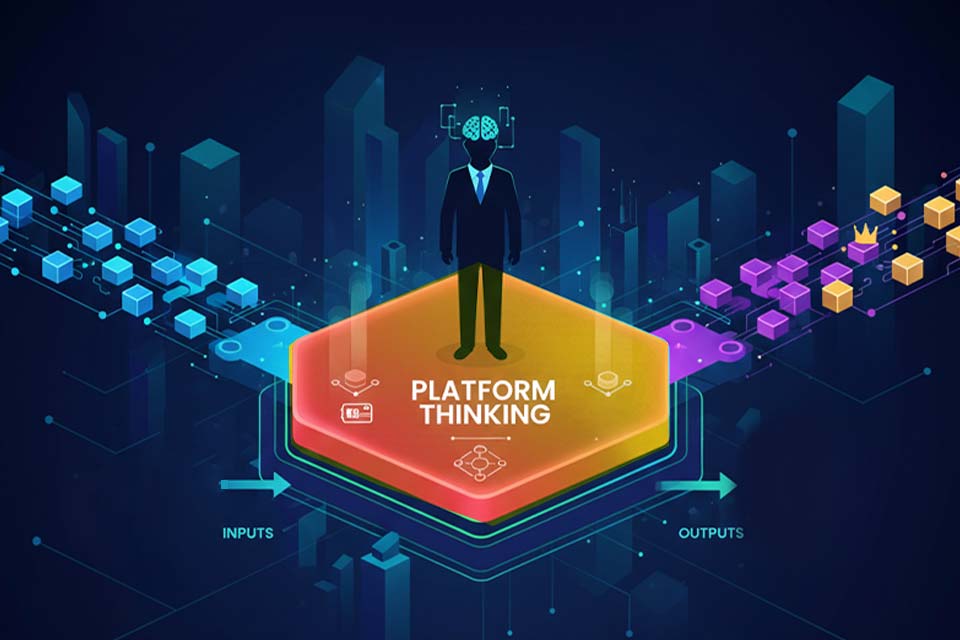
The traditional view of a corporation as a linear, top-down hierarchy is fading in today’s economy. We are seeing a major change in the structure of organizations. They are no longer just places where goods or services are made; they are now complex, interconnected platforms.
In this “Enterprise as a Platform” model, a digital architecture takes the place of the physical walls that separate departments. This makes it easy for data, intelligence, and value to flow freely between them. This change means that CIOs need to completely rethink their role in the C-suite. They are going from the back office to the head of the company’s economic strategy.
You can see this change most clearly in how internal technology ecosystems now look like digital marketplaces. Instead of getting software deployments that are strict and come from the top down, business units can “consume” capabilities from a central hub. In this setting, the relationship between IT and the business has changed completely: internal users are now seen as important customers instead of just “support tickets.” This change makes sure that technology delivery is quick, flexible, and in line with the changing needs of the company’s different value streams.
The main idea behind this new way of thinking is to stop seeing systems as “projects” and start seeing them as “products.” Projects have a set end date and are only meant to deliver one thing. Products, on the other hand, are long-lasting and change over time, so they need to be constantly improved based on user feedback and performance data. This means that CIOs have to keep track of a collection of digital assets that must always have value that can be measured. In this context, CIOs are no longer just keeping the lights on; they are the architects of the company’s internal economy, making sure that every digital interaction helps the company as a whole.
As the people who run these platform-based ecosystems, CIOs‘ economic roles are growing at an unprecedented rate. Now, they are in charge of the “unit economics” of digital services, which means they have to find a balance between the cost of computing, the speed of delivery, and the return on investment of integrated AI agents. This is different from how IT leaders used to be judged. In 2026, CIOs will be judged more on how well they can drive fast execution and agility across the whole company.
The main idea of the modern age is clear: CIOs are no longer in charge of infrastructure; they are platform economists who help businesses create value. CIOs are laying the groundwork for the next wave of business growth by creating an environment where technology is a shared, scalable resource. The future belongs to companies that can think quickly and act with the accuracy of a global marketplace. Tech leaders who know that in a platform world, speed and strategy are the same thing will lead these companies.
The change from an IT department that focuses on services to one that focuses on platforms is a big change in how businesses think about themselves. This change means that CIOs need to stop thinking of themselves as “order-takers” and start leading in a more strategic, product-focused way.
When Internal Systems Work Like Products
The first step in this change is to understand that the software and services that employees use are not just tools; they are also products. Managing internal systems in a platform business is just as important as managing customer-facing apps. These systems include data lakes, API gateways, workflow engines, and localized AI services.
What are Internal Platforms?
Internal platforms are the basic building blocks that let different parts of a business create and use their own solutions. CIOs give users a single data platform instead of making a new database for each request. These platforms provide a reliable, safe, and scalable infrastructure where APIs and AI services are available on demand, which lets the organization move much faster.
Using Product Lifecycle Thinking on Internal Systems
People often stop working on a system once the “go-live” date has passed if they treat it like a project. But if you think about the product lifecycle, you will always take care of your internal tools. CIOs need to make sure that these systems are always being improved, changed, and updated. A product doesn’t just stop working; it changes depending on how the business uses it.
SLAs, User Experience, and Roadmap Management
Service Level Agreements (SLAs) are needed for internal products to make sure they are always up and running and working well. Also, the user experience (UX) of an internal tool is just as important as that of a store website. If it’s hard to use an AI service inside the company, people won’t use it. CIOs are now in charge of keeping clear roadmaps so that every department knows exactly when new features will be available.
How to Measure Adoption, Engagement, and Satisfaction?
CIOs are no longer judged on whether a project was “on time and under budget.” Adoption and engagement are now the main goals. Are employees really using the internal data platform? Do the developers who use the internal APIs seem to be happy with them? These metrics show whether the platform is really adding value.
Viewing Stakeholders as Users of the Platform
In this new model, developers, business units, and outside partners are seen as “customers” of the platform. This change in thinking pushes CIOs to make tools that are easy to use and don’t need help. When a business unit can “subscribe” to a workflow engine without having to hire IT for a month-long consulting job, the whole company becomes more flexible.
Why IT Should Handle Product Management?
The IT department is now fully responsible for the discipline of product management, which is the art of balancing technical feasibility, business viability, and user desirability. CIOs make sure that the technology they build is actually useful by hiring or training internal product managers. This stops the “ivory tower” effect, which happens when IT makes complicated systems that no one in the business knows how to use.
What CIOs Should Know About Platform Thinking
The tech leader’s job changes a lot when the company moves to a platform-centric model. CIOs are changing from being the people who give businesses specific, isolated solutions to being the people who design a wider ecosystem of capabilities.
-
From Getting Projects Done to Making Things That Can Be Used Again
The old IT model was based on “bespoke” projects, which were one-time fixes for specific problems. Modern CIOs know that this is not a good use of time. Instead, they work on making capabilities that can be used again and again. The platform has one high-quality notification API that all departments can use if a team needs a notification system. This “build once, use many” method cuts down on technical debt by a lot.
-
Making shared services instead of custom solutions
Custom solutions make silos. Synergy comes from shared services. CIOs make sure that data and logic aren’t stuck in one department by putting shared services first. For instance, sales, support, and marketing can all use a shared AI-powered customer summary service at the same time, making sure that the whole organization has a “single source of truth.”
-
API-First Architecture and Composability
The idea behind a platform enterprise is composability, which means being able to snap together different digital parts to make something new that is worth more. This is pushed by CIOs who require an API-first architecture. When all of an organization’s internal services are available through an API, it can change direction almost instantly by putting together new workflows from existing building blocks instead of starting from scratch.
-
Encouraging Participation in the Ecosystem
The people who use a platform make it strong. CIOs who think ahead encourage different departments to give back to the platform. If the marketing team makes a one-of-a-kind data visualization tool, it should be added to the main platform so that other people can use it. This makes for a culture of “inner-sourcing,” where everyone in the company works together on the digital infrastructure.
-
Optionality and Modularity as Strategic Assets
Being able to change direction in a market that is always changing is a competitive edge. CIOs give the company “strategic optionality” by using modularity, which means breaking big systems into smaller, separate modules. A modular architecture lets CIOs replace an AI model or vendor that isn’t working for the business anymore without shutting down the whole company.
-
Capability Orchestrators, Not Service Providers
In the end, the job has changed from a “service provider” who waits for a ticket to a “orchestrator” who builds the stage. The data and intelligence of the company now have a “gravitational pull” that CIOs are in charge of. They set the rules, the standards, and the infrastructure that let everyone else in the company come up with new ideas safely and on a large scale.
The Platform CIO’s Financial Mindset
This change also calls for a change in how you think about money. CIOs are now economists for platforms. They need to know how much their APIs cost per unit and how much their services cost to use within the company. CIOs can show a direct link between the health of the architecture and the company’s bottom line by treating IT as a value-generating platform instead of a cost center.
The New Mandate
As the business becomes a platform, CIOs who are able to deal with the complexity of a multipolar digital world will be the ones who do well. They will be the ones who stop fighting against the “shadow IT” of the past and instead build a platform that is so powerful, easy to use, and dependable that the business wouldn’t think of building it anywhere else.
In this new era, the CIOs are in charge of making sure that the business stays flexible by making sure that every line of code and every byte of data supports the organization’s larger goals.
In the age of AI, moving from linear infrastructure to platform-based logic isn’t just a technical upgrade; it’s a complete rethinking of how businesses handle money and distribute work. As CIOs work toward becoming platform economists, they need to learn about the different cost curves and internal market dynamics that make up a modern business.
The Cost Structure of Businesses on Platforms
The idea behind traditional IT finance was to spend money on capital expenditures (CapEx) for certain projects. You bought hardware, made software for one purpose, and then let the asset lose value over time. In a platform business, the way money works changes to a “fixed cost for infinite scale” model.
-
Fixed vs. Marginal Cost in Platform Environments
Building a core capability, like a centralized identity management system or a high-performance data lake, costs a lot of money at first in a platform model. This is a high fixed cost. However, once the platform is up and running, it costs almost nothing to add a new user or application. This is the holy grail of efficiency for CIOs: separating the growth of the business from the growth of the IT budget.
-
High Upfront Investment, Low Incremental Scaling
This “front-loaded” investment can be hard to sell in businesses that work on a quarterly cycle. CIOs need to teach the board about the long-term benefits of this curve. The first six months of building a platform may look like a lot of money spent with little to show for it, but in the years that follow, it can grow quickly in ways that legacy systems could never do without hiring more people and buying more hardware.
-
Economies of Reuse and Shared Infrastructure
The platform’s real money-making power comes from reuse. The marketing department and the logistics team can use the same communication API, which saves the company money on an extra vendor contract. CIOs get rid of the “silo tax” by combining shared infrastructure. This is the hidden cost of paying for the same feature in different departments.
-
Cost of Integration vs. Cost of Duplication
Companies are often afraid of how “complicated” integration can be, so they choose a “fast” duplicate solution for a new project instead. CIOs know that copying things is like taking out a loan with a high interest rate. Integrating with a central platform might take longer on the first day, but it saves money in the long run by getting rid of the costs of keeping separate data sets and security protocols.
-
Technical Debt as a Cumulative Economic Burden
In a world of platforms, technical debt is seen as a debt on the balance sheet. Old code that doesn’t work with the platform’s APIs is like “economic drag,” which makes every new project take longer to finish. Successful CIOs put “debt refinancing” at the top of their list. This means systematically replacing fragile, isolated systems with modular platform components to free up “innovation capital.”
-
Platform ROI compared to Traditional Project ROI
To figure out a platform’s ROI, you need to look at it from a different angle. Traditional project ROI looks at how one tool directly helps the project. Platform ROI, on the other hand, adds up. It includes the “saved costs” of future projects and the “speed-to-market” value that comes from a new product coming out in weeks instead of months. The “Innovation Velocity” of the whole organization becomes the main KPI for CIOs.
Internal Marketplaces and Service Catalogs
Section IV talks about how the platform gets money, and Section V talks about how it is used. A platform needs to change from a “push” delivery model to a “pull” model, where business units “shop” for the features they need, in order to be successful.
-
Service Catalogs and Enterprise App Stores
The modern IT portal should look more like an app store for consumers than a ticketing system. CIOs are now using internal service catalogs that let managers look through AI models, data visualization tools, and security protocols that are available. This “commercialization” of internal IT makes the platform’s value clear and easy to find for everyone in the business.
-
Self-Service Infrastructure and Developer Portals
Waiting for a person to provide a resource is the biggest roadblock to innovation. Self-service is required in a platform business. Developer portals let engineers create sandboxes, use APIs, and deploy code without having to ask for permission. CIOs use these portals to enforce standards through “golden paths,” which are templates that have already been approved, and make sure that every new project is secure and compliant by default.
-
Usage-Based Chargeback Models
To hold people accountable, a lot of CIOs are putting internal chargeback models into place. If a department uses a lot of GPU compute for an AI experiment that doesn’t cost much, the cost will show up in their own budget. This is similar to how cloud providers charge, and it makes business leaders see IT resources as limited economic assets instead of a “all-you-can-eat” buffet.
-
Transparent Consumption Metrics
An internal market needs to be open and honest. CIOs encourage a culture of efficiency by giving each department real-time dashboards that show how much they are using and how much it costs. When a department head realizes that their “legacy data storage” is costing them more than a new cloud solution, they become the biggest supporters of digital transformation.
-
Incentivizing Reuse over Reinvention
Many teams will try to “re-invent the wheel” to meet their own needs if they are left to their own devices. CIOs need to set up reward systems that encourage reuse. This could mean “fast-track” approval processes for projects that use 80% or more platform-standard components, or “innovation credits” for teams that give their own tools back to the central catalog.
-
Creating Supply-and-Demand Dynamics
CIOs can better control the “supply” of technical resources by treating IT like a market. If a certain internal AI service is in high demand, it tells the CIO that they need to put more money into that area. On the other hand, if a “mandatory” legacy system has no internal demand, it gives you the proof you need to finally shut it down.
Also Read: CIO Influence Interview With Jake Mosey, Chief Product Officer at Recast
The Platform as a Plan
The business becomes a living thing when economic logic and marketplace distribution come together. CIOs who know these two areas well are not just in charge of technology; they are also in charge of creating the “operating system” for businesses in the 21st century. They are making sure that the business not only survives the age of AI but also thrives by having the best innovation engine in its field, which is the most efficient, scalable, and user-friendly.
In this situation, the CIOs are the only people who can connect the technical and the financial sides of things. This shows that a well-designed platform is the most valuable thing a company can own.
In the age of AI, the last step in changing a platform isn’t technical; it’s cultural and structural. For CIOs, moving to a platform economy means completely rewriting the company’s social contract. If the platform is the market, then the rule of law is the government, and the community that makes that market work is the organizational structure.
Running Platform Economies
People used to think of governance as the “department of No,” a set of rules that made things take longer in the name of safety. In a platform business, CIOs need to change the name of governance to “the department of How.” It’s not about stopping people from moving anymore; it’s about giving them safe, high-speed rails to move on.
Guardrails vs. Gatekeeping
The old way of gatekeeping meant that every little change had to be looked over by hand and approved by a bureaucrat. Automated guardrails take the place of these gates in modern CIOs. The “rules” are enforced by code, not by meetings, because security and compliance checks are built right into the platform’s CI/CD pipelines. This lets teams come up with new ideas on the edge while the platform makes sure they don’t accidentally break the law or put security at risk.
Standards, APIs, and Principles of Architecture
A platform only works if everyone understands the same language. CIOs need to set the “Gold Standards” for the business by making it clear which APIs, data formats, and architectural principles are not up for debate. These standards shouldn’t be too strict. Instead, they should be seen as universal adapters that let different business units connect to each other’s value streams without having to do any custom engineering.
Platform Scale Security and Compliance
Security is a nightmare with a thousand holes in a fragmented business. Centralized security is a key part of a platform business. When CIOs protect the platform, they protect everything that runs on it. If a new vulnerability is found, it can be fixed once at the platform level, which protects every “product” in the catalog right away. This is called “security by design.”
Identity and Access Management (IAM) as Economic Control
IAM is the way to build trust in a platform economy. It tells you who can “spend” resources, who can get to “data products,” and who can start “agentic AI” workflows. CIOs use advanced IAM protocols to keep track of the movement of digital assets. By making identity a strategic control point, they keep the internal marketplace safe while also making it easy for departments to share information.
-
Governance that Makes New Ideas Possible
The main goal of platform governance is to lower the “cost of failure.” A small team can try out a new AI app with very little extra work when the platform takes care of compliance, logging, and encryption. CIOs do well when they make it possible for developers to go from an idea to a working, secure prototype in hours instead of months.
-
Framing: Rules for Trade Within an Economy
In the end, platform governance sets the rules for the economy inside the platform. It decides how to measure “value” and how to lower “risk.” By setting these rules early, CIOs stop the “tragedy of the commons,” which happens when a few teams use too many resources at the expense of the whole group.
Organizational Shifts Required
Making a platform is a job for technology; making a platform business is a job for people. To do this, teams need to be set up, paid for, and rewarded in a completely different way. For a lot of old companies, this is the hardest part of the journey.
From Siloed Teams to Cross-Functional Product Squads
The “IT vs. Business” split is something that happened a long time ago. CIOs are in charge of “Product Squads” that work across departments in the platform era. These teams are made up of developers, data scientists, and business domain experts who are all working toward the same goal. This gets rid of the “hand-off” friction that usually slows down projects and makes sure that the platform is always being built with the needs of the end user in mind.
Product-Centric Operating Models
If you want to run a platform, you can’t do “annual planning” anymore. There is no end date for platforms. CIOs, on the other hand, use a product-centric operating model in which money and resources are given to capabilities that will last. This lets the company change how it uses its resources based on real-time usage data instead of random deadlines set a year ago.
Funding Platforms, Not Isolated Initiatives
The budgeting process is one of the hardest things for CIOs to deal with. Finance departments love to pay for “projects” that have clear start and end dates. CIOs need to push for a change to funding “platforms.” This means making a permanent “core team” for the platform and giving it extra money “surges” for adding new features. This makes sure that the basic infrastructure never becomes “legacy” because it isn’t kept up.
Changing KPIs: From Delivery Times to Adoption Rates
“On-time delivery” is a secondary metric if the platform is a product. “Active Internal Users” and “Service Adoption Rate” are the main measures. You should judge CIOs by how much of the company’s total computing or logic is going through the platform. The best proof of value is high adoption. If the business units are choosing the platform over making their own shadows, the CIO has won.
Cultural Resistance to Shared Ownership
Politics is often the biggest problem. When department heads move their data or logic to a shared platform, they may feel like they are losing “control.” CIOs need to be diplomats and show that “shared ownership” really does lead to “greater capability.” They can get over the “not invented here” syndrome that affects big companies by showing that the platform makes each department faster and more powerful.
The Growth of Platform Product Managers
CIOs are creating a new job called the Platform Product Manager to connect technical infrastructure with business value. These people don’t write code; they take care of the “customer experience” on the internal platform. They talk to people who use the platform, keep track of the service catalog, and make sure that the platform’s roadmap matches the CEO’s strategic goals. This job is the “connective tissue” that keeps the platform working for businesses.
Taking the Lead on the Platform Pivot
The transition to a platform-based enterprise represents the quintessential leadership challenge for contemporary CIOs. It takes the technical vision of an architect, the business sense of a CFO, and the diplomatic skills of a statesman. CIOs turn IT from a cost center into the very fabric of the company’s value creation by learning how to manage internal economies and the cultural changes that come with product-centric teams.
The business is no longer just a collection of assets; it is now a digital marketplace that is alive and breathing. CIOs who get this will not only be in charge of the technology of the future, but they will also be in charge of the company’s success.
In the age of AI, the end of the platform shift is not just an architectural feat; it is also a strategic tool. “System coherence” is what sets apart the market leaders from the laggards as companies get closer to 2027. CIOs who have successfully become platform economists are now seeing their investments pay off in market dominance.
Strategic Results of CIOs on Platforms
The main goal of a platform-based business is to make technology a driver instead of a barrier. When CIOs build systems that work like modular marketplaces, they open up a whole new set of strategic possibilities that can’t be reached with traditional, siloed IT management.
-
“Velocity as Currency” and “Faster Time-to-Market”
In 2026, speed is the most important thing for success. Platform-based businesses use pre-integrated, reusable features, which means that it takes up to 80% less time to launch a new digital product. CIOs let teams “snap together” existing services like identity, payment, and AI-driven analytics to go from idea to production in weeks instead of quarters.
-
Reduced Integration Friction
In the past, integration has been the “innovation killer” in big businesses. CIOs get rid of the problems that come with connecting different systems by using an API-first architecture. In a platform economy, every new service is “born integrated,” which means it can use and share data across the whole ecosystem right away, without needing custom, fragile middleware.
-
Improved Data Accessibility and “Sovereign Intelligence”
CIOs who focus on platforms see data as a highly liquid asset. They make sure that AI agents and business analysts can safely and quickly get to the information they need by moving away from separate databases and toward a “data mesh” or “lakehouse” architecture. This accessibility is what makes sovereign intelligence possible: a company can train its own proprietary models on its own clean, controlled data.
-
Lower Costs of Marginal Innovation
The platform model makes it much cheaper to try something new, as we talked about in Section IV. The cost of a “failed” experiment is low because the basic infrastructure is already paid for and working. This lets CIOs promote a culture of “high-frequency experimentation,” where the company can try out many AI use cases at the same time to find the one that really makes a difference.
-
Increased Resilience through Modular Systems
Linear organizations are weak; if one link in the chain breaks, the whole system stops working. Platform businesses are flexible and can adapt to change. CIOs can replace a specific third-party AI provider with a different module without having to redesign the whole business if that provider goes down or changes their prices. This modularity acts as a “strategic shock absorber” against changes in the market.
-
Internal Optionality Leads to External Agility
The internal flexibility that CIOs create gives the CEO “optionality” from the outside. The platform gives the company the tools it needs to quickly move into a new market or respond to a competitor’s move. Internal systems are no longer the reason a business can’t move; they are the reason it can.
How to Measure Platform Economics?
You can’t control what you can’t measure. CIOs need to go beyond “uptime” and “ticket counts” to show that they are good platform economists. They need to use metrics that show how healthy and liquid the internal digital market is.
-
Rate of Adoption of Platforms
Adoption is the most important measure for any leader who runs a platform. The platform has failed if business units are going around IT to buy their own SaaS tools, which is called “Shadow IT.” CIOs keep an eye on what percentage of enterprise workloads are running on the core platform. A lot of people using the platform means that it is more useful and less annoying than other options.
-
The Ratio of Reuse
This metric shows how much of a new app is made up of “new code” and how much is made up of “reused services.” A high reuse ratio is a clear sign that the architecture is in good shape and costs are low. The best CIOs want a “70/30” split, where 70% of a new project is made up of parts from existing platforms, and only 30% is for new, custom logic.
Cost to Integrate and Time to Deploy
CIOs keep track of how much time and money it takes to connect a new data source or third-party partner to the business. “Cost-to-Integrate” should go down over time in a mature platform environment. “Time-to-Deploy” for new features is also an important KPI for measuring how productive the engineering team is.
-
“Developer Joy” and “Developer Productivity”
Talent is hard to find in the age of AI. CIOs don’t look at lines of code to see how productive a developer is. Instead, they look at “flow state,” which is how much time an engineer spends solving business problems instead of fighting with infrastructure. A platform’s long-term success is likely to be high if developers give it high internal NPS (Net Promoter Scores).
-
Primary KPI: Cost of Innovation Over Time
The “Cost of Innovation” is the most important economic indicator for CIOs. As systems get more complicated, it costs more to come up with new ideas in a legacy environment. As the library of reusable parts grows, the cost of coming up with new ideas goes down over time in a platform enterprise. The CIO has built a self-sustaining innovation engine when this curve starts to go down.
Conclusion: CIOs as Platform Economists
We are now living in a time when the line between “the business” and “the technology” has all but disappeared. In this fast-paced world, businesses don’t compete based on their size or history anymore; they compete based on how well their internal systems work together.
The design of the digital world inside affects what the physical world outside can do. If your internal systems are broken up, slow, and stuck in their own little worlds, your external strategy will be defensive and reactive. You can be aggressive and creative with your external strategy if your internal systems are coherent, modular, and platform-based.
CIOs are the ones who make sure everything fits together. They are no longer just “keeping the lights on.” They are the economists who shape the internal marketplace that drives every move the company makes in public. CIOs are making sure their companies have the strategic flexibility they need to succeed in a world full of AI and rapid change by focusing on building platforms that act like markets—liquid, open, and self-service.
In the future, companies will be successful if their CIOs are platform economists. This is because, in the end, how well a company does on the inside determines how well it does on the outside. A business that can come up with new ideas at a lower cost and faster than its competitors is mathematically likely to win.
The modern CIOs have a clear order: stop working on projects. Begin constructing the platform. Organize the ecosystem, control the flow of value, and set up the stage for the future of the business to take place.
Catch more CIO Insights: CIOs as Ecosystem Architects: Designing Partnerships, APIs, And Digital Platforms
[To share your insights with us, please write to psen@itechseries.com ]
