

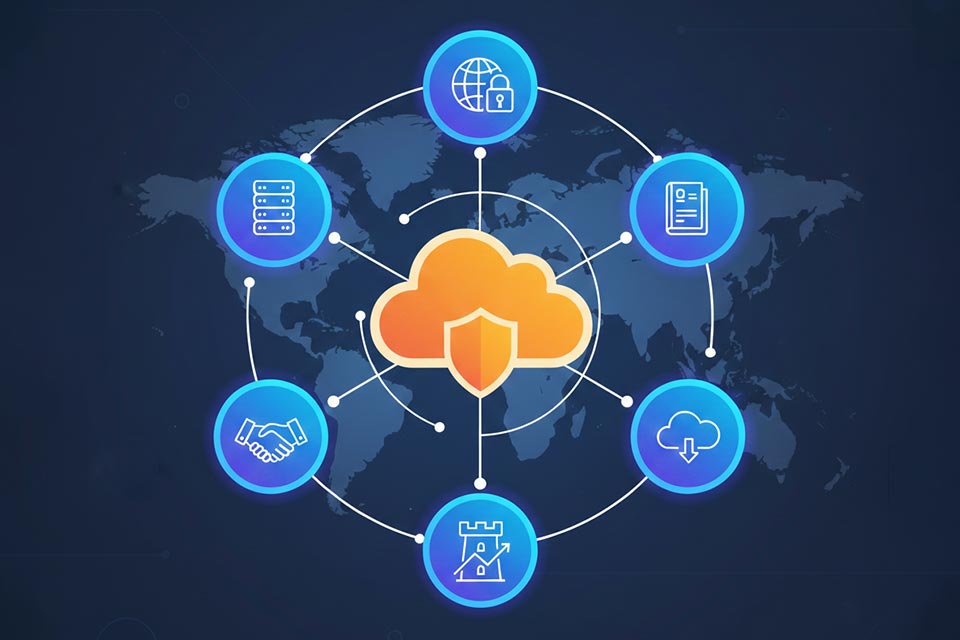
You used to treat the internet as a borderless place. You moved data freely between servers in Virginia and Frankfurt without thinking twice. That world is gone. Regulations like GDPR and the Cloud Act have fractured the global internet into distinct legal zones. You now face a complex map where the physical location of your server determines who can legally access it. This shift demands a robust sovereign cloud strategy.
What Does This Term Actually Mean for You?
We need to define exactly what we are talking about here. A sovereign cloud strategy goes beyond simple data residency. It is not just about storing files on a server located within a specific country’s borders. It is about ensuring that the data is subject only to the laws of that country.
You must have total jurisdictional control. This prevents foreign governments from subpoenaing your data through the cloud provider’s parent company. You need to know that no matter what happens geopolitically, your digital assets remain under your specific legal protection. This protects you from external overreach.
Why Is Encryption Not Enough to Keep You Safe?
You might think holding your own encryption keys solves the problem, but operational access remains a critical vulnerability.
-
Support Access:
Technicians from the provider’s foreign headquarters often retain remote access to fix bugs or patch systems during outages.
-
Metadata Leakage:
Even if the file is encrypted, the metadata about who is accessing it remains visible to the provider.
-
Legal Subpoenas:
The US Cloud Act allows American authorities to demand data from US companies regardless of where the server sits.
-
Hardware Control:
True operational sovereignty requires that the physical hardware is managed and operated strictly by local citizens in the jurisdiction.
Which Industries Are Leading This Massive Shift?
Specific sectors cannot afford to wait for regulations to settle. Governments, healthcare providers, and financial institutions are moving first. If you handle citizen data or patient records, you are likely already feeling the pressure to localize.
A sovereign cloud strategy is becoming the license to operate in these fields. You risk massive fines or losing your license if a foreign entity accesses your sensitive records. The public sector is driving this demand, forcing major cloud providers to build entirely new infrastructure models to comply.
Who Are the Key Players in This New Market?
The market is splitting between local European initiatives and American giants trying to adapt their global platforms.
-
Gaia-X:
A European initiative building a federated infrastructure to ensure data independence from American tech giants.
-
Microsoft Cloud for Sovereignty:
An offering that adds residency and control features to the standard Azure public cloud platform.
-
Local Providers:
Smaller regional hosts like OVHcloud are seeing renewed interest due to their native jurisdictional status.
-
T-Systems:
German providers are partnering with hyperscalers to act as a “data trustee” for sensitive customers.
-
Google Distributed Cloud:
This allows you to run air-gapped infrastructure on your own premises while using Google software.
Is Moving Data Back On Premises the Answer?
“Cloud repatriation” is a growing trend for a reason. You might find that the easiest way to achieve a sovereign cloud strategy is to bring the data home. Moving critical workloads back to private data centers eliminates jurisdictional ambiguity instantly.
However, this is not a retreat to the past. You are not building old-school server rooms. You are deploying modern private clouds that offer the same agility as the public cloud. This hybrid approach gives you the legal safety of on-prem with the technical benefits of cloud computing.
How Do You Manage Multiple Clouds With Constraints?
Running a global business means balancing sovereign requirements in one region with public cloud speed in another.
-
Data Classification:
You must rigorously tag every dataset to ensure only non-sensitive information flows to the public global cloud.
-
Policy Automation:
Your sovereign cloud strategy relies on automated policies that block restricted data from leaving specific geographic zones.
-
Unified Dashboards:
You need a single control plane that visualizes where your data sits across all sovereign and public environments.
-
Routing Logic:
Intelligent network routing ensures that user traffic stays within the borders required by local compliance laws.
Also Read: CIO Influence Interview With Jake Mosey, Chief Product Officer at Recast
Do You Have to Sacrifice Innovation for Control?
There is a painful trade-off here. The most advanced AI tools and machine learning models usually live in the public cloud. If you lock your data in a sovereign bunker, you might lose access to these cutting-edge services.
Your sovereign cloud strategy must balance protection with progress. You cannot let compliance make your business obsolete. The goal is to bring the AI models to the data, rather than sending the data to the models. This requires careful architecture planning to ensure you stay competitive while staying compliant.
How Do You Protect Against Future Geopolitical Risk?
The world is unstable, and you need an architecture that survives sudden changes in international relations.
-
Modular Architecture:
Build systems that can be disconnected from the global network without crashing your critical local operations.
-
Vendor Diversification:
Avoid relying on a single nation’s technology stack to prevent total failure during trade wars.
-
Open Standards:
Use open-source technologies to ensure you can migrate data easily if a provider is banned.
-
Legal Reviews:
Regularly audit your contracts to ensure they account for new sanctions or data transfer bans.
-
Local Talent:
Ensure you have teams in each region capable of running the stack without outside help.
Data Location is Now a Boardroom Issue
Data location is no longer just an IT detail. It is a core boardroom issue that defines your risk profile. Adopting a sovereign cloud strategy is the only way to navigate this fractured landscape safely. You must act now to secure your digital borders.
Catch more CIO Insights: CIOs as Ecosystem Architects: Designing Partnerships, APIs, And Digital Platforms
[To share your insights with us, please write to psen@itechseries.com ]
