

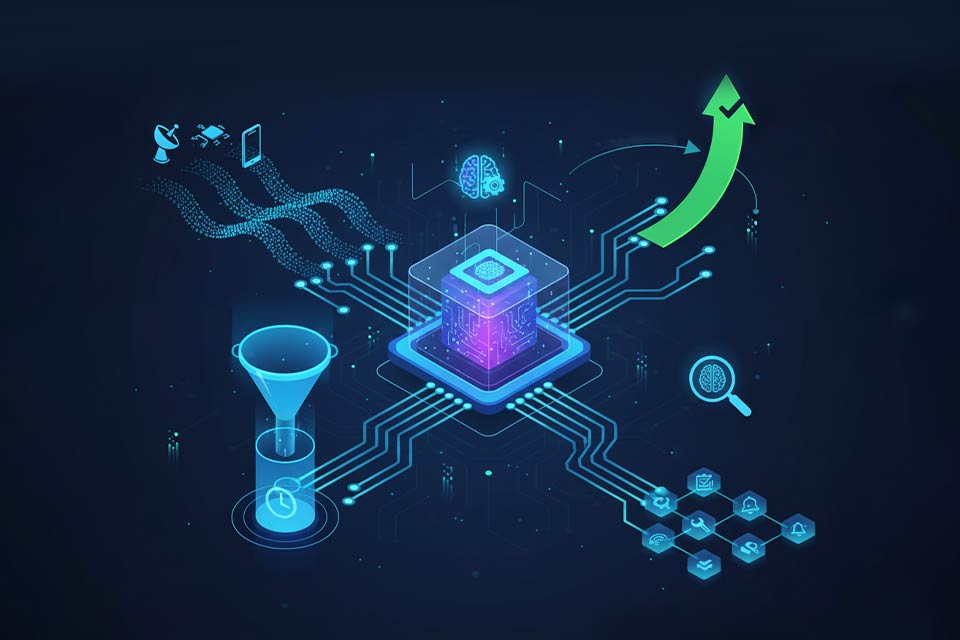
Time and again, organizations have embraced advanced IT infrastructure to enhance their performance and productivity. With more hybrid & multi-cloud set-ups, microservices, edge computing, and distributed workloads, modern IT infrastructure adds to the complexity generating a flood of logs, metrics, traces, and alerts. When organizations found it difficult to monitor and issues manually, the sought help from AIOps.
Haven’t you implemented AIOps into your IT infrastructure yet? Well, it is not just a nice-to-have system, but has become a foundation for resilient and agile operations.
AIOps (Artificial intelligence IT operating systems) is a system where you use AI techniques to maintain your IT infrastructure. With AIOps, you can automate critical operational tasks like performance monitoring, workload scheduling, and data backups. AIOps is a powerful mechanism working on the foundation of modern machine learning (MML), natural language processing (NLP), and other advanced AI methodologies. It provides you with proactive, personalized, and real-time insights to IT operations by collecting and analyzing data from various sources.
Also Read: CIO Influence Interview with Duncan Greatwood, CEO at Xage Security
Why AIOps is important for modern organizations?
Your organization can benefit from a modern IT infrastructure only when you ingest, analyze, and apply increasingly large volumes of data. Apparently, AIOPs helps you do that. Let us see how:
-
Reduce operational costs:
With AIOps your team can derive actionable insights from big data while maintaining a small team of data experts. When your systems are well-equipped with AIOps, your data experts can also augment IT teams to resolve operational issues with precision, which helps to avoid costly errors.
-
Reduce problem-solving time:
AIOps has the capability to analyze real-time data. It can determine patterns that might point to system anomalies. Using AIOps, your operations team can conduct root-cause analyses to not only figure out problems but also the solutions to resolve them quickly.
-
Enable predictive service management:
AIOps can analyses your historical data with machine learning technologies. ML models analyze large volume of data and detect patterns that human assessments might miss.
-
Streamline IT operations:
Before AIOps, IT teams were working on different sets of data. It slowed down the operation processes and had errors. AIOps has a framework to aggregate all the organizational data into a single source so your teams can coordinate and collaborate workflows with little human intervention.
-
Increased customer experience:
As modern AIOps tools can analyze data and give your team a clear picture of everything, you can have a customer’s data unified at one place. You can also use AIOps to analyze customer behavior and improve service deliveries.
Key trends driving AIOps adoption
These are the biggest currents shaping how AIOps is evolving in 2025 and beyond:
1. Alert noise reduction & event correlation
Teams are overwhelmed by redundant, duplicated, or low-priority alerts. Modern AIOps platforms use correlation across services, infrastructure, and dependencies to group related events and suppress noise. This improves signal clarity, reduces alert fatigue, and speeds up response.
2. Predictive detection and proactive remediation
Rather than waiting for something to break, AIOps tools are increasingly predicting performance degradation, resource saturation, or upcoming failures (e.g., disk capacity, memory leaks) and recommending or triggering actions before user impact. Self-healing systems that auto-rollback deployments or restart failing services are rising.
3. Unified observability over hybrid and multi-cloud environments
With parts of IT infra on-premises, others in public cloud, plus edge / IoT, visibility is fragmented. Organizations want dashboards that span all environments, enabling consistent analytics across cloud providers, Kubernetes, serverless, VMs, etc. AIOps platforms are integrating tightly with observability tooling (logs, traces, metrics) to deliver holistic views.
4. Integration with DevOps, SecOps, and FinOps
IT operations no longer work in isolation. AIOps is intersecting with security operations (for detecting threats via operational telemetry), with DevOps (CI/CD pipelines, change risk, rollback mechanisms), and with FinOps (controlling cloud spend via predictive cost anomalies).
5. Low-code/no-code AIOps and democratization
Organizations are recognizing that not every alert or automation scenario should require ML engineers. Hence, AIOps platforms are offering more usable interfaces, prebuilt templates, dashboards, and rule builders so operations engineers, site reliability engineers, and even DevOps can configure patterns without deep data science.
Final take
AI-Powered AIOps is beyond a toolset, it is a capability that gives you an edge over others with resilience and agility. When implemented well, AIOps frees teams from firefighting, strengthens system reliability, and empowers IT operations to scale in complexity with confidence.
But technology alone won’t save you. It takes smart goals, clean data, cultural alignment, prudent automation, and continuous oversight. CIOs and Ops leaders who embrace these dimensions will lead in 2025 and beyond, not just by minimizing downtime, but by transforming IT operations into a strategic advantage.
Catch more CIO Insights: The CIO’s Role In Data Democracy: Empowering Teams Without Losing Control
[To share your insights with us, please write to psen@itechseries.com ]
