

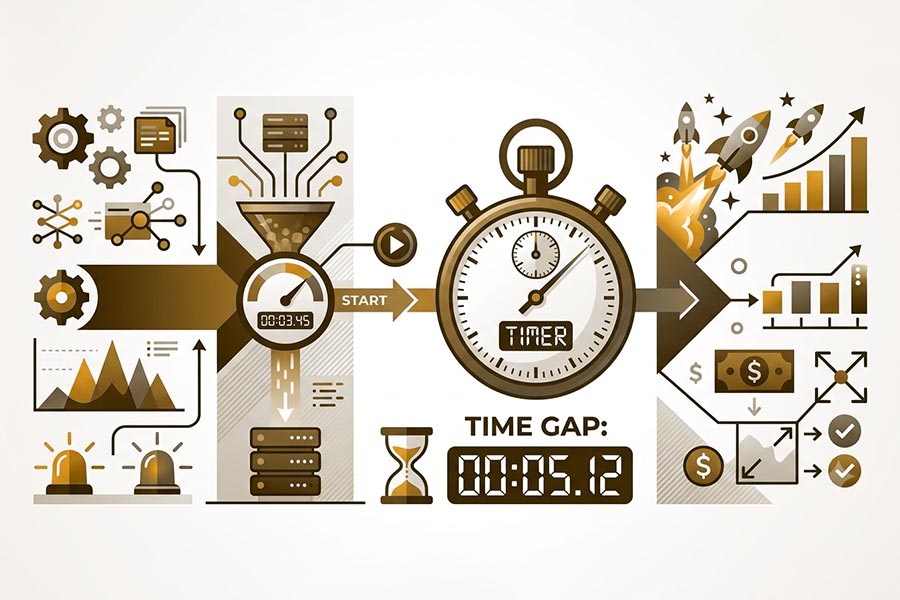
Enterprise tech is now dramatically faster. Cloud infrastructure can scale workloads in seconds, modern databases can process vast amounts of information in real-time, applications can respond almost instantly, and event-streaming platforms can move business signals across systems as they emerge. But faster tech doesn’t necessarily mean a faster organization.
A company could have highly available applications, powerful infrastructure, sophisticated analytics, and large volumes of real-time data and still take hours or days to respond to an important business signal. A cybersecurity alert could be instantly picked up but remain sitting there unresolved while teams work through it manually. A customer may show a strong purchase intent but the sales organization might only react when the opportunity has cooled off. A supply chain disruption can be visible in operational data, but approvals and disconnected workflows delay the response.
This gap is generating interest in Decision Latency as a new technology and business-performance metric. Decision Latency is the time from when an important enterprise signal occurs until the organization takes meaningful action in response. Instead of asking whether technology can process information fast enough, it asks whether the enterprise can turn information into decisions and decisions into outcomes fast enough.
This gives CIOs a broader way to evaluate technology performance. The goal is no longer to optimize infrastructure, applications, networks or data pipelines in isolation. It’s about valuing how efficiently technology compresses the whole journey from signal to action.
Decision speed impacts customer experience, cyber-resilience, fraud prevention, supply chain agility, financial operations, sales performance, and executive decision making. But faster decisions are not necessarily better decisions. The aim is to remove wasted time, but not at the expense of accuracy, governance, human judgment, or strategic context.
Decision Latency is thus a link between technology performance and business performance. It helps CIOs figure out whether investments in real-time data, AI, automation, orchestration, and modern infrastructure are actually helping the organization respond better to changing conditions.
Also Read: CIO Influence Interview with Srinivasan Panchapakesan, Chief Platform Officer at Hexaware
What is Decision Latency?
Decision Latency is the time taken from the appearance of a meaningful enterprise signal to the point where a suitable business decision or action is taken.
The signal could be anything: a suspicious transaction, customer complaint, demand spike, machine failure, new sales opportunity, cybersecurity event, change in liquidity, or new market condition.
The key difference is that Decision Latency is not just the time it takes for a system to see or process that signal. It consists of the organizational and technological steps that are taken after detection.
It may help you to think of the process as:
Signal Shows Up → Take → Look → Understand → Choose → Recognize → Act → Evaluate Result
All phases can cause delay. The technology may find a signal in milliseconds, but the interpretation can take minutes, approval can take hours, and execution may require additional manual coordination.
a) Core Measurement: Signal-to-Action
So the primary metric for Decision Latency is the entire signal-to-action interval.
For example, a fraud detection system might be able to flag an unusual transaction immediately. The decision latency is low if the system automatically blocks the transaction in within seconds. Even with fast detection technology, if the alert is sent to an analyst who reviews it several hours later, the enterprise has a much longer decision cycle.
This makes the metric very useful for CIOs because it shows bottlenecks that are outside the technology layer. Poor data integration, manual investigation, unclear ownership, approval requirements, disconnected applications, or the absence of automated workflows may cause a delay in a decision.
Also, organizations can measure different components individually, such as:
- Detection time-to-signal ratio
- Time from detection to analysis
- Decision Time to Analysis
- Time to approve
- Approval to action time
- Average time from signal to action
Together, these measurements provide a more complete picture of enterprise responsiveness.
b) Decision Latency vs Data Latency and System Latency
Do not confuse Decision Latency with data latency or system latency.
Data latency is the delay from when an event takes place until the data is available. The latency of a system is usually the time it takes a technical system to respond to a request or to process an operation. Decision Latency is broader as it incorporates technology, people, processes, and organizational structures.
An enterprise may have near real-time data but slow decision-making. For example, an executive dashboard could indicate a sharp drop in regional sales very quickly, but it may take managers several meetings to identify the reason and authorize a course of action.
The data moves fast. That decision takes time.
This distinction matters because better data pipelines don’t necessarily mean a faster response time for the business. CIOs should find out what the real source of delay is in the entire decision chain.
c) Information Availability versus Business Action
The fact that information is available does not mean that an organization will act on the information.
Traditional enterprise architectures have typically been all about collecting, storing, analyzing, and presenting information. Dashboards, reports, alerts, and business intelligence systems give organizations a high degree of knowledge and not necessarily a high degree of responsiveness.
The burning question is: What happens once the insight arrives?
Even in the case that the system detects a potential supply shortage but does not trigger a procurement workflow, the organization has a decision bottleneck. If customer-service teams get the information too late to act on a possible churn risk flagged by an AI model, the intelligence has limited operational value.
Thus, Decision Latency emphasizes actionability, not information availability.
Why Decision Latency Is Becoming a CIO Metric
As enterprises become more digital, time to respond to signals can have a direct effect on business outcomes. CIOs are increasingly accountable for the technology architecture that connects data, AI, applications, workflows, and business operations.
Decision Latency is one way to measure that architecture through a business lens.
Instead of just asking if an organization has real-time analytics, AI capabilities or automated workflows, CIOs can ask if those capabilities really do cut the time it takes to make and execute important decisions.
a) Signal detection and capture
All decisions start with a signal. Signals can originate from applications, transactions, sensors, customers, employees, market feeds, security systems, websites, or external data sources.
The first challenge is to detect relevant signals rapidly and discriminate between important events and background noise. Event-driven architectures, streaming platforms, observability tools and real-time monitoring can help minimize the time between an event happening and the enterprise knowing about it.
But detection alone does not lead to action. That’s only the beginning of the decision chain.
b) Data Movement and Processing
If a signal is detected, then the data must be provided to the relevant systems or persons so that it can be interpreted.
Delays can be caused by fragmented databases, batch-processing systems, out-of-date integrations, and disconnected applications. A signal might be in one business system, but the context to understand it is somewhere else.
Delays can be reduced by using real-time data platforms, event streaming, APIs, data fabrics, and integrated architectures to make relevant information more readily available when it is needed.
c) Analysis and Interpretation
The next step is to figure out what the signal means. Trends, risks, potential outcomes, and recommended actions can be identified, evaluated, predicted, and recommended by analytics, machine learning, predictive models, generative AI, and decision intelligence to speed up this process.
The goal is to move from displaying data to delivering contextual intelligence. A decision system could do that and figure out what the likely impact is, guess when a shortage will happen, and recommend what to do about it instead of telling a team that inventory is down.
d) Decision Formation and Approval
Even when intelligence exists organizations may introduce significant lag through decision-making structures.
Too many levels of approval, unclear ownership, risk committees, manual reviews, departmental handoffs can all slow things down. Some of these controls are inevitable, particularly with high-impact decisions, but some can be friction we can live without.
CIOs can help organizations define clearer decision boundaries. Routine, low-risk decisions can be potentially automated, and ambiguous or high-impact decisions can be routed to appropriate human experts.
e) Execution of Business Action and Workflow
The last step is to turn the decision into an operational action. It could be updating a customer record, halting a transaction, reassigning inventory, changing a security policy, contacting a customer, initiating a payment, or allocating resources.
Workflow orchestration and process automation can link decisions directly to business systems, reducing the distance between knowing what should happen and making it happen.
The full chain is important because there can be latency at each stage that can add up. This is a problem because an enterprise can have fast infrastructure and slow business response if even one critical stage is heavily manual.
Why Old-School IT Metrics Don’t Work
a) Infrastructure Performance vs. Business Agility
Traditional IT metrics still count. Technology health is informed by infrastructure utilization, application performance, network latency, uptime, and throughput.
But they don’t necessarily reflect the speed of the business to changing conditions.
A system can be operating within its performance targets, but employees spend hours interpreting its outputs or waiting for approvals. The infrastructure is good, but the enterprise may not be responding well.
b) Application availability and Decision availability
Application availability shows if a system is available when users need it. Decision availability is another matter: Does the right intelligence reach the right decision maker at the right time?
Critical decisions can still be made using spreadsheets, emails, manual analysis, or disconnected systems even if the application is 99.99% available.
This creates a distinction between technical availability and operational readiness.
c) Speed of Data Processing vs. Actionable Intelligence
Speed in data processing is only valuable if it leads to better and more timely decisions.
A company may be processing millions of transactions per second but taking hours to investigate anomalies. Likewise, an organization may have sophisticated analytics infrastructure, but make decisions based on weekly reports when decisions need to be made on a daily or real-time basis.
Decision Latency pushes CIOs to align data-processing performance with the business action that comes next.
d) Uptime, but No Operational Agility
High availability is not the same as organizational agility.
Organizations can be slow yet have reliable systems because of legacy processes, organizational silos, manual approvals or disconnected workflows. These bottlenecks are not captured by traditional infrastructure monitoring, but can directly impact business performance.
Measuring decision latency can reveal these hidden constraints.
Moving From System-Centric to Outcome-Centric Measurement
The emerging approach does not replace the traditional IT metrics. Instead, it stretches them.
Metrics for traditional technology are:
- Availability and uptime, system response time
- Throughput for processing data
- Utilization of infrastructure
- Performance of the application
- Latency of the network
Decision-oriented metrics may include:
- Signal-to-decision time
- Decision-to-action time
- Overall signal-to-action time
- Automated decision rate
- Exception resolution time
- Business response time
- Time to intervention
The larger shift is from measuring how fast technology works to how fast technology allows the enterprise to respond.
This helps CIOs make a more meaningful connection between technology investments and business outcomes. Real-time infrastructure, AI analytics, automation, event streaming, and intelligent workflows are valuable not just because they are technically sophisticated, but because they can eliminate unnecessary decision latency while maintaining the quality, governance, and accountability required for responsible business action.
Where Enterprise Decision Latency Comes From?
Decision Latency is seldom the result of one technology failure. It is often a result of a combination of fragmented data, manual processes, organizational complexity and disconnected systems. The best infrastructure can be hampered by slow decision cycles when information doesn’t reach the right people, approvals take too long, or business applications can’t coordinate their actions effectively.
a) Fragmented Enterprise Data
Enterprise data is often siloed across customer relationship management systems, enterprise resource planning, financial applications, supply chain databases, HR platforms and operational tools. When working in isolation, these systems can leave decision-makers with an incomplete view of a situation.
For example, a supply chain manager looking into a delay in delivery might have to look at inventory records, updates from suppliers, transportation data, and commitments to customers, all separately. By the time these are consolidated, the opportunity to act proactively may have passed.
Data silos therefore increase the time taken to collect, validate and interpret information. This fragmentation can be overcome through integrated data platforms, common data models and access to real-time information.
b) Manual Analysis and Report Writing
Many organizations continue to rely on spreadsheets, manually created reports, email updates, and periodic performance reviews to make critical decisions. These techniques offer useful context, but may introduce lag when business conditions change faster than reporting cycles.
Managers may spend a lot of time gathering information, looking for discrepancies, preparing presentations, and explaining performance differences before they can figure out what to do.
With AI-powered analytics, automated reporting and real-time dashboards, you can eliminate repetitive analytical work. They can also help decision makers see unusual patterns and prioritize issues that need attention.
c) Organizational Approval Bottlenecks
Multiple approvals are needed for routine actions and this can cause significant latency due to the decision-making structures. A financial adjustment, a purchase request, a customer compensation, an operational adjustment and a security response may have to go through several departments to be approved.
Some approval processes are necessary for financial control, regulatory compliance and accountability. But imposing similar levels of approval for routine decisions and decisions having a higher impact can bog down business unnecessarily.
Organizations can control this through risk-based approval structures, pre-established decision limits and delegated authority. Policies that are approved allow routine decisions, while exceptional or high-risk situations are subject to additional human review.
d) Applications and Workflows in Silos
There may, of course, be relevant data in enterprise apps, but they are not necessarily communicating well with each other. Employees might have to manually move information from one system to another, reenter data, or contact other departments to start the next step in a process.
For example, finding a customer service issue doesn’t automatically trigger a replacement order, a refund, or an escalation workflow.
You can link these processes to APIs, workflow orchestration, and event-driven integrations so that business systems can share information and trigger the right actions with fewer manual steps.
e) Limitations of Legacy Infrastructure and Integration
Legacy applications and aging infrastructure can make it difficult to access enterprise information in real time. Information may not flow efficiently across departments due to batch processing systems, limited API support, incompatible data formats, and older integration mechanisms.
Modernization does not have to mean replacing all existing applications. Middleware, integration platforms, event streaming and cloud-based data services can help bridge legacy environments with newer technologies.
f) Ambiguous Ownership and Decision Authority
Decision latency can also arise when employees don’t know who is responsible for interpreting a signal, approving a response or initiating an action. Ownership is unclear and an operational alert may be passed between departments. This leads to delayed escalation or issues unresolved if teams assume another department is responsible.
CIOs need to work with business leaders to define decision ownership, escalation responsibilities, and accountability around critical workflows. Clear decision rights help make sure important signals reach the right people in a position to respond.
g) Excessive Human and Organizational Handoffs
Every handoff between teams, departments, or management levels can add more waiting time. For example, a cybersecurity alert can transition from monitoring teams to security analysts to incident managers to IT operations to business leadership and finally to containment.
Need to coordinate systems and teams better to reduce unnecessary hand-offs. Automated routing, shared operational dashboards, predefined escalation rules, and workflow orchestration can help get information to the right decision maker without having to pass it around manually, over and over again.
Measuring Decision Latency Across the Enterprise
First, to reduce decision latency you need to understand where the delays are happening. CIOs need a measurement framework that covers the whole journey from signal detection to meaningful business action, not just a system performance.
a) Identifying Critical Enterprise Signals
The first is to recognize signals that call for timely organizational responses. These could be cybersecurity alerts, anomalies in financial transactions, customer complaints, inventory shortages, equipment failures, changes in customer demand or new sales opportunities.
Not every signal is meant to be acted upon. CIOs ought to assign priority to events according to business impact, urgency, financial implications and operational risk. A possible security breach, for example, might need to be responded to immediately, whereas a slow shift in customer purchasing habits might be assessed over a longer time period.
b) Defining the Start and End Points of a Decision
To measure consistently, you need clear definitions of when a decision cycle starts and ends. The starting point could be when a signal first appears in an enterprise system or when monitoring technology picks it up. The endpoint could be when an authorized decision is made, when an operational action is taken or when the desired business outcome is achieved
Rather than treating these milestones as a single measurement, CIOs should differentiate between them. Otherwise organizations may report faster decisions but miss delays in actual execution.
c) Measuring Signal-to-Decision Time
Signal-to-decision time is the time it takes for an organization to interpret an event and determine the appropriate response. This interval includes information gathering, analysis, risk assessment, consultation and approval where required.
For example, if an AI monitoring platform detects anomalous activity immediately, but security teams take 25 minutes to respond and determine if it’s a real threat, that’s a 25-minute signal-to-decision interval.
Keeping an eye on this metric helps organizations identify bottlenecks in analysis and approval.
d) Measuring Signal-to-Decision Time
A decision has no business value unless the right action is taken next. Decision to action time means the time between a decision being approved and it being put into effect. For example, this may be to update an application, assign a task, block a transaction, contact a customer or redirect resources.
Workflow automation and system integration can help reduce this interval by connecting the decision engines directly to operational applications.
e) Measuring End-to-End Signal-to-Outcome Time
End-to-end measurement means the measurement of the entire period from first time a signal appears until a meaningful operational outcome is achieved.
Complementary metrics CIOs can monitor include:
- Mean Decision Latency: Mean time to complete a decision cycle.
- Median Decision Latency: Average time to decide, reducing the effect of outliers.
- 95th and 99th Percentile Decision Latency: Shows delays impacting the slowest decision cycles.
- Time-to-Detect: Time required to detect a relevant signal
- Time-to-Understand: The time to understand the signal and its significance.
- Time-to-Approve: The time required to obtain the required approval.
- Time-to-Execute: The time between decision and execution.
- Time to Resolution: Time to resolve the underlying issue.
- Percentage of Automated Decisions: Share of eligible decisions completed by approved automation.
These metrics need to be looked at in the light of decision accuracy, business impact and risk. A faster response that provides an incorrect result does not yield an improved result.
Technologies That Reduce Decision Latency
We need decision-latency-reducing technologies that link enterprise information, analytical intelligence, decision-making, and execution. The goal is to build a system that can read important signals and translate them into action, with less noise in between.
a) Real-Time Data Platforms
Real-time data platforms deliver information as business events unfold, rather than only through scheduled batch updates. They link data from multiple sources, allowing decision-makers and analytical systems to use more current information.
These platforms help you keep tabs on transactions, inventory, customer behavior, financial activity and how well your operations are running.
b) Event Streaming and Event-Driven Architectures
Event streaming technologies capture and share events across enterprise applications continuously. Event-driven architectures allow systems to react to specific conditions.
An alert can be raised, say, when inventory is suddenly low, a replenishment workflow can be started and procurement teams can be notified, without waiting for a scheduled report.
c) AI Analytics and Real-Time Intelligence
AI analytics enables organizations to understand large volumes of data, to find patterns and to detect anomalies. Analytical models can point out events that need attention right away instead of having employees go through all the data point by point.
That cuts the time it takes to comprehend changing business conditions and rank potential responses.
d) Predictive Intelligence and Forecast
Predictive intelligence enables an organization to foresee events before they turn into operational issues. Machine learning algorithms can identify emerging demand trends, predict the likelihood of equipment failure, forecast shifts in cash flow, and flag anomalous transaction behavior.
By spotting potential problems earlier, enterprises have more time to consider and prepare appropriate responses.
e) Automated Decision Engines
Automated decision engines use pre-defined rules, analytical models and risk thresholds to decide on appropriate responses. They can help with decisions on transaction approvals, fraud screening, credit decisions, resource allocation and operational exceptions.
They act on well-defined decision boundaries, reliable data, and proper escalation processes.
f) Workflow Orchestration and Process Automation
Workflow orchestration connects decisions to the business processes needed to execute them. It coordinates applications, distributes tasks, issues notifications and handles dependencies between tasks.
Automation of processes decreases repetitive manual actions and helps organizations to move faster from decision approval to execution.
g) Real-Time Enterprise Models and Digital Twins
Digital twins are virtual models of physical assets, facilities, processes or operational environments. “Real-time data can be used to simulate conditions, test potential outcomes and inform decision-making before changes are actually made.
For example, manufacturers can determine how adjustments to production will impact utilization of equipment, delivery times, and operating capacity.
h) AI Agents and Executing Tasks by Themselves
AI agents will be able to understand information, plan activities, communicate with enterprise applications and perform permitted actions within set limits. A supplier can see a delayed purchase request, look at supplier information, make a recommendation, and start an approved workflow.
Their potential contribution to Decision Latency lies in the connection of intelligence to action. But high-impact decisions still need proper oversight by humans and governance.
AI as a Decision-Latency Accelerator
Artificial intelligence is changing the way businesses interpret signals, assess alternatives, and coordinate business responses. More than just faster analytics contributes to Decision Latency. Artificial intelligence can help tie together information gathering, reasoning, recommendations, and operational execution.
a) Moving From Analytics to Decision Intelligence
Traditional analytics tells us what happened and helps organizations understand performance patterns. Decision intelligence extends this by linking data analysis to potential actions and their expected results.
It uses analytical models, business rules, contextual information and decision frameworks to help organizations determine what should happen next.
b) AI-Powered Signal Interpretation
AI models can look at structured and unstructured data—transactions, customer communications, operational records, documents, and system logs. Artificial intelligence can help decision-makers derive the value of a signal faster by identifying connections across disparate information sources.
For example, a customer complaint can be assessed based on purchase history, previous service interactions, and product availability to provide a more contextualized response.
c) Predictive Detection Before Problems Escalate
Predictive artificial intelligence can also detect trends that might indicate emerging risks or operational disruptions. This allows organizations to look into possible issues before they become bigger problems.
They can be used to spot suspicious patterns in transactions, to predict when equipment is likely to fail, to anticipate inventory shortages, and to sense signals that a customer is about to drop out.
d) Generative AI in Decision Making
Generative artificial intelligence can assist in synthesizing complex reports, analyzing results, evaluating possible responses, and providing relevant context for decision-makers. Rather than manually sifting through a number of dashboards and documents, managers can ask questions about business conditions and receive structured explanations via conversational interfaces.
The systems assist decision-makers but are not to be regarded as automatically authoritative. If the decisions have financial, regulatory or operational implications, their recommendations must be validated.
e) AI Agents for Execution of Decisions
AI agents extend decision support by interfacing with business applications and performing pre-approved tasks. They are capable of handling workflows, pulling data, updating records, raising requests, and executing predefined actions.
For instance, an enterprise agent can detect an operational bottleneck, retrieve supplier details, recommend substitutes, and initiate a procurement process, all within its allowed permissions.
f) Human-AI Collaboration in High-Impact Decisions
Artificial intelligence can speed up routine analysis and execution, but human judgment remains important for decisions involving ambiguity, significant financial exposure, regulatory obligations or strategic consequences. A useful distinction is between the following two approaches:
- AI-assisted Decision-Making: AI analyzes signals, summarizes evidence, and recommends actions – but authorized employees make the final decisions.
- AI-enabled actions: artificial intelligence systems trigger defined responses according to authorized policies, thresholds, and operational boundaries.
The goal is not to take the human out of the loop, but to put the human in the loop for the decisions most in need of expertise, accountability, and contextual judgment.
Decision Latency in Cybersecurity
Decision Latency is important for a good example of Cyber Security. While a threat can be quickly identified, slow investigation, escalation or containment can give attackers more opportunities to compromise systems and access sensitive information.
a) Detecting Threat Signals in Real Time
Security information and event management platforms, endpoint detection tools, network monitoring systems, and identity security solutions aggregate signals from across enterprise environments.
Real-time monitoring enables security teams to identify suspicious login attempts, abnormal network activity, malware behavior, privilege escalation, and potential data exfiltration.
b) AI-driven threat analysis
AI is able to link security events from different systems, spotting irregularities and telling the difference between real threats and everyday actions. This context analysis can reduce the amount of time analysts spend sifting through large volumes of alerts and investigating unrelated events.
c) Automated Incident Prioritization
Not all security alerts represent the same level of risk. AI-based prioritization can assess factors such as asset criticality, threat behavior, exposure, and possible business impact. This allows security teams to focus their attention on those incidents that need immediate investigation.
d) Automated Response and Containment
Security automation can trigger approved responses, such as isolating compromised endpoints, disabling suspicious accounts, blocking malicious traffic, and escalating incidents to the right teams.
These actions can reduce the response delay, provided that automation is within clearly defined security policies and escalation controls.
e) Reducing Mean Response Time
Metrics like mean time to detect and mean time to respond are usually monitored by cybersecurity teams. Decision Latency considers things from a different angle — the time between the identification of a threat and the execution of an effective response.
A typical security response might look like:
Threat Signal → Detection → Risk Assessment → Decision → Containment
The critical question is not how fast a threat was identified but how quickly the organization recognized its importance and acted. CIOs can reduce unnecessary delays while maintaining control over critical security decisions by blending real-time monitoring, AI-driven analysis, automated response workflows, and human supervision.
Customer Experience: Decision Latency
Customer experience is increasingly about how quickly organizations can identify customer needs and respond to them with relevant actions. Customers want quick support, personalized recommendations, accurate information, and quick resolution of support issues.
Yet, fractured customer data, disjointed service channels, manual processes, and slower approvals can create gaps between spotting customer intent and delivering a suitable response. Decision Latency helps organizations measure and reduce delays in customer-facing operations.
a) Detecting Customer Intent
Website interactions, searches, purchase history, support conversations, product questions and service requests are all expressions of customer intent. AI-powered analytics can dissect these signals to determine what customers might want or expect. Connecting information from CRM platforms, digital channels and customer service systems helps organizations understand intent without the need to wait for manual analysis.
b) Real-Time Personalization
Real-time personalization enables organizations to customize recommendations, offers, communications, and service experiences based on the current customer behavior. Decision engines can apply context to identify the most relevant content or interaction. The faster you can get to customer signals, the less lag between recognizing an opportunity and serving up a personalized experience.
c) Predicting Customer Needs
Predictive analytics can identify likely customer needs even before they are voiced. Models can detect patterns related to product demand, service issues, dissatisfaction or churn risk. This allows organizations to provide proactive support, recommend relevant services, or resolve issues earlier.
d) Triggering Next-Best Actions
Next-best-action systems convert customer intelligence into recommended actions. These may include: sending a product recommendation assigning a service representative initiating a retention offer escalating an unresolved issue. These recommendations can be tied directly into client engagement platforms with workflow automation.
e) Reducing Customer Response and Resolution Time
For example, in a customer-facing setting, an organization can measure Decision Latency by measuring response times, time to resolution, and time between customer signals and service interventions.
The main applications are:
- Automated routing and triaging of customer service.
- Proactive churn prevention & personalized recommendations.
- AI-Driven Support & Faster Resolution of Complaints.
By reducing the latency in decision-making, organizations can transform customer service from reactive to responsive, predictive, and contextual customer experiences.
Decision Latency in Supply Chain and Operations
Supply chain and operational performance depends on organizations’ ability to sense disruptions and coordinate responses. If decisions are delayed you could have inventory shortages, production stoppages, missed deliveries, increased logistics costs and unhappy customers. Decision Latency provides a way to understand how fast operational signals turn into coordinated business actions.
a) Detecting Supply Chain Disruptions
These can result from delays from the supplier, problems with transportation, equipment breakdown, weather or unforeseen fluctuations in demand. Real-time monitoring platforms can receive signals from logistics systems, supplier networks, sensors and enterprise apps. AI analytics can recognize anomalous patterns, and notify teams when operational conditions demand attention.
b) Real-Time Inventory Insights
Visibility into inventory lets organizations see what they have in stock, how fast it’s being consumed, what needs to be replenished, and the status of the warehouse. Real-time data platforms can link inventory records among warehouses, distribution centers and retail locations. This allows decision makers to detect shortages and coordinate replenishment before they impact customer commitments.
c) Predictive Demand Signals
Predictive models that analyze historical sales, market conditions, seasonal trends, and customer behavior are employed to predict demand. These insights enable procurement and operations teams to adjust inventory levels, production schedules and resource requirements. The earlier demand signals allow us to prepare for changing conditions.”
d) Automated Supplier and Logistics Response
When workflows are automated, pre-defined conditions can trigger supplier notifications, procurement requests, shipment adjustments and delivery escalations. AI-powered systems can also analyze alternative suppliers or transport options and recommend them to authorized decision-makers.
e) Digital Twins to Enable Operational Decision Making
Digital twins create virtual representations of physical operations, facilities and supply chain processes. They feed live information into organizations, allowing them to play out possible disruptions and assess possible responses before making changes.
For example, a manufacturer might use a digital twin to evaluate the impact of a late shipment of a part on production capacity and delivery schedules.
Organizations can benefit from reducing operational decision latency by:
- Identify issues before they escalate
- Making decisions on inventory and logistics more effectively.
- Thinking of other operational scenarios.
The goal is to connect operational visibility with timely intervention, so that enterprises can react to changing conditions without depending solely on periodic reports and manual coordination.
Decision Latency in Financial Operations, Risk, and Fraud
Decisions where the time taken can have a direct financial impact are common in the financial industry operations. Fraudulent transactions, unexplained account activity, liquidity shortages, payment failures, and new credit risks need to be identified and dealt with in an expeditious manner. But the speed of response needed varies with the financial activity. Transaction screening can take milliseconds, but treasury planning or credit reviews may have longer decision cycles.
a) Real-Time Detection of Fraud Signals
Fraud detection systems track transaction activity, account activity, customer behavior, device information, and payment patterns. Machine learning algorithms can be used to detect unusual activity and send alerts if transactions are not consistent with expected behavior. Real-time monitoring allows financial institutions to detect potential fraud prior to further transactions.
b) Transaction Risk Analysis
Just because an anomaly is found does not mean that fraud has been committed ipso facto. Risk analysis takes into account the context of the transaction, customer history, location, transaction value, behavioral patterns and other relevant indicators. AI-enabled decision systems can synthesize these signals to assess risk and determine whether further verification is required.
c) Automated Financial Decisions
Automated decision engines can assist with transaction approvals, payment routing, credit decisions, and fraud interventions. They use pre-defined rules and predictive models to decide what actions are appropriate within the limits of what they’re allowed to do. Cases with elevated risk or uncertainty can be escalated to human analysts.
d) Real-time Liquidity and Cash Decisions
Treasury teams require a view of cash positions, payment obligations, receivables and liquidity needs. Real-time financial data and predictive forecasting help organizations identify potential funding gaps and assess their cash allocation decisions. Faster access to information may enable better timing of liquidity management responses.
e) Minimizing Risk Escalation Time
Decision Latency measures the time that elapses from detecting a risk signal to mounting an effective response and is used by financial organizations to understand this metric.
Important areas of measurement are:
- Time from detection of suspicious activity to intervention on a transaction.
- Financial exceptions investigation and escalation time.
- Time elapsed from the identification of liquidity risks to remedial action.
For some payment and fraud systems, milliseconds are the difference between a transaction being approved or blocked. Other financial decisions may reasonably require minutes, hours or days of analysis. The goal is to match response time with financial risk, complexity of decisions and regulatory requirements, without sacrificing accuracy and accountability.
Sales & Revenue Operations Decision Latency
The ability to spot buyer intent fast and jump into the right conversations is becoming the biggest driver of sales success. Signals are created through website visits, content downloads, product demos, pricing inquiries, email interactions, and buying conversations. If these signals are not connected to sales workflows, organizations may miss opportunities or respond after competitors have already engaged the buyer. Decision Latency is the time between the appearance of buying interest and the occurrence of significant sales activity.
a) Detecting Buying Signals
Sales intelligence platforms powered by AI can evaluate customer interactions, engagement patterns, CRM activity, and website behavior to identify potential intent to purchase. Together, these signals give sales teams more visibility into where prospects are in their buying journeys.
b) Lead and Opportunity Scoring in Real Time
Lead scoring models assess prospects against metrics like engagement, company attributes, purchasing behavior, and historical conversion patterns. As new information comes in, AI is able to update the opportunity scores, enabling sales teams to prioritize prospects that require immediate attention.
c) Triggering Next-Best Sales Actions
Next-best-action systems suggest the right engagement based on the customer context. Suggestions could include setting up a demo, sharing relevant product information, reaching out to a decision-maker, or starting a follow-up conversation.
d) Automate the Sales Process
CRM automation and workflow orchestration can shorten the time between discovery of an opportunity and the next action. Systems can automatically distribute qualified leads, set up reminders, keep records, and alert account managers when important buying signals are detected.
e) Reducing the Time from Buyer Intent to Seller Response
For sales organizations, Decision Latency can be measured as the time between a buying signal and the first meaningful sales response. They can also think about the time it takes to qualify leads, schedule demos, write proposals, and get internal approvals.
Areas for development are relevant in:
- Quicker lead assignment and qualification
- Automated follow-ups based on customer interaction.
- Prompt proposal development and opportunity escalation.
Cutting down decision latency does not mean contacting every prospect right away or sending out automated messages without context. It’s about getting the right signals to the right sales people at the right time when the opportunity is still meaningful. This connects sales intelligence to revenue execution and helps organizations make better use of existing demand signals.
Workforce and Enterprise Management decision lag
Managing the workforce involves a constant juggling act between employee availability and skills, workload, operational demand, and business priorities. Delays in decision-making can result in staffing shortages, uneven workloads, project bottlenecks, and inefficient use of resources. Decision Latency provides a means to analyze the speed at which workforce signals are converted into management decisions and operational adjustments.
a) Detection of Workforce and Capacity Signals
Information about employee availability, attendance, workloads, skills and productivity is produced by Enterprise HR platforms, workforce management systems, project management applications and operational tools. Including these signals can help managers identify capacity constraints, scheduling conflicts, and developing workforce needs.
b) Forecasting Workforce Planning
Predictive analytics can help organizations estimate future staffing needs by looking at historical demand, project schedules, seasonal patterns, employee availability and business forecasts. These insights help workforce planners identify potential shortages and prepare for recruitment, training, or resource adjustments sooner.
c) Resource Allocation Based on Machine Learning
Resource allocation systems can advise on how to divide staff, equipment, and budgets between projects and departments. Automation can help with regular scheduling, task assignments, and workload adjustments based on pre-defined business rules. Managers still own decisions around employee development, tricky staffing issues, or competing strategic priorities.
d) Real-Time Operational Escalation
Workforce and operational systems can raise alerts when staffing gaps, workload imbalances, missed deadlines or service-level risks occur. Workflow orchestration can escalate these issues to the responsible managers and trigger predefined escalation processes.
e) Aid in Executive and Management Decisions
Decision latency affects management decisions on hiring, budgeting, project priorities, and organizational capacity. By integrating workforce intelligence, leaders can have more timely information on resource constraints and operational performance.
CIOs can help to cut delays through:
- Workforce and operational data combined
- Predictive scheduling and capacity planning
- Automatically increase priority for critical resource constraints.
The objective isn’t to automate every workforce decision. Rather, technology should enable managers to detect changing conditions earlier, have access to reliable information and respond within the bounds of good decision-making. This leads to a tighter alignment between enterprise execution and workforce planning.
Decision Executive Latency
Executive decision-making increasingly relies on the ability to read signals from across the organization. Leaders need to assess their financial results, customer behaviors, market developments, cyber risks, workforce capacity, and conditions of operation. But often, executives receive their information in the form of separate reports, department dashboards, and scheduled reviews. Decision Latency occurs when relevant signals exist but do not have the integration, context, or coordination to enable timely action.
a) From Dashboard Reporting to Real-Time Executive Intelligence
The traditional executive dashboard tends to be more about reporting past and present performance. Real-time executive intelligence goes one step further, highlighting changes of note, pointing out emerging risks, and providing information that may need attention. AI-powered analytics can help leaders understand developments without manually combing through multiple reports.
b) Linking Enterprise Signals Across Business Functions
An executive decision may need input from finance, sales, ops, HR, customer service, and tech teams. However, integrated data platforms can link these signals and provide a wider view of business conditions. This enables leaders to see how developments in one function might affect other areas.
c) Decision Support for Executives Based on AI
Generative AI and decision intelligence platforms can summarize reports, explain changes in performance, compare alternatives, and surface relevant information. Executives can use conversational interfaces to explore business questions and measure possible responses. These tools are for judgment, not for replacing executive accountability.
d) Scenario Analysis and Predictive Intelligence
Predictive models and simulation technology can show executives what could happen in different business situations. Leaders can assess how changes in demand, pricing, investment, staffing or supply chain capacity might impact organizational goals. Scenario modeling can help decision-makers prepare their responses before the situation becomes critical.
e) From Periodic Reviews to Continuous Decision Making
Continuous enterprise intelligence can help organizations to detect important developments in between scheduled management meetings. Alerts, predictive analytics and automated workflows can alert responsible leaders sooner about emerging issues.
The evolution also changes the CIO role. The CIO is increasingly becoming an architect of the organization’s decision infrastructure — connecting data platforms, artificial intelligence (AI) systems, enterprise applications and workflow orchestration.
The purpose is to establish an environment where:
- There are warning signs across functional areas of the business.
- Decision makers have relevant information in sufficient context.
- Approved decisions are converted into aligned business actions.
CIOs can connect technology performance to executive responsiveness, helping to steer organizations away from intermittent reporting and toward a more continuous, data-driven, and accountable process for making decisions.
Overcoming Organizational Decision Bottlenecks
Organizations need to consider not only their technology infrastructure but also the processes and approval structures that influence decision-making if they are to reduce Decision Latency. Even with enterprise systems that rapidly identify signals and provide insights, superfluous levels of approval, ambiguous responsibilities, and disconnected workflows can delay meaningful action. CIOs therefore need to work with business leaders to simplify decision-making structures and build processes that enable information to flow directly to the people or systems most responsible for reacting.
An important step is to remove unnecessary layers of approval. Even where routine operational decisions involve predictable situations with limited business impact, they often pass through multiple managers, departments, and review stages. These procedures tend to slow response times without necessarily improving the quality of the decisions. Organizations can address this by setting approval levels and enabling designated staff or automated systems to operate within specified constraints. For example, a procurement system might automatically approve purchases below a certain dollar amount, and forward larger commitments to management for review.
Equally important is clear ownership of decisions. Where there are multiple teams involved without clear accountability, decisions can get hung up with departments waiting on each other. CIOs can help establish decision ownership by mapping out business processes, identifying the stakeholders responsible for each decision, and defining who can approve, execute, or escalate specific actions. Connecting previously separate applications and workflows also cuts down on delays caused by the manual transfer of data and the constant back-and-forth between teams.
Automation can also speed up predictable, low-risk decisions like routine service requests, inventory replenishment triggers, transaction checks and standard workflow approvals. But automation should not substitute for human judgment when circumstances are uncertain or consequences are significant.
A practical framework is Automate → Assist → Escalate. Predictable decisions can be automated, decisions that require interpretation can receive AI-supported advice, and high-impact or exceptional situations can be escalated to authorized human decision-makers. This approach allows enterprises to avoid unnecessary delays while maintaining accountability and appropriate oversight.
Speed of Decision vs Quality of Decision
It’s important to remember that Reducing Decision Latency is not about rushing to make every enterprise decision as quickly as possible. Quicker decisions are not necessarily better decisions. The benefits of a rapid response may be outweighed by the consequences of misinformation, poor analysis or poorly configured automation. Therefore, organizations need to take into account decision speed along with accuracy, reliability, business impact and risk.
The time needed to respond appropriately depends on the nature of the decision. While a cybersecurity alert involving an active threat may require immediate investigation and containment, a major investment, acquisition, or organizational restructuring requires broader analysis and consultation. To expect the same speed in both cases would be to create unnecessary risks. CIOs should set expectations for decision-time based on business urgency, complexity and potential consequences.
Also, it’s all about accuracy. AI-powered systems can process large amounts of information and detect trends quickly, but their recommendations may be influenced by incomplete datasets, outdated information, or incorrect assumptions. Organizations need to look at the key signals, monitor the performance of models, and ensure decision-makers understand the limits of automated recommendations.
Special attention is required for false positives and false negatives. A false positive may require unnecessary investigation and/or business disruption, while a false negative may allow fraud, security threats, and/or service disruptions to go undetected. Organizations can identify these problems and improve decision reliability by constant surveillance, feedback systems, and regular model evaluation.
Humans are still needed for review and decision-making regarding financial commitments, customer rights, employee outcomes, regulatory obligations, or sensitive business operations. Artificial intelligence can help with analysis, show you possible scenarios and suggest actions. But the people who do this job still need to make the decisions that require contextual understanding or ethical judgment.
Also strategic decisions should be deliberate. It is not to cut out consideration and consultation but to cut out the unnecessary delays from the processes. A mature Decision Latency strategy differentiates between value-adding delays due to careful evaluation, and delays arising from fragmented information, unnecessary approvals, or inefficient workflows.
Governance, Risk & Trust Faster Decision Making Systems
With enterprises implementing real-time analytics, automated decision engines, and AI agents, governance is key to maintaining trust and operational control. Faster decisions can increase business responsiveness, but they can create risks if organizations cannot explain how an action was generated, what information informed that action, or who authorized it. CIOs have to make sure decision systems are run within well-defined governance frameworks.
A basic requirement is the ability to audit decisions. Enterprises should capture the key signals, data sources, recommendations, approvals, system actions, and resulting outcomes. These records help organizations investigate errors, demonstrate compliance, identify recurring issues, and understand if automated decisions are delivering the intended results.”
And, not least, explainable AI and transparency of decisions. Staff and managers need to know why an AI system has made a particular recommendation, particularly where the recommendation impacts financial and operational or customer-related metrics. Where technically feasible, systems should be able to provide relevant information about the signals, rules and confidence levels that support recommendations.
Human-in-the-loop controls can put in place more protections. Certain transactions of high value, decisions affecting customers, unusual security responses and any action that exceeds a pre-determined risk threshold may require human approval. The boundaries of the automated decision should be explicit about what activities systems are able to do autonomously and what needs authorization.
Data privacy and security must also be at the center of the architecture. Access control, encryption, minimization of data, and secure integration practices become more important in real-time decision systems that often combine information from multiple enterprise applications. Organizations must make sure that sensitive information is only accessible to authorized users and systems.
Finally, enterprises need mechanisms for rollback and exceptions. If an automated action results in an unexpected outcome, authorized teams should be able to stop the workflow, roll back supported actions or move the decision to manual review. Therefore, governance needs to be integrated into the decision architecture and not be a separate compliance activity. This allows organizations to be more responsive without losing accountability, transparency or trust.
Designing a Decision Latency Architecture
An integrated technology environment links enterprise signals, intelligence, decision making and execution through a Decision-Latency architecture. Its aim is to shorten the time from when a meaningful business signal is detected to when an appropriate action is taken. CIOs must build this architecture based on business outcomes—not simply by adding more analytical tools or automation platforms.
The first step is to map the critical enterprise signals. They can be cybersecurity alerts, customer interactions, transaction patterns, inventory changes, supplier disruptions, sales activity, workforce capacity and financial movements. Finding the signals that need a fast response enables organizations to understand where real-time processing can really make a difference.
The next layer is a real-time data foundation. Data platforms, APIs, event streaming and integration technologies all reduce reliance on manual reporting by allowing information to flow between enterprise systems. Data quality, consistency and accessibility must be maintained to ensure that downstream systems receive reliable information.
On top of this foundation is an enterprise intelligence layer that analyzes incoming signals and identifies patterns, anomalies and emerging conditions. AI analytics and predictive models can help to interpret complex information and decision engines can apply business rules, risk thresholds and organizational policies to determine appropriate responses.
Then the architecture has to connect decisions to execution. Workflow orchestration platforms can orchestrate activities across customer relationship management, enterprise resource planning, cybersecurity, finance and service management systems. Within the approved permissions and governance boundaries, the AI agents also have the ability to execute defined tasks.
The full architecture can be represented as:
Enterprise Signals → Real-Time Data Layer → Intelligence Layer → Decision Engine → Orchestration Layer → Business Systems → Outcome Feedback
Outcome feedback is especially important because it allows organizations to assess whether decisions produced the desired results. Such information can be used to improve processes, refine models, and adjust decision rules.
CIOs should implement the architecture in pieces, starting with high-value processes and expanding as integration ability, governance practices and organizational readiness are further developed. The system should include human escalation mechanisms for complex or high impact decisions to ensure that they are handled appropriately.
How CIOs Build a Decision Latency Strategy?
To develop a Decision-Latency strategy, CIOs need to connect technology investments to the decisions that drive enterprise performance. Instead of trying to speed up everything at once, they should identify business conditions where slow action has real financial, operational, customer or security impacts.
“The first step is to identify high-value, time-sensitive decisions across the departments. These may include responding to cyber security incidents, responding to customer complaints, authorizing transactions, managing supply disruptions, following up on sales opportunities, or reallocating workforce resources. By assigning priority to these decisions, CIOs can concentrate their attention on areas where reducing lag can have a real impact on operations.
Then organizations should establish a baseline Decision Latency by measuring the time it takes to make selected decisions today. This means determining when a relevant signal first appears, when it is available to decision makers, when a decision is made, and when the resulting action is completed. Measuring these stages separately shows where time is being lost.
Once the baseline is established, CIOs can identify the biggest bottlenecks. Reasons for this include: incomplete data, manual reporting, too many approvals, disconnected applications, unclear ownership or lack of automation capability. Technology investments should be made to address these constraints rather than adding solutions without a clear business requirement.
Then, automation and AI opportunities are prioritized by decision frequency, business value, complexity, and risk. Routine decisions can be automated. Complex decisions can be supported by AI-assisted analysis and recommendations. CIOs should also create Decision SLAs that establish appropriate response expectations for various types of business decisions.
A helpful management tool is a Decision Latency Map that depicts the time it takes to make critical decisions regarding cybersecurity, sales, customer service, finance, operations, and workforce management. This creates a common view for leadership teams of where decisions are getting stuck and what needs to improve.
Finally, the strategy must include ongoing measurement. CIOs should be regularly measuring decision cycle times, automation outcomes, error rates, and business performance to determine whether changes are making the organization more responsive without sacrificing decision quality.
Final Words
The true value of enterprise technology isn’t just how fast systems process information, how efficiently applications run, or how reliably infrastructure performs. More importantly, it is the degree to which an organization converts information into significant business actions. With enterprises becoming more connected and data driven, the pace of technology needs to be measured against business responsiveness. An organization can have sophisticated digital platforms and generate insights in seconds, but if those insights are stuck in dashboards, waiting for approval or lost in disconnected workflows, their business value is limited. Decision Latency becomes an important measure of enterprise performance here.
Decision Latency links classic IT performance to broader business outcomes. It changes the perspective from individual system metrics to the entire journey from an emerging signal to the action taken in response to it. By measuring this journey, CIOs can see how long it takes an organization to locate information, process it, understand what it means, make a decision, sign off and implement the required response. More importantly, it helps to identify where delays are occurring and whether they are due to technology limitations, organizational structures, manual processes or unclear decision ownership. Enterprises can track responsiveness across cybersecurity, finance, customer experience, sales, supply chain, and operational management, by looking at the full signal-to-action spectrum.
New technologies are opening up new opportunities to reduce these decision cycles. Real-time data platforms and event-driven architectures make relevant information available sooner and AI-powered analytics can interpret complex signals and find patterns that traditional reporting methods can’t. Using predictive intelligence, organizations can predict possible disruptions and through automated decision engines, routine actions can be performed based on predefined rules. Workflow orchestration links applications and departments, reducing manual handoffs, and AI agents can orchestrate specific tasks and support approved operational activities. Together, these capabilities can assist enterprises in evolving from reactive processes to more continuous and coordinated decision making.
But, of course, Decision Latency should never be reduced at the expense of accuracy, accountability, or responsible judgment. Not every decision has to be automated in real time, not every situation can be assessed with predefined rules. High-impact decisions about finance, operations, regulations, and people may require human interpretation, further verification, and proper approval. Therefore, governance, transparency, data security, auditability and clear automation boundaries must remain inherent in faster decision environments. The point is to speed up appropriate action, not merely to take away time for consideration.
The mandate for CIOs is to build something more than systems that process information at speed. It is about building enterprises that can sense important signals, understand their business implications and translate intelligence into appropriate action at the right speed. Decision Latency offers a way to measure and improve on that capability. Ultimately, the move from fast systems to fast enterprises will be a matter of tying technology, people, processes and intelligence together into a coordinated decision environment where responsiveness is a quantifiable aspect of business performance.
Catch more CIO Insights: The Overlooked Security Risk Behind Enterprise AI Rollouts
[To share your insights with us, please write to psen@itechseries.com ]
