

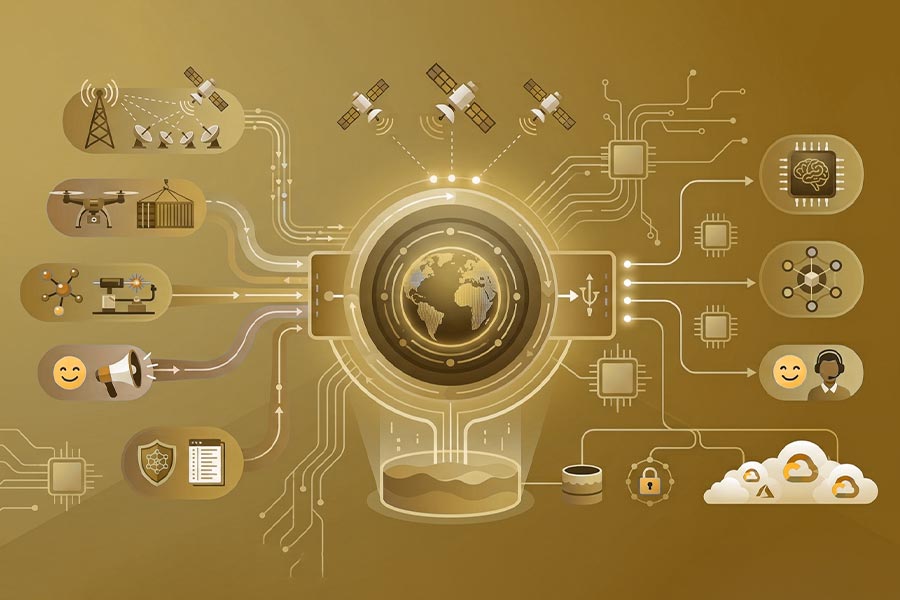
For years, enterprise technology has largely been built on periodic snapshots. Business leaders get weekly reports, monthly financial statements, quarterly forecasts, scheduled dashboards of performance, and post-mortem incident notifications. These systems can provide valuable information, but they are often describing the organization after the fact, rather than holding a more real-time understanding of what’s unfolding now. The CIO of the Real-Time Enterprise is moving away from that retrospective model to one of a technology infrastructure that senses, interprets, and responds to organizational change in real-time.
A real-time enterprise is not simply an organization that has faster dashboards. It’s a company where technology is continuously collecting signals from applications, infrastructure, employees, customers, monetary systems, supply chains, connected devices, cybersecurity platforms, and the outside world. These signals can be processed and combined into a common organizational view that changes as conditions change. Thus, the CIO’s role expands from managing the technology infrastructure to designing the sensing and intelligence layer through which the enterprise understands itself.
There are a number of technological advances that are making this change possible. Event-driven architectures enable systems to communicate when something meaningful happens, rather than waiting for scheduled processing. Real-time data streaming allows information to flow continuously between applications and analytics platforms. Observability tools deliver visibility into infrastructure, applications, and digital services, while AI analytics can sift through a large volume of signals and find patterns that traditional monitoring might miss.
Other technologies improve this organizational awareness. Enterprise knowledge graphs facilitate cross-departmental and cross-system data integration. Digital twins can provide up-to-date representations of operations, assets, and processes. Predictive analytics can identify possible consequences before they manifest themselves in traditional reporting, and IoT devices can provide real-world operational signals. Intelligent alerting can then identify which signals need attention, instead of drowning employees with all signals available.
The purpose is not to make all enterprise activity instantaneous. Instead, it is to shorten the distance between an organizational change and the organization’s capacity to understand the meaning of the organizational change. A customer experience problem, supply disruption, cybersecurity anomaly, employee capacity issue, infrastructure failure, or liquidity change can enter a connected intelligence environment almost instantly.
This alters the technology agenda for CIOs. Increasingly, infrastructure needs to support four capabilities: sense what is changing, understand why it matters, predict what could happen next, and be able to respond appropriately. The enterprise develops from information gathering to organizational awareness.
The central model can be written as:
- Sense: Capture enterprise signals continuously.
- Understand: Connect events to business context.
- Predict: Predict possible consequences.- Answer: Initiate the relevant human or automated response.
- Learn: Use the results to inform future decisions.
This evolution broadens the CIO’s mandate over the enterprise’s technological nervous system—the infrastructure that allows the organization to see, understand, and respond to its own changing condition.
Who is the Real-Time Enterprise CIO?
The Real-Time Enterprise CIO is a technology leader committed to creating infrastructure that delivers ongoing awareness to the organization, not periodic visibility. This role is far more than just making applications available or providing data to business teams. This means connecting technology systems to detect, interpret, prioritize, and translate important changes into action.
1. From IT Operations to Awareness of the Organization
Traditionally, CIOs have been focused on infrastructure reliability, cybersecurity, application portfolios, cloud strategy, data management, and tech transformation. These are still critical, but the real-time enterprise has one more responsibility: ensuring that technology can explain what’s going on in the organization in real time.
A real-time CIO asks:
- What has happened in the last few minutes?
- What changes are of operational significance?
- How does activity in one department impact another?
- What is the most probable next event?
- What signals require a human to intervene?
- What answers can be automated safely?
It creates a different relationship between IT and the larger organization. Technology not only becomes an operational base, but an organizational sensing mechanism.
2. Linking Signals Across the Enterprise
Being constantly aware means putting together information that has been separated for a long time. Customer interactions may be in CRM platforms, financial data in ERP systems, operational data in process applications, infrastructure telemetry in observability platforms, and cybersecurity incidents in security systems.
The real-time CIO wants to have a common intelligence environment where these signals can be read together. For instance, a sharp rise in customer complaints gets more significant when tied to an application performance problem, a recent software release, and a spike in support tickets.
Context makes personalized events into organizational intelligence.
3. The CIO as Enterprise Orchestrator
The role also becomes more and more cross-functional. A real-time CIO should partner with finance, operations, HR, security, customer experience, supply-chain teams, and business leadership to assess what signals matter and what actions to take.
Thus, technology architecture should be aligned with business priorities. Not all events need to be processed in real-time, and not every anomaly needs to generate an alert. The goal is not absolute visibility but meaningful awareness.
A mature Real-Time Enterprise CIO builds:
- Standard definitions of important organizational signals
- Shared architectures of event and data
- Clear attribution of critical responses
- Thresholds for alerts and automation that are appropriate
- Governance of real-time data and AI decisions
4. From Monitoring to Anticipation
The most significant development is going from seeing what is happening to predicting what may happen next. AI analytics and predictive models can use current signals to detect emerging risks or opportunities based on historical patterns.
This allows CIOs to enable proactive intervention. The enterprise can identify deteriorating performance instead of waiting for a system failure. Organizations can identify behavioral shifts earlier rather than waiting for the dissatisfaction to appear in quarterly metrics. Instead of finding supply disruption after inventory falls, systems can identify leading indicators. The CIO of the Real-Time Enterprise builds an organization that is always informed and never distracted.
The Architecture of Continuous Organizational Awareness
Continuous organizational awareness requires an architecture that collects signals, moves fast, adds context, interprets their meaning, and connects knowledge to action. This isn’t a single platform but a layered technology ecosystem of data, applications, infrastructure, analytics, AI, workflows, and governance.
1. Event and Signal Collection
The foundation is the ongoing gathering of signals. Applications, databases, cloud infrastructure, IoT devices, employee systems, customer platforms, security tools, and external data sources can all generate events that represent changes in organizational conditions.
This change can be made available to downstream systems using event-driven architecture immediately. Instead of asking over and over if anything has changed, systems can react to the occurrence of an important event.
2. Real-Time Data and Streaming Infrastructure
Data streaming brings a movement layer on which continuous awareness depends. Streaming platforms are able to process application events, transactions, telemetry, customer interactions, operational updates, and other information as it happens.
The infrastructure enables organizations to transition from isolated batch processing into continuously updated data environments.
But speed is not going to be enough. Data also needs to be reliable, well governed, and linked to business context.
3. Context & Business Knowledge
Context is of limited value without an event in real time. A sudden spike in transactions may be a sign of growth, fraud, a marketing campaign, or a system error. The organization needs more info to comprehend the difference.
Enterprise knowledge graphs and semantic layers can link events to customers, employees, assets, applications, suppliers, business processes, policies, and financial relationships. This allows artificial intelligence systems to reason across organizational boundaries, rather than interpret each signal in isolation.
4. AI Analytics and Interpretation
AI is the intelligent layer that transforms information flows into organizational insight. Machine learning can detect anomalies, find patterns, classify events, and predict. Generative and agency AI are becoming more and more capable of deciphering complex combinations of signals and translating them into explanations or suggested actions.
A mature architecture would distinguish:
- Detecting events
- The meaning of their significance
- Forecast possible results
- Recommendation or implementation of a response
This separation leads to better governance and reduces the risk of letting an automated system act just because it detected an anomalous condition.
5. Digital Twins and Models of Organizations
Extended continuous awareness can be delivered by digital twins through maintaining dynamic representations of assets, processes, infrastructure, facilities, or wider operational environments. Models become dynamic planning tools reflecting evolving conditions rather than static ones when paired with real-time data.
Digital twins can provide the CIO with a structured environment to understand how changes in one part of the enterprise can impact another. They can also facilitate scenario analysis, allowing organizations to explore potential outcomes before making major operational decisions.
6. Decision and Action Layer
Awareness is only of use if it leads to action. Workflow orchestration, intelligent alerts, automation platforms, and AI agents can turn insights into responses.
Responses may include:
- Alerting an employee or executive
- Opening an operational workflow
- Adjusting infrastructure capacity
- Initiating a security investigation
- Updating a customer-service process
- Escalating a financial or operational exception
Not every reply has to be automated. The architecture should separate low-risk actions that can happen automatically from high-impact decisions that require human authorization.
7. Governance & Control
Continued awareness requires continued governance. Real-time systems can generate large amounts of information, and this creates risks around privacy, access, security, data quality, and alert fatigue.
So the architecture needs identity controls, data governance, policy enforcement, audit trails, model monitoring, and clear human accountability. The aim is to build a business that can see more, without exposing sensitive data or letting automation run amok without the proper guardrails.
Ultimately, the architecture of continuous organizational awareness builds a loop:
Sense → Contextualize → Interpret → Predict → Decide → Respond → Learn
This loop is what turns enterprise tech from a set of systems that report on organizational activity into an infrastructure that is constantly understanding organizational conditions. That’s a fundamental shift for the CIO, where technology moves from being just the machinery that runs the enterprise to being the intelligence layer that allows the enterprise to see itself in real time.
Also Read: CIO Influence Interview with John Elliott, Cybersecurity Author Fellow at Pluralsight
Technologies for the Real-Time Enterprise
The real-time enterprise requires a technology foundation that can sense change continually, move information as events happen, interpret signals in context, and link intelligence to action. Traditional enterprise architectures were application-centric architectures with databases, scheduled integrations, and periodic reporting. But these systems still count, and they can introduce delays between when an event occurs and when the organization knows what it means. That model is being transformed by technologies like event-driven architecture, real-time data streaming, AI analytics, observability platforms, intelligent automation, and contextual data layers.
For the CIO, it’s not just about faster information processing. It is about building an infrastructure where significant organizational changes become quickly visible and can be connected to the bigger business picture. A customer transaction, application failure, supply-chain disruption, employee event, security anomaly, or financial movement can be a signal in a larger organizational intelligence environment.
The resulting architecture can be seen as a continuous loop:
Events produce signals
- The streaming infrastructure transports those signals.
- Contextual systems connect them to pertinent business information
- AI understands patterns and meaning.
- Decision systems decide on appropriate responses
- Automation and workflows perform allowed actions.
- The results become new signals for further learning.
This means that the CIO needs to think about enterprise technology as an infrastructure for sensing and interpreting, rather than just a collection of independent systems. This transformation is powered by the following technologies.
1. Event-Driven Architecture and Real-Time Data Streaming
Event-driven architecture is one of the key building blocks of the real-time enterprise because it enables systems to respond to changes as they occur. An event-driven environment generates and distributes events when meaningful activities happen, rather than just relying on scheduled data transfers or applications polling for changes.
Events that can be consumed by other systems include an order made by a customer, an employee changing a role, a payment being processed, a server degrading performance, or a security system identifying suspicious activity.
2. From Batch Processing to Continuous Events
The traditional batch architecture typically gathers information and processes it in set time intervals. This approach can work well for reporting and stable workloads, but it adds latency. A business may not find out about an important change until the next scheduled processing cycle.
In real-time streaming, where data is continuously streamed between producers and consumers, this lag is minimized. Streaming systems can consume application events, transactions, telemetry, IoT signals, customer interactions, and operational data as they are generated.
This change changes the core enterprise information model from:
Event → Store → Report → Respond
toward:
Event → Stream → Interpret → React → Learn
That doesn’t mean you need to process all data immediately. CIOs need to decide which signals truly need to be processed in real-time and which can stay in batch systems.
3. Event Brokers and Streaming Infrastructure
Event brokers and streaming platforms are the glue between enterprise applications. They enable different systems to publish and consume events without requiring tightly coupled integrations. This architecture can support:
- Customer and transaction event streams
- Telemetry for applications and infrastructure
- Events in supply chain and logistics
- Security & identity signals
- Money transactions
- Sensor data from IoT and operations
- Events for employees and the workforce
This decoupling also adds flexibility. New analytics or AI applications can reuse existing event streams without redesigning each source application.
4. Real-Time Data Pipelines
Data streaming is useful when it can be augmented, transformed, validated, and linked to context. Real-time pipelines can combine data from multiple sources and make it accessible to analytics engines, operational applications, dashboards, and artificial intelligence (AI) systems.
For example, a customer service event can be augmented with customer history, product information, recent transactions, and application performance data. Instead of viewing a support request in isolation, the organization can gain a more complete picture of the situation.
5. Event Prioritization and Governance
The continuous creation of events can also generate a lot of information. Without governance, real-time infrastructure is just faster data overload.
So the CIO will need policies around:
- Which events are critical for business?
- Which events need immediate handling?
- How long should different signals be preserved?
- Who has access to sensitive event data?
- What events can trigger automated actions?
- Check the quality and integrity of events.
The goal is not to have the maximum events. It is the highest organizational value from meaningful events.
6. Connecting Events to Business Processes
And the real-time enterprise becomes stronger with events correlated directly to workflows. An investigation may be caused by a security anomaly. A supply-chain disruption can lead to a procurement review. A failed transaction can generate a customer service workflow. Capacity adjustments are triggered by infrastructure load spikes.
It creates an important bridge between awareness and action. With event-driven architecture, the enterprise can react to its changing environment without waiting for manual reporting cycles.
7. AI-Driven Enterprise Sensing and Signal Analysis
Streaming infrastructure can tell an organization what is happening, but it does not automatically explain why something matters. Enterprise sensing powered by AI is the interpretive layer that makes sense of massive amounts of signals, developing meaningful organizational intelligence.
AI can evaluate events across applications, operations, customers, employees, infrastructure, and external environments to find relationships that may not be obvious if looking at each system in isolation.
8. From Detection To Interpretation
Basic monitoring typically answers questions like, is a service available or has a threshold been exceeded? AI-enabled sensing can move toward more contextual questions:
- Is this behavior normal for this business unit?
- What is happening here?
- What other systems are affected?
- What might happen if the trend continues?
- Is this event a risk, an opportunity, or a normal variation?
This difference is important because continuous awareness needs interpretation, not just continuous data collection.
9. AI for Signal Correlation
Signals from thousands of sources are generated in enterprise environments. AI is able to cross-correlate these signals to find patterns across organizational boundaries.
For instance, a dip in customer conversions might at first look like a marketing problem. However, coupled with application latency, payment failures, and higher support tickets, it could indicate a technology issue affecting the customer journey.
Likewise, an odd spike in employee turnover can be given more meaning by combining it with patterns of workload, changes in compensation, restructuring of the organization, and signals of engagement.
Artificial intelligence can assist in bridging these otherwise disjointed observations.
10. Business Intelligence to Forecast
The next step is to predict. Instead of just recognizing what is happening, artificial intelligence systems can predict what is likely to happen next, based on historical patterns, current conditions, and emerging signals. Predictive applications may help with:
- Capacity planning for infrastructure
- Detecting customer churn
- Forecasting supply chain disruption
- Cyber security risk identification
- Predicting Workforce Needs
- Financial forecasting
- Forecasting operational failures
This allows the CIO to shift the enterprise from reactive awareness to anticipatory awareness.
11. Intelligent Alerts
One of the biggest problems of real-time systems is alert fatigue. If you get an alert for every unusual event, employees will soon be overwhelmed and miss important warnings.
AI is able to rank alerts by severity, context, business impact, confidence, and potential consequences. A minor technical anomaly may need to be monitored; a similar anomaly involving a critical customer-facing system may need to be escalated immediately.
Effective intelligent alerting should therefore answer not only “What happened?” but also “Why should the organization care?”
12. Enterprise Context and AI Thinking
AI is far more useful when linked to enterprise context. A model that knows about business processes and application dependencies, organizational relationships, customer segments, financial priorities, and security policies will be able to interpret signals more accurately than a model that acts on isolated telemetry.
This context can be provided by enterprise knowledge graphs, semantic layers, metadata systems, and organizational data models.
This combination can create a constant loop of intelligence:
Sense → Correlate → Understand → Predict → Prioritize → Act.
13. AI And Human Decisions
We should not assume that AI-enabled sensing equates to AI-enabled decision-making. In many enterprise situations, the right use of AI is to detect meaningful signals, explain their probable importance, suggest actions, and escalate decisions according to established risk thresholds.
In situations of high impact, human leaders may be responsible for the final decision. Automation may be possible for low-risk, highly repeatable responses.
The CIO therefore needs to define clear boundaries between:
- AI surveillance
- Interpretation by AI
- AI suggestion
- Automated operation
- Human Approval
This separation helps mitigate the creation of uncontrolled automation in the interests of real-time responsiveness.
Event-driven architecture gives the enterprise continuous signals, and AI provides the intelligence needed to interpret them. Together they constitute the technological foundation of an organizationally shared consciousness that is continuously updated rather than periodically reconstructed.
The Real-Time Enterprise CIO can then use this foundation with knowledge graphs, digital twins, predictive analytics, observability, and intelligent workflows to move the organization from knowing what happened to understanding what’s happening, what might happen next, and how the enterprise should respond.
Knowledge Graphs and Context-Aware Intelligence for Enterprises
Enterprise knowledge graphs are a central capability of the Real-Time Enterprise because they connect information that would otherwise be distributed across applications, departments, and data silos. Instead of seeing each event as an isolated data point, a knowledge graph links customers to transactions, employees to business processes, applications to infrastructure, suppliers to contracts, and assets to operational dependencies. This relationship layer provides artificial intelligence systems with the context to understand what an event really means.
Context-aware intelligence is critical, especially when organizations are generating large volumes of real-time signals. For example, a sudden spike in application errors may look like a technical incident. When correlated with customer journeys, recent deployments, payment activity, and business-critical applications, the same signal can reveal a much larger operational issue.
The value for CIOs is in creating a shared organizational context for continuous adaptation.
- Link data across applications, processes, people, assets, and systems.
- Identify connections between events and business impact.
- Provide organizational context to artificial intelligence systems to improve interpretation.
- Faster root-cause analysis and decision-making.
- Establish a shared intelligence layer across business functions.
Knowledge graphs can also improve enterprise AI by giving AI models structured relationships to work with instead of forcing them to interpret isolated documents or datasets. Streaming allows the graph to update in real time, as relationships and conditions change.
This is a major change in enterprise architecture. Data is not simply gathered and saved for future analysis. It becomes a part of a dynamic knowledge environment in the organization. This environment allows the CIO to tie operational awareness to business priorities and create enterprise technology that is more and more able to understand not just what happened, but how different events are tied to one another.
Digital Twins and Continuously Updated Business Models
Digital twins give organizations greater awareness by creating a dynamic digital representation of physical assets, technology environments, business processes, facilities, supply chains, or even broader enterprise operations. Digital models have traditionally been used for simulation or planning. They can continuously consume operational signals and be living representations of the current state of conditions in a real-time enterprise.
An enterprise digital twin for a CIO could combine infrastructure telemetry, application dependencies, workforce capacity, supply-chain information, customer demand, financial conditions and operational events. This constructs a model through which leaders can make sense of how changes in one domain might affect another.
For example, a technology outage could be cross-referenced against affected applications, customers, revenue-generating processes, employees, and downstream dependencies. The digital twin might let you estimate the broader impact on the organization, rather than just giving the CIO an infrastructure alert.
Continuous model maintenance can help with:
- Scenario Modeling and Operational Simulation
- Optimization of capacity and infrastructure
- Visibility in Supply Chain
- Planning for business continuity
- Managing facilities and assets
- Predicting maintenance
- Enterprise risk assessment
With AI that can interpret changing conditions and generate possible scenarios, these models can be more useful. A CIO may ask, ‘What happens if demand goes up, a supplier disappears, infrastructure capacity is reduced or a major system goes down?’
The goal isn’t to build a perfect digital twin of the enterprise. The goal is to produce an accurate enough representation, always up to date, that helps leaders to see relationships, dependencies and possible consequences. Connected to live events, digital twins can provide a vital decision support layer for an always-on enterprise.
Real-Time Awareness for Business Operations
It is valuable to have ongoing awareness of the organization when it goes beyond IT and into the operational core of the enterprise. Business operations generate thousands of signals every day through orders, transactions, production systems, logistics platforms, procurement applications, customer interactions, and internal workflows.
A real-time enterprise connects those signals so leaders can see what’s happening on the shop floor as it happens. Operations teams can see bottlenecks, demand shifts, process delays, resource shortages, and service disruptions as they happen, rather than waiting for the end-of-day reports.
For example, a supply chain system could detect that shipments are slowing down at a specific location. By integrating inventory levels, customer orders, supplier dependencies, and transportation data, the organization can ascertain if the issue is likely to have a significant business impact.
The same applies to the internal processes. A backlog in an approval workflow can be a leading indicator of staffing constraints or process inefficiency. Live operational awareness can help with:
- Supply-chain monitoring
- Production and logistics optimization
- Process performance management
- Inventory visibility
- Service-level monitoring
- Resource allocation
- Operational risk detection
Ensuring that these operational signals can be moved across organizational boundaries without creating fragmented monitoring environments is the CIO’s responsibility. Business teams shouldn’t have to piece together information from multiple dashboards to figure out what’s going on.
The ultimate goal is an enterprise operating environment that makes important changes visible, contextualized, and actionable as they happen. That allows organizations to move from retrospective operational reporting to continuous operational intelligence.
Real-Time Customer, Workforce and Financial Intelligence
Among the most important sources of organizational signals are customer, workforce, and monetary systems. By linking these sources, the enterprise can build a much deeper understanding of their current state and of new opportunities.
Customer intelligence constantly monitors interactions, buying behavior, service requests, engagement patterns, sentiment, and the evolution of customer journeys. Organizations can see emerging friction or shifts in demand patterns much sooner, rather than waiting for periodic customer reports.
Workforce intelligence can also link staffing levels, workload, skills, employee movement, scheduling, productivity signals, and organizational capacity. It is not about constantly monitoring employees without limits. Workforce data practices should continue to be centered on privacy, consent, purpose limitation, and ethical governance.
Financial intelligence is another critical dimension. Revenue, cash flow, expenses, receivables, payment activity, forecasts, and financial risk are continuously updated signals.
When these areas are connected, the enterprise can establish relationships like:
- Changes in customer demand affecting workforce needs
- Workforce constraints impacting service delivery
- Operational disruption revenue impacts
- Financial forecasts based on customer behavior
- Changes in cash flow impacting procurement or investment decisions.
AI is able to cross-correlate these signals and help leaders understand the collective meaning. The increase in employee workload and operational delays may exacerbate the drop in customer satisfaction.
Real-time intelligence creates a common view across traditionally separate functions. The CIO can provide the infrastructure that enables customer, workforce, and financial intelligence to inform each other, while maintaining appropriate controls over data access.
The result is a more complete picture of the organization where business leaders can see not only individual metrics but how these relate to each other.
Real-Time Cybersecurity, Risk and Technology Operations
Continuous awareness offers immediate value in fields like cybersecurity and technology operations where threats, failures, and anomalies can change rapidly. Traditional reporting models are not adapted to situations where minutes or even seconds can make the difference in the severity of an incident.
A real-time enterprise can collect identity activity, application telemetry, network events, endpoint signals, cloud activity, vulnerabilities, configuration changes, and security alerts on an ongoing basis. AI is able to correlate these signals to discover patterns that could be missed by any one monitoring system.
Say, a suspicious login may seem relatively harmless in itself. When combined with abnormal access behavior, privilege escalation, data movement, and activity outside of normal operating times, it could be a sign of an emerging security incident.
The same model can be used in technology operations. In contrast, observability platforms can monitor applications, infrastructure, networks, databases, and cloud environments, while standard artificial intelligence can detect abnormal behavior or possible degradation.
Major capabilities are:
- Continuous threat detection
- Infrastructure monitoring in real time
- Insights into identity and access
- Performance analysis of applications
- Vulnerability prioritization
- Automated incident investigation
- Predictive failure detection
Risk management can also go beyond cybersecurity. A broader organizational intelligence layer can incorporate operational, financial, regulatory, supplier, and technology risks.
The challenge for the CIO is to integrate these systems without creating unnecessary duplication or overwhelming security and operations teams. Real-time awareness should improve prioritization, not just increase the number of alerts.
When properly designed, the result is a technology environment that can detect emerging problems earlier, understand their potential impact, and support quicker and more coordinated responses.
Intelligent Alerts, Signal Prioritization And Predictive Response
It is very easy for continuous awareness to become continuous noise. As organizations add more systems and sensors, they can generate thousands or millions of events. Sending every anomaly to employees would create a less intelligent, less effective real-time enterprise.
Intelligent alerting solves this problem by deciding what signals are worth looking at. AI is able to prioritize events based on severity, business impact, historical patterns, dependencies, confidence, and potential consequences.
A little blip in infrastructure may just need to be watched, but the same technical problem in a core revenue system needs to be fixed immediately. Therefore, context is needed to prioritize alerts.
Efficient systems can place signals into different response categories:
- Informational events requiring no immediate action
- Signals requiring monitoring
- Events requiring employee investigation
- High-risk incidents requiring escalation
- Conditions that can trigger approved automation
Predictive response goes one step further by looking for possible consequences before they happen. When infrastructure performance is declining, artificial intelligence is able to predict a potential outage. If demand is going up and inventory is going down, then it can predict a shortage. If cybersecurity behavior trends toward a known attack pattern, it may recommend intervention.
The CIO should set clear limits for automated responses. Some of the low-risk actions can be automated. Decisions around finance, security, customers, or workforce that have significant consequences may require human approval.
The goal isn’t just quicker alerting. It is better organizational attention. Alerts should be less frequent, but more meaningful, with the right context, likely impact, recommended action, and appropriate escalation for the enterprise. This changes alerting from a notification mechanism to an intelligence and decision-support capability.
Challenges of Building Continuous Organizational Awareness
Building a continuously aware enterprise is, technically, difficult because organizations don’t tend to have clean, unified infrastructure in place to work with. Real-time integration is difficult to achieve because of legacy applications, fragmented data, inconsistent standards, disconnected workflows, and competing departmental priorities.
Another challenge is the volume of data. Continuous sensing can generate more information than humans can reasonably interpret. Organizations risk creating alert fatigue and decision overload without strong filtering and contextualization.
Real-time infrastructure can also be a major driver of cost and complexity. Streaming data, high-availability systems, observability platforms, AI processing, storage, and integration layers require architecture and investment to be carefully thought out.
Other challenges are :
- Legacy systems that are not easy to produce real time events
- Bad quality of data; definitions are not consistent
- Management of sensitive and privacy data
- Security threats in cyber-connected systems
- Estimation errors and false positives
- Integration and interoperability limitations
- Governance of recommendations generated by AI
- Resistance of organizations to new operating models
And there is a cultural problem, too. Continuous awareness doesn’t mean every employee should respond to every signal right away. Real-time infrastructure can generate a culture of perpetual interruption, so organizations need clear decision rights and escalation models.
So the CIO has to balance speed with relevance, visibility with privacy, automation with accountability, and constant monitoring with human capacity. A successful real-time enterprise doesn’t react to everything. It knows what matters and acts accordingly.
CIO Strategy to Build a Real-Time Enterprise
Building a real-time enterprise is a strategic transformation, not merely a case of buying streaming or artificial intelligence (AI) technologies. First, the CIO should identify which decisions and processes in the organization would deliver measurable value from faster awareness.
Next you need to map the signals that support these decisions. That means knowing where the data comes from, how quickly it’s coming, who owns it, what’s missing contextually, and what to do next.
A practical strategy might involve several steps:
- Identify high-value use cases in real time.
- Create a common event and data architecture.
- Enhance core integration and streaming capabilities.
- Create a shared context using metadata and knowledge models.
- Use AI for detection, correlation, and prediction.
- Link knowledge to workflows and controlled automation.
- Put governance, privacy, and human oversight in place.
- Measure gains in decision speed, accuracy, and business outcomes.
The CIO should resist the temptation to make the whole organization real-time go. One way to begin is to focus on a targeted area such as cybersecurity, customer operations, technology reliability, supply-chain visibility, or some other area where latency has a clear business cost.
Successful capabilities can evolve into reusable enterprise services over time. Event streams, identity systems, knowledge graphs, observability platforms, AI models, workflow engines, and governance controls can all help support a variety of business functions.
The strategic goal is to ultimately build an enterprise that senses meaningful change in technology, understands the context of that change, anticipates consequences, and enables appropriate action. The CIO becomes the architect of this layer of organizational awareness, linking technology infrastructure with business intelligence, and laying the foundation for an enterprise that can adapt to evolving conditions.
Catch more CIO Insights: How Are CIOs Aligning Technology with Workforce Agility?
[To share your insights with us, please write to psen@itechseries.com ]
