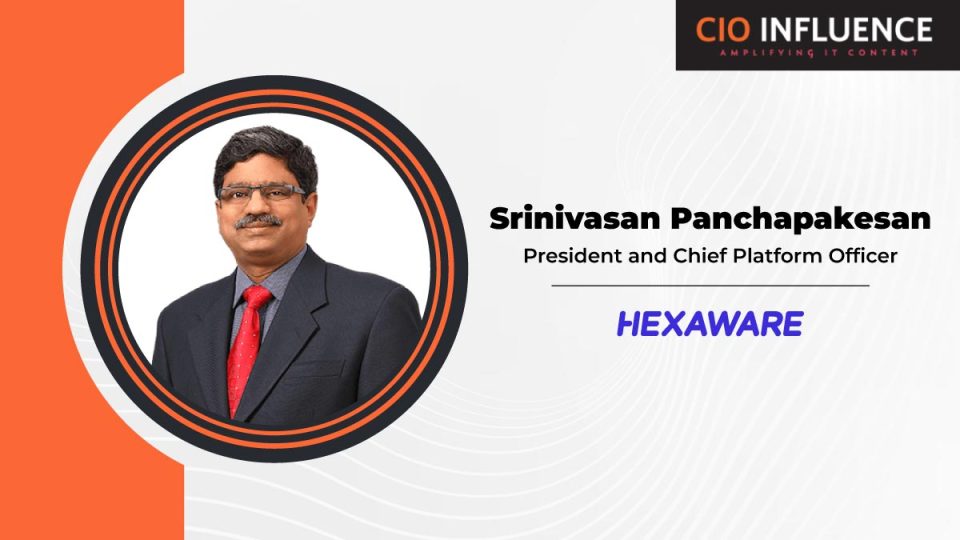
Srinivasan Panchapakesan, Chief Platform Officer at Hexaware chats more about how modern CIOs, CISOs, engineers, and platform teams need to prioritize clear policies at the ground level to optimize for an AI driven era in this catch-up with CIO Influence:
_______
Hi Srinivasan, what are you looking forward to as a Chief Platform Officer?
I’m looking forward to helping Hexaware bring its platform portfolio together as one connected foundation for the agentic AI era. We already have strong capabilities across Amaze, RapidX, Tensai, and Agentverse. Now, we get to make those platforms work even more cohesively, so clients can move fast, operate with confidence, and scale AI. This will help enterprises move beyond isolated pilot periods and access the real value of AI as it’s embedded into daily workflows, grounded in a client’s own data, code, and business decisions.
What should the core KRA’s of this new role – ‘Chief Platform Officer’ be in your view?
I focus on three things: unification, adoption, and governance. My first priority is to ensure the platform portfolio is managed as one connected system, not as siloed products. The second is to drive enterprise adoption by making the platforms easier for clients to consume, scale, and measure. The third is to strengthen governance so that innovation happens with the right controls, traceability, and accountability built in from the start.
Just as important, my role helps align the roadmap to business outcomes, increase reuse across the platform stack, deepen ecosystem partnerships, and support enterprise-scale deployment across AWS, Azure, and Google Cloud. In practical terms, my job is to turn platform strategy into a repeatable engine for modernization and AI-led transformation.
Also Read: CIO Influence Interview with John Elliott, Cybersecurity Author Fellow at Pluralsight
How can engineers and IT teams (CIOs / CISOs) actively ease governance issues as AI becomes more mainstream to cloud storage, IT processes and overall IT infrastructure?
Governance becomes fundamentally different when AI moves from generating suggestions to taking action on a user’s behalf. As AI becomes more embedded in cloud storage, IT processes, and infrastructure, the risks are no longer limited to the model itself, but also extend to data access, decisioning, auditability, and the actions AI systems take on behalf of users.
That means CIOs, CISOs, engineers, and platform teams need to define clear policies for data use, model access, and tool approval, while also embedding role-based controls, audit trails, observability, and policy guardrails into the platform layer.
What changes is the level of oversight required when AI can act, not just advise. Automated checks can help catch issues early, but human oversight still remains crucial, especially in environments where AI can take action, not just generate suggestions. For example, an AI agent might identify a cloud resource that appears unnecessary and recommend shutting it down, but a person should still have the final say before anything business-critical is taken offline. The goal is to make governance strong enough to reduce risk, but seamless enough that it doesn’t slow innovation. That balance is what will allow enterprises to scale AI responsibly.
How can enterprises unify AI initiatives and objectives across teams?
AI can’t scale if every team is building in isolation. Without a shared operating model, teams choose different tools, solve the same problems more than once, and create inconsistent standards that are difficult to govern.
To bring AI efforts together, organizations need a common vision tied to business outcomes, shared standards and governance, and reusable platform services that teams can build on instead of rebuilding from scratch. It also helps to maintain a central inventory of use cases, owners, and KPIs, so everyone is working toward the same goals.
When AI is treated as a company capability, not just a set of individual experiments, it becomes easier to scale, govern, and measure. That’s the shift many enterprises are trying to make right now, and it’s also the kind of unified foundation Hexaware is building across its platform portfolio.
How will the scope of software development and security change as AI becomes more crucial to workflows? What is trending today across software teams and data security teams keeping this AI-first trend in mind?
AI is changing software development from a code-centric discipline into a more intent-driven, lifecycle-wide practice. Developers are using AI to accelerate design, coding, testing, and deployment, which improves speed and productivity. But as AI becomes involved in more of the development lifecycle, it also introduces new questions around what data these tools can access, how AI-generated code is reviewed, and how decisions and changes are traced. Teams now need to think about architecture, quality, security, and control from the beginning rather than treating them as separate concerns later in the process.
That is bringing software and security teams closer together. Security teams are increasingly focused on shifting toward securing AI-assisted pipelines, protecting sensitive data, monitoring for shadow AI and policy violations, and ensuring provenance and auditability across prompts, code, and outputs. The big trend across software and security teams is a move toward governed acceleration, using AI to move faster, while embedding controls and accountability into the process itself.
What final thoughts would you leave our readers with before we wrap up?
The biggest opportunity right now is not just to adopt more AI tools, but to build and strengthen the platform foundation that lets AI scale responsibly and repeatedly across the enterprise. Organizations that connect modernization, engineering, operations, data, and governance into one operating model will see the most ROI from their tech stack. The real test isn’t whether an enterprise can launch AI. It’s whether it can make AI work at scale without creating a new set of problems along the way.
Catch more CIO Insights: How Are CIOs Aligning Technology with Workforce Agility?
[To share your insights with us, please write to psen@itechseries.com ]
Hexaware is a global IT services provider and IT consulting company—combining AI with human expertise to transform enterprises across industries and geographies.
Srinivasan Panchapakesan, also known as Srini, is the President and Chief Platform Officer at Hexaware. A goal-driven, hands-on technology leader with more than 35 years of industry experience, he leads the development, integration, and scaling of Hexaware’s unified platform portfolio, including Amaze®, RapidX®, Tensai®, and Agentverse™. He also oversees Global Delivery for Hexaware’s Digital & Software service line, driving customer digital adoption, product engineering, user experience, delivery excellence, and employee engagement.