

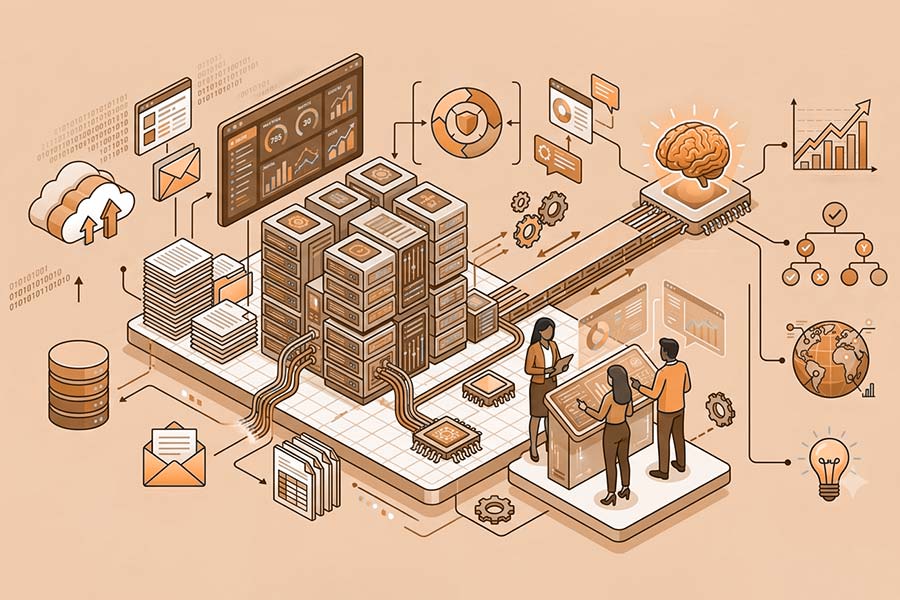
Every day, companies collect huge quantities of knowledge. Projects teach lessons of what worked and what didn’t work. Customer interactions give insights into preferences, problems, expectations, and buying patterns. Operational decisions create records of teams’ responses to changing circumstances. Policies and procedures are captured in documents, transactions and workflows are held in systems, discussions are recorded in communications, and practical expertise is built up by employees over years of experience.
But having the information doesn’t mean that an organization can necessarily remember it.
Much enterprise knowledge is still scattered across applications, databases, shared drives, emails, collaboration platforms, departmental repositories and individuals. A customer insight might be sitting in a sales platform, but the operational context is in an email thread. I don’t think many folks know that a project lesson is documented in a presentation. One experienced engineer might understand an important technical decision but never formally document it.
This fragmentation causes a serious problem from the organizational point of view; knowledge can be lost even when data itself remains available.
Loss of institutional knowledge can result from the departure of experienced employees, reorganization of teams, end of projects, replacement of systems and changes in business processes. An organization can technically keep thousands of documents and records but lose the reasoning, context, relationships and experience that make those records useful.
Traditional enterprise data strategies have largely been about collecting, storing, securing, and extracting data. Data warehouses, databases, document management platforms, and cloud repositories have built massive digital archives. But an archive is not always a memory. Storage tells you where the information is. Organizational memory must also capture what the information means, why a decision was made, how different knowledge elements relate to each other, and whether that knowledge is still relevant today.
This distinction brings in the concept of Technology as Organizational Memory. It’s a framework where enterprise technology is a living layer for keeping, connecting, making sense of, and activating knowledge in the organization.
This is an evolution of the role of enterprise technology for CIOs. Technology infrastructure is no longer just about running applications and storing information. It can become more and more the foundation that an organization can use to remember its experience and to apply it to decision-making.
Artificial intelligence, knowledge graphs, enterprise search, semantic technologies, retrieval systems, data fabrics, and intelligent knowledge platforms can connect information that was once siloed. Rather than expecting employees to know what system has an answer, these technologies can assist organizations in unearthing relationships across their accumulated knowledge.
The basic question is thus beginning to change.
Instead of asking “Where is the information?” organizations can increasingly ask, “What does the organization already know and how can that knowledge inform the next decision?”
This change has implications for employee onboarding, customer service, project management, compliance, strategic planning, sales, operations, and enterprise AI. A company that can hang onto the lessons from past projects can prevent the repetition of mistakes. A customer service team with access to historical interactions can provide more informed support. The new employee who can access institutional knowledge quickly can become productive faster.
Technology as Organizational Memory is really about the transformation of enterprise information into something that can persist, evolve, and contribute to action. The following sections explore what organizational memory is, how technology can create it, where businesses can use it, what benefits it provides, and what CIOs need to consider as they build increasingly intelligent enterprise knowledge environments.
Understanding Organizational Memory
Organizational memory is the knowledge that an enterprise develops over time through its experience, decisions, processes, relationships, interactions and results. It is the knowledge an organization has acquired over time as well as the organization’s capacity to make that knowledge available when similar situations arise.
Organizational memory, unlike individual memory, does not depend on the capacity of an individual to recall an event or describe a process. It should still be available when employees get promoted, leave the company, or retire.
Organizational memory might include:
- Past business decisions and the rationale behind them.
- Lessons learned from project completion.
- Customer histories and relationship background.
- Process knowledge and operational procedures.
- Past problems and how they were resolved.
- Decisions on regulatory compliance and interpretation.
- Product development experience.
- Decisions about the technical architecture.
- Business strategies that work and those that don’t.
- Knowledge and Practical Experience of Employees
Technology can provide the infrastructure to capture and preserve this knowledge. But storing more information is not the same thing as organizational memory. Data needs context, relationships, accessibility, governance, and the ability for employees and artificial intelligence systems to use it properly.
A good organizational memory system should assist in answering questions such as:
- Has the organization faced this problem before? What was the earlier decision? Why was that decision made?
- What happened next? What staff/teams have the relevant expertise? Which documents are evidentiary support?
- Has the policy or procedure changed since then?
- How relevant is the historical information to the present?
This is the transfer of organizational memory from archival storage to active institutional intelligence.
Data, Knowledge and Intelligence
One of the key differentiators in building organizational memory is understanding the difference between data, knowledge, and intelligence. Data is the most basic layer of enterprise information. This can include transactions, customer information, documents, application logs, financial records, project information, and communications. Data gives evidence, but rarely enough context to explain why something happened or what to do next.
Data has meaning in context. It describes relationships, timing, circumstances, ownership, and business relevance.
Knowledge is formed by linking information to experience, processes, decisions and outcomes. A project document is more useful to an organization if it knows which project it is from, who made the decisions, what the constraints were, and what the outcome was, for example.
Intelligence is that knowledge being useful for a current or future action.
So the progression can be viewed as:
Data → Context → Knowledge → Wisdom → Action
This distinction is critical as enterprises already have enormous amounts of data. The challenge is to convert that accumulated information into knowledge that employees and systems can actually use.
Organizations should think about:
- Data tells us what happened.
- Context explains why it happened.
- Knowledge connects information, experience, and relationships.
- Intelligence is the way knowledge can influence a decision.
- Action is applying the intelligence you have gained to the business situation.
Hence, big data volumes do not automatically translate into institutional intelligence. An enterprise might have petabytes of information, but if the relevant context is spread across multiple systems, it still won’t be able to answer a simple question.
Technology as Organizational Memory tries to fill this gap by linking information with the context and relationships required for its proper interpretation.
Tacit and Explicit Knowledge
Organizational knowledge is explicit as well as tacit.
Explicit knowledge is knowledge that has been documented or stored. It can be found in policies, databases, reports, project plans, operating procedures, training materials, customer records, presentations, and enterprise applications.
Samples:
- Standard operating procedures (SOPs).
- Product documentation.
- Project report.
- Customer Case Studies
- Compliance policies.
- Technical documentation.
- Financial reports
- Business Process Documentation
Tacit knowledge is more difficult to understand. It is found in employee experience, judgment, intuition, relationships, and practical understanding gained from repeated exposure to specific situations.
An experienced account manager can probably tell you which customer concerns are likely to hold up a contract. An experienced engineer may know of a technical failure mode that is not documented anywhere. A finance professional might have been involved in the original decision and therefore know why a particular process was designed in a certain way.
When these employees go, much of this information may go with them.
Technology can help uncover some of these patterns by looking at organizational records and connecting information employees might not know is linked. Artificial intelligence systems can discover commonalities in project documentation, communication, support cases, and operational records. Knowledge platforms can also offer mechanisms for validation, annotation, and contribution by employees.
But technology should not assume that inferred knowledge is automatically correct. The transformation of tacit experience into institutional knowledge still requires human validation.
Organizations can enhance this process by:
- Learning from close-outs of projects.
- Recording the rationale for major decisions.
- Enabling experienced employees to share contextual knowledge.
- Connecting employee expertise to relevant projects and processes.
- Using AI to recognize recurring patterns in the organization.
- Allow subject-matter experts to verify AI-generated knowledge.
- Clear ownership of key knowledge areas.
The objective is not to record every conversation. It is to find knowledge that can make a significant difference to future decisions and to keep it in a form that can be discovered and re-used.
Why is Organizational Memory Lost?
Organizations are in a state of constant change, and organizational memory is fragile. People move from one job to another, teams change, projects are finished, applications are replaced, and business directions change.
Institutional knowledge loss is the result of several factors:
- Employee turnover and retirement can result in the loss of years of practical expertise
- Organizational restructuring can put teams out of touch with the knowledge they once shared.
- Valuable lessons learned are buried in project-specific repositories when the project is completed.
- Trusting in historical information can be difficult with old documentation.
- Isolated data can keep employees from having the full picture of an issue.
- Knowledge saved in personal inboxes can become lost to the organization as a whole.
- Personal workflows may include valuable information that has never been formally documented.
- Without institutional mechanisms to capture lessons learned, organizations repeat the same mistakes.
- Historical information can be difficult to access due to legacy system replacement. Departmental silos may result in the same knowledge being recreated in isolation by different teams.
So, knowledge loss is not the only problem. It is also the invisibility of knowledge.
Information may be technically available but practically not available. There might be a document, but the employees might not know what that is. You could have a customer interaction logged, but the context might not be relevant to the current account situation. A solution to a current problem might be buried in a past project, but the team that worked on it may never find it.
That’s why enterprise storage isn’t sufficient for organizational memory. It demands an architecture that can retain information, understand context, form relationships, deal with freshness, respect access restrictions, and make relevant knowledge available at the point of use.
Here’s an opportunity for CIOs to consider organizational memory as an enterprise capability, rather than a collection of disjointed knowledge management programs. Enterprises can start to transform accumulated information into persistent institutional intelligence through a technology layer that constantly connects what the organization has experienced to what it is doing now.
From Data Repositories to Enterprise Memories
Enterprises have been building systems to capture and store information for decades. Databases, data warehouses, document repositories, cloud storage platforms, content management systems, and business applications have created massive digital archives. But the ability to seize information doesn’t mean an organization can remember, understand or utilize what it has learned.
The enterprise memory needs a different architectural mindset. Organizations have to link historical information to people, processes, decisions, relationships, and outcomes rather than viewing information as isolated records that can be retrieved when someone knows where to look. The goal is to make knowledge available in context and at the time it can influence action.
As organizations embrace AI, this shift from data repositories to enterprise memory is becoming ever more critical. While artificial intelligence systems can process enormous amounts of data, the value they provide is largely dependent on their ability to access accurate, relevant, and contextualized enterprise knowledge. Thus, the quality of institutional intelligence is not only a function of the quantity of data an organization has, but also of how that data is connected and activated.
Challenges of Existing Data Repositories
Traditional repositories were developed primarily to solve the problem of storage. The idea was to make sure that enterprise information could be captured, retained, secured and retrieved when needed.
That model worked well when employees knew which application had the information they needed. But that assumption is far too simplistic for the modern enterprise. Knowledge is distributed over hundreds, or thousands of systems, and meaningful knowledge often spans multiple systems.
Say, a customer issue may have data from a CRM system, a support platform, a billing application, a product database, an email conversation, a project management system, and so on. Each repository may contain a piece of the story, but none may contain the complete context.
a) The Limitations of Traditional Data Repositories
Traditional repositories have a few limitations:
- Typically, a database stores structured records, but it does not capture the full rationale of business decisions.
- Document repositories may store files, but they may not show how those documents relate to current projects or business situations.
- Keyword search relies on employees knowing the terms that were used when information was created.
- Departmental systems can generate isolated knowledge environments that hinder discovery enterprise-wide.
- Historical information may be technically available but practically invisible to employees.
- Information can lose value if its context, ownership, relevance or freshness is unclear.
- These limitations create a gap between availability of information and availability of organizational knowledge.
An employee may be searching for a past project and find hundreds of documents but not know which one has the most important lesson. A customer service rep might have access to years of customer records, but not the context to know what’s going on now. A senior executive might get detailed reports but he still has to ask several teams what happened in a similar situation in the past.
The root problem is that traditional repositories primarily organize information around storage structures rather than organizational meaning.
With enterprise memory, systems need to understand relationships like:
- Which customer was involved?
- Which project generated the information?
- Which decision was made?
- Who made the decision?
- What circumstances influenced it?
- What happened afterward?
- Is the information still valid?
- Where can supporting evidence be found?
Answer these questions and you turn enterprise information—a collection of records—into a connected knowledge environment.
b) Connecting Historical Information With Current Context
When you link historical information to what is happening in business today, it becomes much more useful.
A solution to a problem that another team is facing today may already exist in a previous project. A customer’s previous interactions can indicate an important preference pertinent to a current conversation. A decision on compliance made in the past may shed light on a new regulatory issue. Lessons learned from a previous product launch can help improve an upcoming launch.
- The trick is to do these connections automatically and reliably.
- Historical information related to the current context could involve:
- Connecting past projects to present efforts and recognizing similar circumstances.
- Connect customer histories with live customer interactions
- Linking past operational incidents to current system conditions.
- Making historical financial decisions based on current market or business conditions.
- Linking past strategic decisions with today’s organizational goals.
- Relating past compliance interpretations to current regulatory requirements.
- Providing teams engaged in similar efforts with lessons learned from previous projects.
This approach transforms the way employees interact with enterprise knowledge. Instead of looking in different repositories for something, they can ask questions about the situation they are in right now.
For example, an employee might ask which previous migrations had similar performance issues and how those issues were solved, rather than asking for “previous cloud migration projects.” The system would then need to find the relevant projects, assemble supporting information, understand the context and present the lessons that apply.
This is where enterprise memory wins against traditional search. The goal is not just to find historical information. It is to find out what history is relevant to the current situation.
It is particularly important to make this knowledge available in existing workflows. Employees should not have to leave their CRM, project platform, financial application or service environment any time they need institutional knowledge.
Or knowledge can be surfaced in the actual workflow:
- Customer service systems may provide pertinent historical cases during the active customer interaction.
- Project-management platforms can bring up lessons from similar projects that are already done.
- Sales systems can determine what customer objections have been in the past and how they have been successfully handled.
- Engineering environments can provide context of historical incidents and context of architecture.
- Executive dashboards link current performance with historical business patterns.
This allows a move from passive storage of knowledge to context-aware delivery of knowledge.
c) Constructing an Enterprise Memory Layer
An enterprise memory layer can be thought of as a knowledge architecture that persists and connects information throughout the organization.
Instead of displacing existing data systems, the memory layer can overlay them, integrating information from both structured and unstructured sources while preserving the necessary control over access.
The architecture may link:
- Enterprise databases and data warehouses.
- SaaS and business applications
- Repositories of documents and content
- Email and collaboration tools.
- Customer engagement.
- Project Documentation.
- Logs of service.
- Policies & Procedures.
- Technical documentation & knowledge bases.
- Knowledge from our employees.
The aim is not to build one huge repository that holds all the information of the enterprise. Instead, it is to build a connected layer that enables relevant knowledge to be found and interpreted.
There are several capabilities important for building this layer:
- A persistent knowledge model that captures key enterprise concepts and relationships.
- Connectors that combine information from multiple systems.
- Metadata about ownership, source, time, business relevance and data quality.
- Semantic technologies that provide consistent meaning across data sources.
- Context-sensitive relevant information retrieval systems.
- Access restrictions on the information that employees and artificial intelligence systems can view to only what they are allowed to access.
- Mechanisms to identify stale or outdated information.
- Feedback systems that aid employees in validating and improving organizational knowledge.
This architecture alters the role of the enterprise data. Data is no longer simply for reporting or record keeping. It becomes one element of the organization’s always-on knowledge layer.
The transition may be defined as:
Data storage → Information retrieval → Contextual knowledge → Institutional intelligence → Business action
The ultimate goal is knowledge activation. Enterprise memory has value to the extent that it can affect what employees and systems do next.
d) Decision Infrastructure: Memories
Enterprise memory can be an important input into organizational decision-making. Decision-makers can use the history of the organization, rather than relying only on current data, or the experience of one employee.
This can provide a wider perspective on complex situations.
Enterprise Memory enables organizations to:
- Draw on the relevant historical precedents.
- Find comparable projects and previous results.
- Compare current customer situations with historical customer interactions.
- Identify common operational issues.
- Review past risk events and reactions.
- Understand the reasons for past strategic decisions.
- Find relevant institutional expertise in employees or teams.
- Connect current problems with previously successful solutions.
The value is important particularly when decisions are made under uncertainty. The historical context tells us what happened when the same conditions existed before, what the options were, what choice was made and what the end result was.
But we should not necessarily take the historical precedent as a recommendation. Things change and a decision that was good five years ago may not be a good one today. So enterprise memory has to provide context, not just mindlessly regurgitate the past.
This is an important distinction between memory and automation. Memory holds what the organization knows. The way knowledge should be understood in the present is intelligence.
When enterprise memory is well integrated, dependence on informal knowledge networks can be eliminated. Employees don’t have to know the one person who “remembers how this was done last time.” Instead, the organization can make that knowledge discoverable via technology.
Core Technologies Behind Organizational Memory
To build an enterprise memory, several technology layers have to work together. No single technology can capture the full complexity of organizational knowledge. Knowledge graphs can express relationships, search can enable discovery, retrieval systems can link AI models to enterprise information, data fabrics can connect distributed sources, semantic layers can establish shared meaning, and generative artificial intelligence can render knowledge consumable through natural language.
Together, these technologies can act as an intelligent knowledge environment.
a) Knowledge Graphs
Knowledge graphs address this problem by describing relations between entities rather than isolated information records. An enterprise knowledge graph can link people, customers, products, projects, documents, applications, processes, decisions, incidents, and outcomes.
This enables organizations to understand relationships such as:
- Who worked on what project?
- What customers were affected by a specific product change?
- What document justifies a particular decision?
- What operational incident was associated with a specific system?
- What other projects have had a similar problem?
- Which teams have relevant subject matter expertise on an issue at hand?
Knowledge graphs are especially useful because knowledge in organizations is inherently relational. We often need to understand how one piece of information relates to other information.
b) Enterprise Search
Enterprise search is the discovery layer of organizational memory. Modern enterprise search is shifting from exact keyword matching to semantic and natural-language retrieval.
Employees can ask questions in everyday language, instead of having to know the exact name of a document, system or database field.
The best of enterprise search can:
- Provide unified discovery across multiple information sources
- Understand questions in natural human language.
- Focus on ideas, rather than just matching keywords.
- Sort results by relevance
- Customize results based on employee role and permissions.
- Surface history information relevant to current activities.
The goal is to reduce the time employees spend searching and increase the time they spend applying knowledge.
c) AI-Driven Retrieval Systems
Generative AI is connected to enterprise information through AI retrieval systems. Retrieval-augmented architectures can fetch relevant organizational information before an AI model generates a response.
This approach can improve the grounding of enterprise AI by giving models access to current organizational information rather than relying solely on their general training knowledge.
AI retrieval systems can help with:
- Enterprise assistants with context awareness.
- Internal knowledge discovery
- Customer service copilots.
- Technical support assistants.
- Policy & Compliance Questions.
- Project knowledge extraction.
- Executive research.
The retrieval layer is critical because an AI response is only as good as the enterprise information it’s based upon, and that information needs to be relevant, up-to-date, authorized and accurately retrieved.
d) Data Fabric
Data fabrics are an architectural approach to connect distributed data environments. They can help organizations discover, unify, govern and access information across disparate platforms.
Organizational memory: Data fabrics can give you:
- Unified access to distributed enterprise data.
- Metadata-driven discovery.
- Connections between structured and unstructured information.
- Support for historical and real-time information.
- Data governance and lineage.
- Integration across cloud, on-premises, and hybrid environments.
This means a data fabric can provide some of the connectivity foundation required for an enterprise memory layer, without requiring organizations to physically centralize every data asset.
e) Semantic Layers
Semantic layers provide consistent meaning across enterprise information.
Different departments have different names for the same idea. One team might call a customer an account, another a client, and another a business entity. Financial, sales, operational and technical systems may also define metrics differently.
A semantic layer can generate shared definitions of:
- Customers.
- Products.
- Business processes.
- Financial metrics.
- Organizational units.
- Projects.
- Risks.
- Employees.
- Business results.
This makes it easier for humans to understand and for AI to reason. By using common, consistent concepts across the enterprise system, information can be linked more easily across departments and knowledge can be retrieved accurately.
f) Generative AI
Generative AI provides an accessible interface to an organization’s memory. Employees can interact with enterprise knowledge using natural language rather than complex information systems.
Generative AI is able to:
- Provide historical project summaries.
- Justify earlier decisions.
- Compare Current Situations With Past Examples.
- Integrate information from several texts.
- Handle questions about organizational processes.
- Develop briefing from corporate knowledge.
- Make contextual recommendations.
- Transform complex information into practical explanations.
The goal is not to make generative AI the memory. Rather, artificial intelligence may serve as the interface through which employees access and interact with a broader enterprise knowledge architecture.
This distinction is important because an AI model without reliable enterprise retrieval can generate plausible but unsupported answers. Organizational memory is the foundation of the information architecture, governance, and retrieval that provide artificial intelligence systems with trustworthy context.
g) Information Platforms
Intelligent knowledge platforms unite these capabilities in a single environment.
Platforms like this can merge:
- Enterprise Searching.
- AI search.
- Graphs of knowledge.
- Data integration
- Semantic models.
- Generative AI (AI)
- Knowledge management.
- Access control.
- Audit and governance capabilities.
The outcome is a technology layer that can push organizational knowledge directly into employee workflows. Rather than asking employees to be experts on where information is stored, the platform can understand what they are trying to do and surface relevant institutional knowledge.
That is the fundamental change from enterprise data repository to enterprise memory. The organization isn’t just capturing what happened anymore. It builds an architecture that can remember what happened, understand how events and decisions are linked, and make that knowledge available when it can improve what happens next.
Also Read: CIO Influence Interview with John Elliott, Cybersecurity Author Fellow at Pluralsight
How Technology Transforms Enterprise Data Into Institutional Intelligence?
Turning enterprise data into institutional intelligence is more than just putting information into a repository. Organisations need a process that allows them to collect, contextualise, connect, retrieve, interpret and continuously improve data. The aim is to create an environment in which the knowledge built up over years of business can influence today’s decisions and workflows.
Technology supplies the infrastructure for this transformation. Enterprise applications create records, data platforms organise data, semantic technologies add meaning, knowledge graphs establish relationships, AI retrieval systems surface relevant information, and generative artificial intelligence can make the resulting knowledge accessible via natural language.
You can think of this as a knowledge lifecycle that never ends. Data is captured, context is added, relationships are made, knowledge is retrieved, intelligence is triggered, outcomes feed the system again.
a) Data Collection
The foundation of organisational memory is the collection of comprehensive and deliberate data. Almost all business activities create information for enterprises. However, such information is often captured by systems that are designed for individual functions rather than for institutional learning.
Customer relationship platforms capture interactions and account activity. Enterprise resource planning systems are used to capture financial and operational transactions. Project management tools save plans and milestones. Customer problems and solutions are recorded on service platforms. Collaboration tools are full of discussions, decisions and informal knowledge. Documents and presentations include strategic and technical information.
An organisational memory strategy must connect these sources into a knowledge environment while maintaining appropriate ownership and control over access.
Examples of relevant information include:
- Enterprise Application Records and Transaction Data.
- Customer contact and service history.
- Project plans, reports and lessons learned
- Events and incident logs (operational).
- Regulatory Documents, Policies & Procedures
- Internal communications & collaboration logs.
- Technical documentation and architectural decisions.
- Knowledge and expertise created by employees.
- Past business decisions and their outcomes.
The challenge isn’t necessarily to collect all of the information. Over-collection can lead to information overload and unnecessary privacy and governance risks. Rather it should be on the search for information that can be used for future organisational understanding.
Another key requirement is the ability to work with structured and unstructured information. While structured data is easy to query, a lot of important organisational knowledge is still stuck in documents, emails, presentations, transcripts, and other less structured forms.
These sources can be mined for meaningful entities, concepts, relationships and events using modern AI and data-processing technologies. This makes formerly inaccessible information available in the broader organisational knowledge environment.
b) Data Contextualization
Raw data rarely contains enough information to be useful institutional knowledge. Context helps an organization to make sense of information, its meaning, who created it and how it relates to other events.
Contextualisation is the process of enriching enterprise information with metadata and business meaning. For example, a project document is much more useful if the organization knows which customer it was for, which team built it, when the project happened, what business goal it served, and what resulted from it.
Important contextual elements are:
- People and roles in the organization
- Customer relationships Business relationships
- Initiatives & projects
- Goods and services.
- Business processes.
- Dates and times.
- Decisions and the logic behind them.
- Measurable outcomes and results.
- Policies and regulatory requirements.
- Source systems and data ownership.
temporal context is especially important. Organisational knowledge is dynamic. What was good policy three years ago may not be so now. Technical architecture might have changed. Customer tastes could have changed. A strategic decision may have been superseded;
Enterprise memory therefore has to understand both what information says and when it was true. Contextualisation can also be used to resolve ambiguity across departments. Different teams may have different language to talk about the same business concept. A semantic layer can link these ideas and define common meanings, which makes it easier for both employees and artificial intelligence systems to understand relationships across organisational boundaries.
Enterprise memory that is context-free risks becoming nothing more than a big document dump. With context it can start to represent how the organization actually operates and learns.
c) Knowledge Linking
The next step is to link related information across the enterprise systems. Knowledge is seldom found in a single record. It is generated from the interrelationships between events, people, decisions, processes, and outcomes.
Imagine a large customer implementation. You may be able to find the project information in the CRM platform, the technical details in engineering systems, project milestones in a project-management tool, and lessons learned in a final report. Linking these sources provides a much more complete picture of organisational experience.
Knowledge linking can be:
- Link customers to their engagements, projects, products and outcomes.
- Connecting staff with projects and areas of expertise.
- Connecting business decisions to the information that led to those decisions.
- Operational incidents mapped to systems and solutions.
- Linking projects to lessons learned.
- Connecting policies with the correct processes.
- Linking financial events to business decisions.
- Relating risks to past events and responses.
Knowledge graphs can be important in this process, since they explicitly represent relationships. Instead of merely keeping documents, the organization can produce a linked representation of relationships among entities and events.
This enables systems to identify repeatable patterns and organisational dependencies that may not be immediately obvious through traditional search. An enterprise might, for example, find that a number of unrelated projects experienced comparable delays in implementation because they depended on the same internal process. That insight becomes valuable institutional intelligence because it can affect the planning of future projects.
Thus, knowledge linking transforms isolated records into interlinked organisational experience.
d) Knowledge Retrieval
Once enterprise information is connected and contextualised, employees and artificial intelligence systems need a dependable way to retrieve it.
Traditional enterprise search requires the users to know the right keywords, document titles, folder structures or application locations. Organisational memory calls for a more contextualised approach. Ideally, an employee would describe a problem or objective in natural language and receive back information that reflects the situation rather than a list of matching documents.
Contextual retrieval can take into account:
- The employee’s position.
- The current business process
- The customer or project that was added.
- Related historical circumstances.
- The time the information was given.
- Source reliability and recency.
- The employee’s consent.
- The relationship between different sources of information.
With enterprise search, semantic understanding and generative AI in AI retrieval systems can provide more useful answers. Rather than hundreds of documents, a system can retrieve the most relevant sources and synthesise the key information from those.
The importance of evidence and source references cannot be overemphasised. Institutional intelligence should not be a black box, with employees not knowing where an answer came from. Employees can provide supporting documents, records, dates, and source references to verify critical information.
This is particularly important when enterprise artificial intelligence (AI) systems are used for strategic, financial, legal, technical or compliance-related decisions. Thus, the goal is to shift from document level search to contextual knowledge retrieval.
e) Intelligence Activation
If you bring knowledge into the workflows where decisions are being made, it’s strategically valuable. Enterprise systems can automatically surface the right information based on the business context, instead of employees having to hunt for organisational knowledge themselves.
For example, when a sales rep creates an account, the system could show relevant previous conversations, past objections, contract information and successful engagement techniques. When an engineer faces a technical incident, the system could surface similar incidents and their resolutions. When a project manager begins a new project, the platform can surface lessons learned from similar projects.
Intelligence activation can help:
- Decision recommendations.
- Contextual employee assistance.
- Customer-service responses.
- Project planning.
- Risk evaluation.
- Workflows for compliance.
- Sales activities.
- Troubleshooting operations.
- Strategic analysis .
AI-based enterprise assistants can bring this knowledge directly into business applications. Knowledge can also trigger automated actions when predefined conditions are met.
For example, if an operational event occurs that is similar to a prior encountered event, the system could automatically surface the resolution procedure used to resolve the previous event. If a compliance workflow reaches a certain condition, the system could display the relevant policy and historical interpretation.
This creates a transition from knowledge retrieval to knowledge activation. The organization is not just answering questions about the past. It is drawing on its accumulated experience to shape what happens next.
f) Ongoing Learning and Validation
Organisational memory can’t be static, because organisations are always changing. New projects bring new lessons. New customer interactions bring new knowledge. Regulations change. Technologies evolve. Business strategies shift.
A successful enterprise memory system thus needs a continuous learning and validation mechanism.
New experiences can be added through:
- Project review on completion.
- Customer service outcomes.
- Employee contributions.
- Analysis of operational incidents.
- Revised policies.
- New interpretations of rules.
- Business performance outcome.
- AI pattern detection.
- Feedback from subject matter experts.
Validation is just as important. Employees must be able to recognise information that is wrong, obsolete, incomplete or misleading. There should be clear mechanisms for owning and reviewing critical knowledge.
Enterprise memory can track metrics like:
- Freshness of information.
- Quality of source.
- Confidence indices.
- Ownership of knowledge.
- Validation status
- Last reviewed date
- Historical versus current relevance.
It is useful to prevent the fallacy of considering stale information as current institutional truth.
Continuous learning also gives organisations a way to measure whether their knowledge is actually driving better outcomes. If a previously recommended process continues to produce poor results, the system should be able to detect that pattern and change the way the knowledge is presented or weighted.
The result is a living organisational memory, not a static archive.
Business Applications of Organizational Memory
When the knowledge of an organization is tied to real world business processes, it becomes more apparent how much value enterprise memory has. Most functions can benefit from access to relevant historical context, without relying on individual employees or piecemeal searches.
a) Getting Institutional Knowledge
One of the most valuable, yet vulnerable, sources of knowledge in an organization is the employee experience. When experienced employees leave, organisations lose the knowledge of why processes are in place, how complex problems were previously solved, and what worked in certain situations.
Enterprise memory can keep this knowledge by linking employee expertise with projects, decisions, documentation and results.
Organisations can utilise it for:
- Collect lessons learned from completed projects.
- Retaining expertise as staff move around or leave.
- The reasons and the decisions as they were historically made.
- Building searchable institutional knowledge.
- Connecting employees with the relevant historical expertise.
- Reduce dependence on individual experts.
The goal is not to make the importance of old hands disappear. But technology can make sure that the knowledge they have acquired serves the organization beyond their immediate function.
b) Accelerating Employee Onboarding
New employees often spend a lot of time getting to know how an organization operates. Policies and procedures can be explained in formal training but organisational context can take much longer to learn.
Enterprise memory can help to reduce this learning curve by enabling new employees to access the right historical information.
AI-powered onboarding assistants might explain:
- How important processes function?
- Why are there specific procedures?
- What systems support specific workflows?
- How have previous teams reacted in similar situations?
- What documents are authoritative?
- Who has experience in organization, as related to?
This may result in more contextual and interactive onboarding. Rather than just reading training materials, employees can ask questions about how the organization has dealt with real situations in the past.
c) Enhancing Customer Service
Institutional knowledge can be valuable for customer relationships. But that knowledge can be scattered across support tickets, CRM records, emails, sales conversations, product conversations and account management systems.
Organisational memory can link these interactions and give customer-service teams a richer picture.
Uses include:
- Linking current conversations to past customer interactions.
- Finding similar support issues and the solutions that worked.
- Understanding customers’ recurring problems.
- Provide relevant history of product and account.
- Offering support for more tailored answers.
- Reducing the need for customers to repeat their situation over and over again.
This results in both improved service efficiency and customer experience, as employees spend less time reconstructing history and more time fixing the current problem.
d) Supporting strategic decisions
The institutional context is also useful for strategic decisions, because executives often want to know not only what happened but why past decisions were made. Memory can report on past strategies, past market responses, operational outcomes, and past assumptions.
Executives may utilise organisational memory to:
- Compare current conditions with historical precedent.
- Review past strategic decisions and their results.
- Recognise patterns across business cycles.
- Use the lessons learned from prior initiatives.
- Support scenario analysis
- Challenge assumptions with historical evidence.
The system can be an institutional research layer for the leaders to make decisions based on the experience gained in the organization.
e) Learning From Previous Projects
Lessons learned are not easily available when new projects start, and organisations often repeat project mistakes. Enterprise memory captures project decisions, challenges, dependencies, risks and outcomes so future teams can benefit from that knowledge.
It can help teams to:
- Identify common implementation issues.
- Watch what works.
- Compare new projects and historic initiatives
- Use processes that work.
- Expect standard risks.
- Enhance project planning.
More projects adding information to the knowledge system increases the value. Over time the enterprise can build up a deeper understanding of what works in what circumstances.
f) Enhancing Compliance
Compliance processes are often based on historical interpretations, policies, evidence, decisions and documentation. Without this institutional context, inconsistency and higher regulatory risk can result.
Enterprise memory links policies to the processes, decisions and evidence that support them.
Applications could include:
- Maintaining Regulatory Interpretations .
- Linking policies to operational procedures.
- Keeping records of historical compliance decisions.
- Supporting audit preparedness.
- Supporting evidence for earlier actions.
- Ensuring consistency across all compliance processes.
This allows compliance teams to move beyond looking through archives to find contextual institutional knowledge.
g) Support for Sales and Account Management
Sales organisations are rich in relationship intelligence, but much of that can stay trapped within individual account managers, CRM notes, emails and meetings.
Enterprise memory captures the account history and provides relationship intelligence to the current teams.
It’s valuable for sales and account-management teams:
- Understand the history of customer relations.
- Good answers and past objections raised.
- Identify key stakeholders and relationships.
- Link sales conversations to customer outcomes.
- Identify relationships between similar accounts.
- Encourage more informed engagement approaches.
When an account manager switches to another role, the organization can preserve more of the relationship context rather than making a new employee recreate years of history by hand.
In these applications, organisational memory is a practical enterprise capability, not a knowledge management concept. The technology doesn’t simply store information for later use. It enables accumulated experience to inform current work.
That’s the core change from enterprise data to institutional intelligence: the organization starts to use its own history as a live source of context, learning and decision support.
Enterprise Organizational Memory: Business Advantages
Enterprise organizational memory can turn accumulated information into a strategic business asset. By avoiding the dispersion of important knowledge across employees, applications, documents and historical records, organizations can develop a linked knowledge environment that facilitates both daily operations and strategic planning. The benefits are productivity, collaboration, resilience, compliance, customer experience, and enterprise AI.
a) Reduced Knowledge Loss
One of the biggest advantages is that you keep the knowledge of the institution when employees leave or change positions. Experienced employees often possess knowledge about customers, processes, technical systems, projects and decisions that may never be fully documented. Enterprise memory can store and link this knowledge to relevant organizational information, thus decreasing the loss of expertise when people leave.
This helps create more continuity across the organization. It enables teams to tap into decisions made in the past, lessons learned on projects, customer context, and operational experience without relying solely on the people who were there when that knowledge was first created.
b) Faster Access to Institutional Information
Employees often spend a lot of time searching for information across different systems. Enterprise memory can help to reduce this friction by offering a connected way of discovering relevant knowledge within the organization.
Instead of having to go to different databases, documents, emails, and project repositories, employees can use contextual search and AI retrieval to find the information they need for the task at hand. Faster access to institutional knowledge can accelerate research, problem solving, customer support, project execution and decision making.
c) Improved decision making
We can learn from history to make better choices today. Enterprise memory enables decision-makers to think back on what happened, analyze the logic of past decisions and to review the results.
That is not to say that organizations should always repeat past decisions. Instead, historical knowledge serves as a reference point for what worked, what did not work, and what conditions influenced past outcomes. This institutional context can be combined with current information to enhance the quality of decision-making.
d) Higher Productivity of Employees
Productivity is lost when employees have to recreate historical context, search for information over and over, or ask colleagues for knowledge that is already somewhere in the organization. Enterprise memory can reduce these activities by making relevant information more accessible to the employee.
AI-enabled knowledge systems can summarize documents, explain processes, find previous solutions and answer questions based on approved enterprise information. This means employees spend less time looking for knowledge and more time using it.
e) Faster onboarding and knowledge sharing
New hires usually require time to learn systems, processes, customers, terminology and organizational practices. Enterprise memory can reduce this learning time by providing access to institutional knowledge through contextual search and AI assistants.
New employees learn what a process is, but also why it exists, how it’s been used in the past, and where the problems are likely to be. This can improve knowledge transfer and at the same time reduce the organizational burden on experienced employees who would otherwise have to explain the same information over and over again.
f) Reduced Duplication of Work
Organizations often reinvent the wheel as employees can not easily find that similar work has already been done. Enterprise Memory is a repository of previous projects, research, technical solutions, customer cases and operational approaches relevant for the current work.
This can reduce duplicated analysis and encourage reuse . This allows teams to build on what they already know instead of starting over, making them more efficient and consistent.
g) More Resilience in Organizations
Organizational resilience is partly based on the ability to create continuity in the face of change. Knowledge gaps can arise through employee turnover, restructuring, technology migration, acquisitions and market disruptions.
An enduring enterprise memory can help maintain important institutional context across those transitions. When knowledge is linked to the organizational systems and not to individual employees, teams are better able to adapt to change.
h) More Robust Organizational Learning
Enterprise memory makes individual experience collective learning possible. Every project, every customer interaction, every operational incident and every strategic decision has the potential to add to the knowledge base of the organization.
Eventually, AI and analytics will be able to find recurring patterns across these experiences. Organizations can discover why projects are late, why customers keep having the same problems, what works well in operations, or why the same mistakes are made in decision making. This provides a basis for ongoing learning in the organization.
i) Superior Customer Experience
Customer data is often spread across sales, service, marketing, billing and product systems. Connecting this history gives employees a better understanding of customer relationships.
The service teams can see past interactions and resolutions, account managers can see the relationship history and support staff don’t have to keep asking customers to repeat the same information again and again. This creates more personalized, consistent and efficient customer experiences.
Challenges and Risks
There are also major challenges in building enterprise organizational memory. An intelligent memory system can quickly become a liability if it is retaining inaccurate information or exposing sensitive data, if it is producing unsupported AI responses or overwhelming employees with irrelevant knowledge. As such, CIOs need to treat governance, quality, security and lifecycle management as core architectural requirements.
a) Outdated Information
Enterprise knowledge is always changing. Policies change, systems change, business processes change, customer relationships change. What was once true in terms of history may later on become misleading.
This is particularly challenging for retrieval based on AI. A system may find an old policy and confidently present it, regardless of whether there is a newer version. Enterprise memory then needs freshness indicators, document versioning, ownership data, review schedules, and lifecycle management.
The system must be able to distinguish between historical context and current guidance so employees know if the info is still relevant.
b) Data Privacy
Organizational memory may include sensitive customer, employee, financial, operational and strategic information. Connecting these sources may improve their utility, but it also raises the stakes of improper access.
Privacy issues need to be considered during data collection, storage, retrieval and processing by AI. Organizations need to decide what information is really needed for institutional memory and not collect everything blindly.
Appropriate data minimization, retention policies, encryption, monitoring, and access restrictions are expected for privacy-aware architectures. Employees should be able to access organizational knowledge without being able to access unnecessary sensitive information.
c) Access Management
Not every employee should have access to every piece of knowledge in the enterprise. A connected memory layer can inadvertently become a tool to circumvent permissions if it fails to maintain the authorization policies of underlying systems.
This makes role-based access, identity management, contextual permissions and source-system authorization essential. AI retrieval systems must respect a user’s current access rights when searching enterprise information.
Controls over access should also be extended to AI agents and automated applications. As machines interact more with corporate memory, organizations will need to define what information each system is allowed to retrieve and what actions it is allowed to perform with that information.
d) AI Hallucinations
Generative artificial intelligence can produce seemingly credible but unsubstantiated information, especially if enterprise sources are incomplete, inconsistent, or poorly organized. An incorrect answer can be particularly damaging in an organizational memory setting since employees are likely to assume the information represents institutional knowledge.
The risk can be mitigated by retrieval grounding, which links responses to authoritative enterprise sources. Additional safeguards can be provided by source citations, confidence indicators, document dates and human validation.
Organizations should also make a distinction between the facts retrieved and the interpretation generated by AI. Employees need enough transparency to know what is coming directly from enterprise records and what has been inferred or synthesized by an AI system.
e) Data Ownership
Organizational memory also brings up an interesting question: who is responsible for keeping institutional knowledge alive?
Different departments may own different sources of information and their definitions or interpretations may be conflicting. If ownership is unclear, the knowledge environment could retain old or conflicting information forever.
Organizations need knowledge owners responsible for important domains including policies, customer information, technical documentation, processes and strategic knowledge. Clear ownership defines responsibility for accuracy, updates, validation and retirement of obsolete data.
f) Data Overload
More information does not necessarily make for more informed employees. Too much information may lead to a different kind of friction within an organization. So, enterprise memory requires intelligent prioritization. The goal shouldn’t be to simply deliver the biggest possible set of documents; systems should be able to determine what’s relevant to the employee’s role, task, customer, project and current context.
Contextual retrieval, relevance ranking, summarization and personalization can convert large amounts of information into manageable knowledge.
g) Knowledge Bias
Historical organizational knowledge may contain outdated assumptions, ineffective practices, or institutional bias. To preserve the past is not to accept the past as right. Artificial intelligence systems need to be able to tell the difference between best practice and precedent. Provide historical decisions as context, especially if the current conditions are very different from the conditions that existed when the original decision was made.
Regular review and human validation will allow organizations to retain useful lessons without institutionalizing outdated approaches.
h) Integration Complexity
By connecting legacy applications, cloud platforms, databases, documents, collaboration tools and specialized business systems, you build enterprise memory. These systems might use different data formats, identities, metadata structures, and access models.
Keeping synchronization can be technically challenging especially when data is changing constantly. CIOs need integration architectures that can preserve data lineage, identity integrity, freshness and reliability across the knowledge environment.
Future Outlook: Toward Continuous Learning Organizations
The future of organizational memory will shift from static knowledge repositories to systems that continuously update, interpret and activate enterprise knowledge. As AI is further embedded in enterprise operations, organizational memory could become an essential layer of how companies learn and make decisions.
a) Self-Updating Corporate Memories
The memory systems of future enterprises will be increasingly self-updating as new information becomes available. New projects, customer interactions, decisions, policies, and operational events are all sources of ongoing additions to the organization’s knowledge base.
AI is able to find outdated information, spot duplicate content, flag inconsistencies, and suggest updates. Rather than constructing a memory that relies on periodic knowledge-management exercises, organizations can construct a memory that constantly changes with the business environment.
b) AI-based Knowledge Agents
AI knowledge agents might be persistent interfaces to institutional intelligence. These agents can get information, bring together historical context, track business activity, and proactively surface knowledge when it is relevant.
For example, an agent might determine that a current project is similar to a past one and therefore present lessons learned from that past experience. Or another agent could keep an eye on customer activity to find relevant past interactions for an account team.
It shifts organizational memory from a system that employees will access to a capability to engage in work.
c) Contextual Intelligence
Future systems will better understand the context behind employee questions and business decisions. Systems will not just return information about a customer, project or process but the information that makes the most sense in the situation.
The context can include role, timing, business objective, customer relationship, project stage, risk level, and previous organizational experience. This will enable enterprise memory to provide more accurate knowledge, rather than generic search results.
e) AI’s Foundation: Organizational Memory
Enterprise memory will take on added importance as organizations roll out internal artificial intelligence (AI) systems. While generic AI models can do many things, enterprises need to be able to feed them proprietary knowledge of the organization to do useful business tasks.
A solid organizational memory can be the foundational layer that links AI models to company-specific information, terminology, processes, policies, history, and decisions. That can lead to better relevance and less reliance on generic model knowledge.
f) Learning Organizations
Evolution’s end point is the continually learning organization from its own activities. Institutions can learn from projects, transactions, decisions, customer interactions and operational experiences that enable a persistent learning cycle.
Artificial intelligence can help employees identify lessons that might otherwise be hidden by identifying patterns across these experiences. Technology becomes an active mechanism by which the enterprise learns, not just a system for storing organizational knowledge over time.
g) CIO as Architect of Institutional Intelligence
This expands the strategic role of the CIO. CIOs will have to go beyond infrastructure, applications and data management, to the architecture of organizational knowledge itself.
The CIO might be accountable for how enterprise information is connected, contextualized, retrieved, governed, protected and activated. This will require coordination across data architecture, AI, cybersecurity, identity, knowledge management, business applications and business processes.
The winners will think of institutional intelligence as an enterprise capability, not a stand-alone AI project. Their technology environments will collect and store experience, link knowledge, offer context, and learn continuously from outcomes.
In the end, enterprise organizational memory can become one of the most important layers of the modern digital enterprise. Organizations that learn to preserve what they know, know what still matters and activate that knowledge at the right time will be best positioned to make faster decisions, adapt to change and build lasting institutional intelligence.
Final Thoughts
One of the most valuable assets an enterprise already has is organizational knowledge, but much of that knowledge is fragmented across applications, documents, databases, workflows and individual employees. Organizations may have years of accumulated experience, but that experience can become difficult to access when employees depart, teams shift, systems are swapped out or historical information loses its context. The result is an enterprise that has accumulated massive amounts of information, but may not be able to remember, understand and apply what it has learned.
There is an opportunity for technology to change this dynamic, turning enterprise data from passive storage into active organizational memory. The goal is no longer to just keep records for future use, but to build a connected knowledge environment where historical experiences, decisions, relationships, and outcomes can inform present work. When information is contextualized and made accessible, the enterprise can begin to treat its accumulated experience as a standing source of intelligence.
The role of CIOs in enabling this transformation is growing in importance. They can connect data, context, history, relationships and workflows to build an institutional intelligence layer across the organization. Knowledge graphs reveal the relationships between people, projects, customers, systems and decisions. Enterprise search can help you find distributed information. AI retrieval systems can tie organizational knowledge to intelligent applications. Data fabrics and semantic layers can offer the connectivity and common meaning needed to make information usable across organizational boundaries. Generative AI and intelligent knowledge platforms can then deliver this knowledge through natural-language interactions and embedded business workflows.
Organizational memory will not be about static repositories but self-updating, context-aware, and AI accessible enterprise memory. Rather than waiting for employees to look for information, future systems will more and more be able to identify when past knowledge is relevant and surface it proactively. AI knowledge agents can identify similarities between current and previous situations, retrieve pertinent evidence, and provide institutional context for decision-making.
Organizations that keep their knowledge alive and active, day in and day out, can reap huge benefits. They can make faster, better decisions, accelerate employee onboarding, improve client experiences, re-use what works, avoid repeating mistakes, reinforce compliance, and become more resilient during organizational change. Most importantly, they reduce reliance on individual employees as the sole bearers of critical institutional knowledge.
The ultimate transition is from an enterprise that simply stores what it knows, to an enterprise that can continually remember, understand and apply what it has learned. Organizational memory is important when past experience is not only retained but also connected to current situations and future choices.
This gives CIOs a chance to raise technology to much higher than an information infrastructure. They may develop an intelligent organizational memory that keeps institutional knowledge alive, evolving and influencing decisions long after the original event, project or employee is gone. Technology becomes part of the enterprise’s capacity for continual learning, adaptation and improvement.
Catch more CIO Insights: How Are CIOs Aligning Technology with Workforce Agility?
[To share your insights with us, please write to psen@itechseries.com ]
