

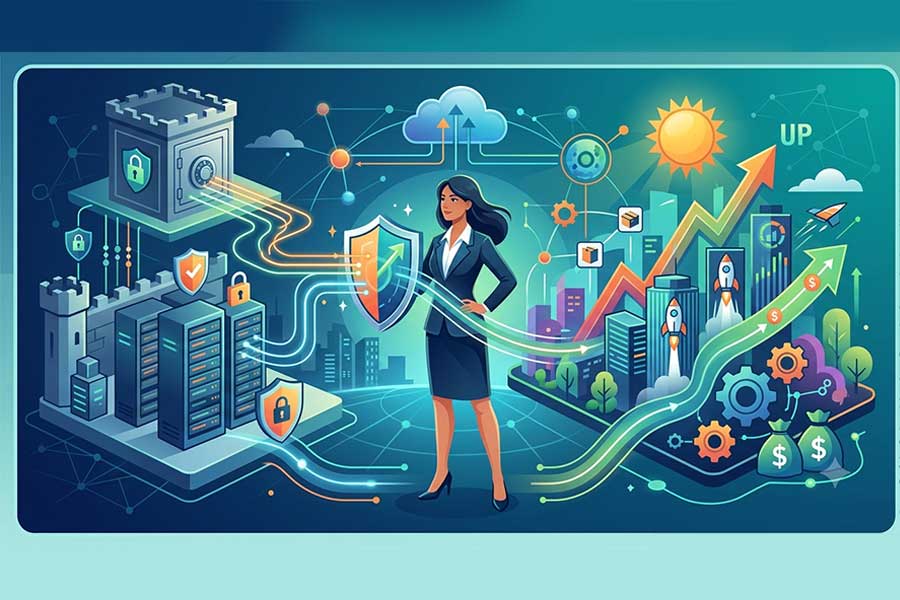
Enterprise security is in the midst of one of the greatest transformations it has ever seen. For decades, cybersecurity has been seen as a primarily defensive function, tasked with protecting networks, devices, and applications against unauthorized access.
Organizations invested heavily in firewalls, antivirus software, and perimeter security controls designed to keep attackers out of the corporate network. These measures were a critical layer of protection in a business environment where employees worked from office locations, applications ran in centralized data centers, and there were relatively limited digital interactions. The highly connected digital economy of today requires a much more intelligent, adaptable approach to enterprise security.
The enterprise attack surface has expanded exponentially with the rapid rise of cloud computing, hybrid work, artificial intelligence, Internet of Things (IoT) devices, and interconnected supply chains. Today’s organizations operate in distributed digital ecosystems where employees, customers, partners and third-party vendors share sensitive information continually. At the same time, the online dangers have become more sophisticated. Ransomware attacks, advanced persistent threats, phishing campaigns, software supply chain compromises and AI-assisted cyberattacks continue to challenge organizations across all industries. These changing threats are coupled with increasing regulatory demands around privacy, data protection and cyber security governance, forcing enterprises to revisit how security supports business operations.
As digital transformation accelerates at an ever-faster pace, cybersecurity is no longer seen as just an operational necessity or a compliance requirement. Rather, security is becoming a strategic business enabler, allowing organizations to innovate with confidence, increase customer trust, safeguard valuable digital resources, and expand into new markets without compromising resilience.
Modern security strategies don’t just prevent cyber incidents; they also speed the adoption of technology, help facilitate cloud migration, protect digital customer experiences, and create secure environments for innovation to thrive. Organizations are increasingly aware that cybersecurity is not just a safety requirement, but a business enabler that helps reduce risk and increase confidence between stakeholders.
This is an artificial intelligence-driven change that enables security operations to be proactive instead of reactive. AI-based cybersecurity platforms continuously monitor network activity, user behavior, application performance, and threat intelligence in real-time to detect anomalies before they escalate into serious incidents. Machine learning algorithms identify emerging attack patterns, automate threat investigation, prioritize vulnerabilities, and recommend remediation actions in real time. This allows security teams to react more quickly, reduce manual workloads, and improve enterprise resilience to ever more sophisticated cyber assaults.
CIO leadership has been crucial in driving the integration of cybersecurity into broader digital transformation strategies. Today’s CIOs integrate cybersecurity efforts into enterprise goals, business continuity planning, innovation initiatives, customer experience strategies and regulatory compliance efforts, rather than viewing security as an isolated IT function. Security decisions are now impacting cloud adoption, software development, artificial intelligence implementation, supply chain modernization and enterprise risk management. This broader leadership role positions CIOs as architects of secure digital transformation that can balance protection with business agility.
This new philosophy of enterprise cybersecurity is business enablement driven by security. Security frameworks are intended to accelerate innovation by embedding protection directly into digital processes, applications, and business workflows, instead of hindering operations with too many controls. This means that organizations can embrace emerging technologies at a faster pace, as intelligent security mechanisms continuously monitor, adapt, and respond to changing risks without impacting business performance.
Thus, cybersecurity has become a strategic business capability, affecting competitiveness, operational resilience, customer loyalty, and long-term growth. Strong security capabilities enable organizations to access regulated markets, create trusted digital services, protect intellectual property, and keep operations running through periods of uncertainty. Smart cybersecurity spending gives businesses a competitive edge and demonstrates to customers, investors, regulators, and partners that they are trustworthy, transparent, and responsible digital citizens.
Today, digital trust is one of the most valuable assets an enterprise has. Customers increasingly expect organizations to protect personal information, to secure digital interactions, and to responsibly address emerging cyber risks. Employees need secure collaboration environments that boost productivity without being overly complicated. Investors want organizations that can manage cyber risk and ensure business continuity.
Creating this trust requires cybersecurity strategies that combine intelligent technologies and effective governance with visionary CIO leadership to enable secure innovation across the enterprise.
What is Security as Business Enablement?
Security as business enablement is the strategic lens of leveraging cybersecurity not just to protect enterprise systems, but also to actively enable organizational growth, innovation, operational resilience, and digital transformation. Security is no longer a barrier to doing business, but an embedded capability that enables organizations to capitalize on new opportunities while intelligently managing risk.
The core idea is to embed cybersecurity in all business processes, technology adoption, and consumer engagement at all levels. Today’s security frameworks are designed to protect enterprise assets while enabling cloud adoption, digital services, AI deployment, remote employment, and global collaboration – all without sacrificing organizational agility.
This approach is motivated by the need to balance protection, innovation, and operational flexibility. Security controls must protect critical information and reduce friction for employees, customers, and business partners. Intelligent cybersecurity enables enterprises to have the confidence to innovate because protection is integrated into enterprise processes, not bolted on after the fact.
The Shift from Traditional Cybersecurity to Business-Centric Security
With the growth of digital technology, enterprise cybersecurity has grown as well. The traditional perimeter security approach focused on securing the corporate network through firewalls, intrusion prevention systems, and endpoint security. Organizations assumed that threats came from outside the enterprise and viewed network boundaries as the first line of defense.
Cybersecurity has evolved to encompass wider risk management strategies as businesses have become digitalized. Insider threats, data protection, identity management, third-party risk, and regulatory compliance were addressed by enterprise-wide security programs.
Another major milestone was the development of the Zero Trust architecture. Zero Trust does not automatically trust users or devices based on their network location, but rather continuously authenticates every identity, device, application, and transaction, regardless of origin. This model delivers enhanced protection across cloud environments, hybrid workforces, and dispersed digital ecosystems.
Today, security-driven enterprise enablement is more than just protecting infrastructure. Cybersecurity is driving cloud migration, software modernization, customer experience, AI adoption, and digital business innovation while enhancing resilience across the organization. Security is now a proactive contributor to business value, not just an operational safeguard.
Why Is Security Becoming a Business Strategic Capability?
There are several broad trends driving cybersecurity to the forefront of enterprise strategy.
The cyber threat is becoming more sophisticated and common. Ransomware attacks, AI-assisted phishing, supply chain compromises, insider threats, and nation-state cyber activities present significant operational, financial, and reputational risks for organizations.
Digital ecosystems increase enterprise exposure even more. Today’s businesses depend on cloud providers, SaaS applications, connected devices, APIs, business partners and remote employees in highly connected environments that need to be monitored for security 24/7.
There are also increasing regulatory expectations. Organizations must be able to demonstrate responsible risk management and comply with the requirements of evolving privacy regulations, cybersecurity standards, financial reporting requirements, and industry-specific governance frameworks.
Digital trust is becoming a key factor for customers in judging organizations. Secure, responsible data management, transparent privacy practices, and trustworthy cybersecurity impact purchase decisions and long-term customer loyalty through digital experiences.
At the same time, businesses have become more and more dependent on secure digital operations. “Resilient digital infrastructure is essential for revenue generation, client engagement, supply chain management, financial transactions and enterprise collaboration. Thus, security directly supports business continuity, competitive advantage, and long-term expansion.
The Rising Power of CIO Leadership
CIO Leadership has grown to be so much more than management of technology. Today’s CIO is a strategic leader who aligns enterprise technology with the organization’s goals and ensures that cybersecurity is embedded in all digital transformation initiatives.
Today’s CIOs are increasingly enterprise risk leaders, accountable for cybersecurity strategy, technology governance, cloud transformation, AI adoption, regulatory compliance and operational resiliency. Security decisions are assessed according to business growth goals and not as standalone technical issues.
By integrating cybersecurity with business goals, organizations can safely adopt new technologies and protect productivity, customer satisfaction, and operational efficiency. Finally, CIOs work closely with executive leadership to align security investments with broader enterprise priorities such as innovation, digital modernization, workforce transformation, and customer experience.
Another defining responsibility is to establish digital trust across the enterprise. CIO Leadership creates governance frameworks, security policies, risk management practices, and technology standards that build stakeholder confidence while advancing responsible innovation.
At the end of the day, CIO Leadership is leading with secure innovation by integrating cybersecurity into every layer of enterprise transformation. Intelligent security allows organizations to modernize with confidence, adopt new technologies responsibly, and compete effectively in a more digital global economy, instead of hindering progress.
Core Components of Contemporary Enterprise Security
Modern enterprise security is not about siloed security tools or reactive defense mechanisms. Instead, organizations are adopting integrated cybersecurity frameworks that continuously monitor, protect, and optimize digital operations across cloud environments, hybrid workforces, applications, data, and connected ecosystems.
AI, automation and intelligent analytics allow security teams to move from threat prevention to enterprise resilience, where security is an active enabler of business continuity, innovation and operational excellence. The following components form the basis of modern enterprise security.
a) Zero Trust Security Architecture
Modern cybersecurity strategies are now based on Zero Trust. Unlike traditional perimeter-based security models that assume users and devices inside the corporate network can be trusted, Zero Trust is based on the principle of “never trust, always verify.” Every user, device, application, and transaction is authenticated on an ongoing basis before access is granted.
Continuous identity verification means users are validated not just at login but continuously during each session. Artificial intelligence evaluates user behavior, device health, location, access patterns, and contextual information to determine whether to allow access to continue.
Least-privilege access also reduces the risk to the organization by giving users the permissions they need to do their jobs. Limiting unnecessary access significantly reduces insider threats, as well as the scope of impact that compromised credentials can have.
Secure access management combines identity verification, device authentication, adaptive authentication, and policy-based authorization into a single security framework that protects enterprise resources across distributed environments.
Organizations derive several key benefits from Zero Trust architecture:
- Seamless identity verification across enterprise systems.
- Controls access based on least privilege.
- Strong identity and access management for cloud and on-premises environments.
- Less exposure to insider threats.
- Enhanced hybrid workforce protection.
Zero Trust never assumes trust, it constantly checks it, helping enterprises build resilience and achieve secure digital transformation.
b) Enterprise Identity and Access Management (IAM)
Identity is the new security perimeter of the modern digital enterprise. Enterprise Identity and Access Management (IAM) delivers seamless user experiences while ensuring only authorized people have access to organizational resources.
Identity governance provides a centralized way to control employee identities, user roles, access rights and lifecycle management. Automated governance keeps access rights in line with changing organizational responsibilities.
Multi-factor authentication (MFA) adds another layer of identity verification by requiring more than one type of authentication before granting access to a system. Combining passwords with biometrics, authentication applications, or hardware tokens greatly mitigates credential-based attacks.
Privileged Access Management (PAM) safeguards the most sensitive admin accounts with elevated system privileges. AI continuously monitors privileged activity, enforces strict access policies and logs all administrative actions for compliance purposes.
There are many benefits to Enterprise IAM:
- Centralized identity governance.
- Multi-factor authentication.
- Privileged access management.
- Automated identity lifecycle management.
- Improved regulatory compliance.
Identity-centric security allows organizations to secure digital resources and fuel workforce productivity.
c) AI-Powered Threat Intelligence
Artificial intelligence is transforming the way that organizations detect, analyze, and respond to cyber assaults.
Threat prediction uses machine learning algorithms to analyze historical attack patterns, threat intelligence feeds, vulnerability databases and organizational activity to predict emerging cyber risks before an attack happens.
Behavioral analytics monitors user behavior, app usage, network traffic and device interactions on an ongoing basis to detect anomalous patterns of behavior that may suggest compromised accounts or malicious activity.
Artificial intelligence (AI) systems detect suspicious behaviour, classify security events, prioritise alerts and initiate remediation actions, without the need for manual intervention, greatly reducing response times in automated threat detection.
Here’s how AI-powered threat intelligence can help organizations:
- Predictive threat identification.
- Behavioral anomaly detection.
- Automated threat investigation.
- Faster incident prioritisation.
- Continuous assessment of cyber risk.
This frees up security teams to focus on strategic threat management, while AI handles routine monitoring.
d) Cyber Resilience
Cybersecurity today is not simply about stopping attacks; it’s about ensuring organizations can continue to operate in and around security events.”
Business continuity planning helps organizations to maintain essential operations in the face of cyber disruptions, infrastructure failures or ransomware attacks. Threat prevention is now being supplemented with operational resilience in security strategies.
Disaster recovery capabilities are organized procedures that enable the restoration of systems, applications, and business operations after major incidents. Cloud technologies, automated backups, and distributed infrastructure speed up recovery.
Automation of incident response allows AI to coordinate containment measures, isolate compromised systems, notify stakeholders, initiate remediation activities, and document security incidents without human intervention.
Cyber resilience offers organisations:
- Business continuity capabilities.
- Disaster recovery planning.
- Automated incident response.
- Operational resilience.
- Reduced downtime during cyber events.
Resilient organizations recover faster, with less disruption to their financial and operational processes.
e) Security Operations Intelligence
Security Operations Centers (SOCs) are transforming into smart operational centers that leverage automation, analytics, and real-time visibility.
Regular monitoring gives you 24×7 visibility into your enterprise infrastructure, cloud environments, applications, networks, endpoints, and user activity. AI is able to sift through huge amounts of security events, far more than any human could process.
Security analytics combines data from an assortment of security tools, threat intelligence platforms, identity systems, cloud applications, and network devices to provide actionable security insights.
Real-time incident management allows security teams to rapidly investigate threats, orchestrate response actions, triage critical alerts, and have complete situational awareness of enterprise environments.
Security operations intelligence:
- Continuous security monitoring.
- Advanced security analytics.
- Real-time incident management.
- Threat prioritization.
- Enterprise-wide operational visibility.
The intelligence capabilities improve cybersecurity effectiveness and operational efficiency.
f) Enterprise Security Governance
Strong governance ensures that cybersecurity is aligned with company objectives and supports regulatory compliance and enterprise risk management.
Risk management frameworks recognize, evaluate, rank and mitigate cybersecurity risks according to business impact rather than technical severity. Executive leadership has become more aware of enterprise cyber risk.
Policy enforcement ensures that security standards are applied consistently across users, devices, applications, cloud environments, and business units. Automated enforcement improves governance and reduces human error.
Compliance automation keeps you up to date with changing rules and laws. It monitors and controls 24/7, generates audit papers, identifies where you are not compliant, and helps with your required reporting.
Enterprise security governance allows organizations to:
- Enterprise risk management.
- Automated policy enforcement.
- Compliance monitoring.
- Governance standardization.
- Executive cyber risk visibility.
Governance makes cybersecurity a measurable business capability that enables making strategic choices.
Technologies for Supporting Enterprise Security
Using advanced technologies, organizations can develop intelligent, adaptive and resilient cybersecurity ecosystems. Artificial intelligence, cloud security, automation, extended detection platforms, and integrated analytics provide organizations with ongoing protection against ever-changing cyber risks while improving operational efficiency and regulatory compliance.
a) Artificial intelligence and machine learning
Artificial intelligence and machine learning are the brains behind modern cybersecurity.
Threat detection systems look at billions of security events to find suspicious activity often missed by traditional signature-based tools.
Predictive cybersecurity helps organizations anticipate attacks by identifying new vulnerabilities, attacker tactics, and changes in threat patterns ahead of an attack.
Intelligent risk assessment continuously assesses enterprise assets, user behavior, vulnerabilities, and operational exposure to prioritize security investments.
AI can do the following:
- Automation of threat detection.
- Predictive Cybersecurity.
- Smart risk assessment.
- Behavior analytics.
- Continuous learning models.
AI allows security teams to detect threats earlier and respond more effectively.
b) Extended Detection and Response (XDR)
Extended Detection and Response (XDR) is a unified threat management platform that integrates a host of security tools.
Unified threat visibility provides you with a single pane of glass view across endpoints, networks, cloud workloads, email, identity, and applications.
The automated response isolates the affected devices to stop the malicious activity and initiates the remediation workflows, accelerating containment.
Cross-platform security breaks down operational silos and enhances visibility across increasingly distributed enterprise environments.
XDR platforms offer:
- Unified threat visibility.
- Automated incident response.
- Cross-platform security monitoring.
- Centralized threat investigation.
- Faster security operations.
c) Zero Trust Platforms
Zero Trust platforms operationalize modern identity-first security approaches.
Identity-first security is a constant verification of users before they can access enterprise resources, regardless of the device or location.
The ongoing verification provides authentication throughout the user sessions while monitoring for anomalous behaviors.
Adaptive access control involves changing permissions dynamically based on risk levels, user behavior, device health, and contextual information.
Zero Trust platforms allow for:
- Identity-first security.
- Continuous verification.
- Adaptive access management.
- Risk-based authentication.
- Secure hybrid workforce support.
d) Cloud Security Platform
As organizations shift workloads to public, private, and hybrid cloud environments, cloud security platforms are becoming vital.
Multi-cloud protection enables consistent security policies across multiple cloud providers.
Cloud workload security secures virtual machines, containers, serverless applications, and cloud-native services through the entire life of the workload.
Secure cloud governance helps organizations stay compliant, retain visibility and manage risk across increasingly complex cloud infrastructures.
Cloud Security Capabilities:
- Multi-cloud protection.
- Cloud workload security.
- Secure cloud governance.
- Continuous cloud monitoring.
- Cloud compliance management.
e) SIEM (Security Information and Event Management)
SIEM platforms centralize security monitoring by gathering and analyzing logs from systems throughout the enterprise.
Log management consolidates data from applications, infrastructure, cloud services, endpoints, and network devices into central repositories.
Threat correlation is the process of combining several security events to identify coordinated attacks that isolated systems may miss.
Real-time security analytics delivers actionable intelligence via dashboards, alerts, predictive analytics, and incident investigations.
SIEM platforms provide support for:
- Centralized log management
- Threat correlation.
- Real-time security analytics.
- Incident investigation.
- Regulatory reporting.
f) Security Orchestration, Automation and Response (SOAR)
SOAR platforms help streamline cybersecurity operations with intelligent workflow automation.
Automated incident response eliminates the need for manual intervention by triggering predefined response actions when threats are detected.
Security orchestration coordinates the activities of multiple security technologies so that they can respond in a consistent way across enterprise environments.
Intelligent workflow automation allows for the automation of repetitive security tasks, such as vulnerability management, ticket creation, threat investigation, compliance reporting and evidence collection.
The SOAR capabilities include:
- Automating incident management.
- Orchestration of security.
- Smart Workflow Automation.
- Faster remediation;
- Higher operational efficiency.
Together, these technologies enable CIO Leadership to build intelligent enterprise security ecosystems that protect digital resources and support innovation, operational agility, regulatory compliance, and long-term business growth.
Also Read: CIO Influence Interview With Jake Mosey, Chief Product Officer at Recast
Business Applications
Artificial intelligence and modern cybersecurity frameworks are transforming enterprise security into a strategic business capability that drives innovation, operational resilience and long-term growth. Today, enterprise security is not just a protective layer, but is integrated into every key business initiative, helping organizations leverage emerging technologies, grow digital services, deepen customer relationships, and better govern enterprise risk.
CIO Leadership is critical to ensuring cybersecurity enables organizational objectives while creating a secure foundation for digital transformation. Modern enterprise security is a critical enabler of business success, from cloud migration and workforce protection to regulatory compliance and executive decision-making.
a) Secure Digital Transformation
Strong cybersecurity is essential for a successful digital transformation. Organizations continue to move applications, workloads and business processes to cloud platforms, modernizing legacy infrastructure and adopting emerging technologies such as artificial intelligence, automation and IoT. Without integrated security, these transformation efforts expose enterprises to significant operational and financial risk.
Cloud migration security protects applications, workloads, and sensitive data throughout the migration process. Security teams use encryption, identity controls, workload monitoring, and ongoing risk assessment to secure cloud environments without slowing deployment timelines. Secure application modernization accelerates the digital transformation journey by incorporating security into the software development lifecycle via DevSecOps, automated vulnerability testing, and continuous compliance monitoring.
Enterprise security also fuels digital innovation, allowing organizations to confidently adopt new technologies, launch digital services and extend customer experiences without sacrificing resilience. Security becomes an innovation enabler rather than a blocker, allowing CIOs to execute on strategic technology initiatives with strong governance and operational continuity.
b) Customer Data Protection
Customer data protection is a critical business application of enterprise security, as the trust of customers has become one of the most valuable assets in the digital economy. Organizations gather and handle enormous amounts of personal data, financial data, behavioural data, and transactional data that have to be secured from the constantly evolving cyber dangers.
Governments are introducing more stringent regulations for how personal data can be collected, stored, and used, making managing privacy increasingly important. Organizations implement intelligent privacy controls that automate consent management, track data usage, and ensure compliance with ever-changing regulations while providing positive customer experiences.
Data governance also improves enterprise security with policies for data classification, access control, retention, and lifecycle management. AI-enabled governance platforms continuously monitor sensitive data across cloud environments, databases, applications and collaboration platforms to reduce exposure and increase operational transparency.
And robust customer data protection also underpins trust-led client engagement. Consumers are more likely to choose organizations that show how they are responsible with data, transparent about privacy, and strong on cybersecurity. Therefore, protecting customer information directly contributes to a solid brand image, customer loyalty, and long-term business growth.
c) Workforce Security
Today’s work environments extend well beyond traditional office networks. Hybrid work, remote collaboration, mobile devices, and cloud applications have fundamentally changed the way employees access enterprise resources, and organizations must adopt more intelligent workforce security strategies.
Secure hybrid work environments require continuous identity verification, secure connectivity, endpoint protection, and adaptive control of access. Employees need seamless access to enterprise systems from anywhere, while organizations want visibility into user activity and potential security risks.
Identity protection has become one of the critical components of workforce security. Zero Trust architectures authenticate employee identities in real time using behavioral analytics, multi-factor authentication, device health checks and contextual risk analysis. These capabilities significantly reduce credential theft and unauthorized access and enhance user experiences.
Endpoint security protects laptops, smartphones, tablets, virtual desktops and other connected devices from malware, ransomware, phishing attacks and unauthorised software. AI continuously tracks activity at endpoints, detects anomalies and isolates compromised devices automatically before threats spread across enterprise environments.
Workforce security at an improved level increases productivity and decreases operational disruption and cyber risk for organizations.
d) Supply Chain Security
Supply chains are more digital, connected, and dependent on third-party vendors, cloud providers, logistics partners, and technology platforms. These interconnected ecosystems open up new avenues for collaboration, but they also pose new cybersecurity threats.
Third-party risk management allows organizations to evaluate the security posture of vendors, suppliers, service providers, and technology partners before entering into business relationships. Continuous surveillance enables external partners to sustain acceptable security standards throughout the life of the partnership.
Vendor security assessments focus on the security policies, compliance certifications, operational controls, and incident response capabilities of a vendor to understand potential vulnerabilities before they impact enterprise operations. Automated risk scoring provides continuous insight into your suppliers’ security performance.
Secure digital ecosystems extend cybersecurity beyond the perimeter of a single organization, establishing common governance frameworks, secure API connectivity, encrypted communications, and shared security standards across partner networks. Operational resilience is built by organizations consistently applying cybersecurity to increasingly complex digital supply chains.
e) Financial and Regulatory Compliance
Regulatory compliance has become one of the biggest drivers of enterprise spend on cybersecurity. Organizations around the world are facing a changing set of requirements in areas like data privacy, financial reporting, cybersecurity governance, industry regulations, and operating standards.
Compliance automation greatly reduces the need for manual administrative effort by continuously monitoring security controls, generating compliance reports, identifying policy violations, and documenting regulatory evidence. AI-enabled compliance platforms are agile to new regulatory requirements and enhance operational efficiencies.
Automated evidence collection, centralized documentation, continuous control validation, and real-time reporting provide additional audit readiness. Organizations are ready for periodic audits and have continuous compliance visibility that makes internal and external assessments easier.
Risk reporting delivers executive leadership actionable intelligence on cyber exposure, compliance status, operational vulnerabilities, and regulatory performance. These insights guide decision-making and support enterprise governance and accountability.
Integrating compliance into the business enables organizations to reduce regulatory risk and increase operational transparency and stakeholder confidence.
f) Executive Risk Management
Cyber risk affects financial performance, business continuity, customer trust, and organizational reputation; therefore, cybersecurity is now top of the board agenda. So, executive risk management is one of the most valuable business applications of modern enterprise security.
Enterprise cyber risk visibility provides executive leadership with an understanding of the organization’s exposure across infrastructure, cloud environments, applications, data, third-party relationships and operational processes. AI aggregates security information into executive dashboards that rank risks by business impact, not technical complexity.
Security intelligence at Board level offers directors and senior executives strategic insights into threat trends, regulatory developments, operational resilience and investment priorities. These intelligence platforms take technical cybersecurity information and translate it into business-centric metrics that inform governance and strategic planning.
Strategic decision support also enables CIOs and executive leadership to evaluate cybersecurity investments against the backdrop of broader organizational objectives such as digital transformation, mergers and acquisitions, product development, international expansion, and customer experience initiatives. Security becomes a function of enterprise strategy rather than a separate technical function.
Business Benefits
Modern enterprise security offers measurable business value that extends far beyond protecting digital information from cyber assaults. Organizations that weave cybersecurity into their enterprise strategy benefit from greater operational resilience, faster innovation, increased customer trust, reduced business risk, and lasting competitive advantage. Enterprise security is a major catalyst for long-term business success with the CIO Leadership’s sustained focus on aligning cybersecurity with company goals.
a) Stronger Cyber Resilience
One of the biggest benefits of smart enterprise security is increased cyber resilience. This enables organizations to detect threats earlier, respond faster, and recover more quickly from security incidents while decreasing operational disruption.
AI-driven monitoring continuously scans enterprise environments for suspicious activity, allowing security teams to contain threats before they materially impact business operations. Automated response capabilities cut down investigation times to limit the spread of attacks.
Resilient security architectures also include disaster recovery, business continuity planning, cloud redundancy, and intelligent incident management as part of enterprise operations, which improves operational continuity. When there’s a cyber incident, organizations sustain critical business services and rapidly recover affected systems.
b) Accelerated Digital Innovation
You can innovate with more confidence when you have strong cybersecurity. Instead of postponing technology adoption due to security worries, organizations are integrating security into their digital transformation initiatives.
Secure technology adoption will help you to migrate to the cloud, deploy artificial intelligence, automate, integrate IoT, and modernize applications, all while maintaining enterprise resilience. Security is integrated into the innovation process and is not a separate implementation step.
By moving to the cloud faster, organizations can modernize their infrastructure while retaining governance, compliance, and operational visibility. Smart security frameworks accelerate digital programs and still keep you safe.
c) Better Business Agility
Business agility is about the ability to respond quickly to changing market conditions and still be able to operate securely. Enterprise security gives organizations the confidence to adapt with continuous visibility into operational risk and cybersecurity performance.
Adaptive risk management enables security controls to adapt to emerging threats, changing business priorities, and evolving regulatory requirements. Organizations can still defend themselves while seeking new growth opportunities.
Security systems that are automated continuously monitor enterprise environments and prioritize incidents and coordinate response activities without excessive manual intervention, thereby improving rapid organizational response. Security therefore improves operational flexibility and supports business resilience.
d) Improved Customer Trust
Trust is now a key competitive differentiator for customers in digital marketplaces. Organizations that consistently protect sensitive information improve business performance over time and build better customer relationships.
Better privacy protection reflects responsible management of customer information, with sophisticated encryption, identity protection, data governance and ongoing compliance.
Transparent security practices also boost stakeholder confidence by communicating how organizations manage cyber risks, protect personal information, and respond to security incidents. Customers want to do business with organizations that take accountability and responsible digital governance seriously.
Robust cybersecurity can also boost brand image by reducing the likelihood of data breaches, regulatory penalties, and business disruptions that erode customer trust.
e) Reduced Enterprise Risk
Enterprise security greatly decreases a company’s exposure to operational, financial, legal and reputational risk. By monitoring continuously, you can spot vulnerabilities before they become big problems, and then analytics that are smart can rank solutions based on how important they are to the business.
Improved governance enhances decision-making through improved policy management, executive oversight, regulatory compliance, and enterprise-wide risk visibility. Organizations feel more confident in handling digital operations and less uncertain.
This helps reduce ransomware attacks, fraud, operational downtime, regulatory penalties, litigation costs, and recovery expenses, which ultimately help prevent financial loss. Intelligent cybersecurity investments therefore generate a measurable financial return by preventing costly security incidents.
f) Sustainable Competitive Advantage
Perhaps the most important long-term benefit of enterprise security is the competitive advantage generated from digital trust and operational resilience. Organizations that continuously exhibit excellent cybersecurity draw in customers, partners, investors, and employees looking for a reliable digital experience.
Security-driven differentiation allows companies to compete in heavily regulated industries, enter new international markets, launch new digital services, and create trusted ecosystems that enable sustainable development.
Trusted digital ecosystems allow collaboration between customers, suppliers, technology providers, and business partners as stakeholders trust the security practices of organizations.
Ultimately, long-term enterprise resilience becomes a strategic capability that enables organisations to continually adapt, innovate responsibly, protect valuable assets and compete successfully in an increasingly connected digital economy. With strong CIO leadership, enterprise security is moving from protection to being a powerful enabler of sustainable business growth, operational excellence, and lasting competitive success.
Challenges and Risks
Enterprise security is no longer a defensive IT function but a new business capability that organizations need to master to address a new generation of challenges that go far beyond cyberattack prevention. Artificial intelligence, cloud computing, digital transformation, hybrid work, and increasingly interconnected business ecosystems have all created both opportunities and risks for cybersecurity.
Today’s CIO Leadership must strike a balance between innovation and governance, providing adaptive, scalable security aligned with business objectives. To overcome these obstacles, organizations will need to combine leading technologies with good governance, skilled talent, and cross-enterprise collaboration.
a) The Changing Cyber Threat Landscape
Cyber dangers are evolving at an unprecedented pace, becoming smarter, automated, and harder to detect. Signature-based detection has become less and less effective as a traditional security control against sophisticated attack techniques that can evade conventional defenses.
One of the biggest threats to modern businesses is the Advanced Persistent Threat (APT). These well-planned attacks can go undetected for long periods of time during which attackers can gather intelligence, steal sensitive information or compromise critical infrastructure. APT groups combine social engineering and long-term persistence with technical sophistication in a coordinated strategy, rather than using the opportunistic tactics of cybercriminals.
Artificial intelligence has also become a powerful weapon for cybercriminals. AI-powered cyberattacks can automate phishing campaigns, generate fraudulent messages mimicking a legitimate source, bypass authentication systems, and detect system vulnerabilities at a much higher rate than traditional attack methods. Cyber defense becomes increasingly difficult as machine learning allows attackers to evolve their methods continuously.
b) Lack of Security Skills
Technology alone can’t secure modern enterprises. But human expertise is still needed to design, manage, and continuously improve cybersecurity programs. But the worldwide deficit of cybersecurity professionals remains an obstacle for organizations in every industry.
The widening gap regarding cybersecurity talent touches nearly every aspect of enterprise security. Organizations are struggling to find experienced security architects, incident responders, cloud security specialists, digital forensics experts, and governance professionals to deal with the increasing complexity of cyber environments.
The challenge has only been compounded by the demand for AI security talent. Today’s security professional needs to understand AI, machine learning, cloud-native security, automation, data analytics and threat intelligence along with traditional cybersecurity disciplines. The pace of technology change often outstrips the availability of professionals with these specialized skills.
Therefore, it is a strategic priority for workforce development. Organizations are increasingly investing in continuous education, internal certification programs, AI security training, and partnerships with academic institutions to build long-term cybersecurity capabilities. Cross-functional learning also helps IT, security, compliance, and business teams to build a shared understanding of enterprise cyber risks.
c) Existing security infrastructure
Many organizations still have legacy security infrastructure built for centralized networks, not today’s distributed digital ecosystems. These legacy systems often lack the flexibility, scalability, and intelligence to secure cloud environments, remote employees, connected devices, and AI-driven applications.
Legacy security tools often operate in silos, creating visibility gaps across enterprise environments. Security teams struggle to correlate information from firewalls, endpoint protection platforms, identity systems, cloud applications, and third-party services, leading to operational inefficiencies and delayed threat detection.
Modernization efforts are complicated by integration challenges. Enterprises need to connect legacy applications to cloud-native security platforms, Zero Trust architectures, AI-driven analytics, and automatic response systems, without interrupting critical business operations. Making old and new technologies work together generally takes a lot of planning and investment.
Modernization complexity is more than just technology replacement. Security will have to be rearchitected, sensitive data moved, staff retrained, governance updated, and new operational processes created, all while running the business. Therefore, successful modernization demands phased implementation strategies that minimize disruption to operations while incrementally increasing enterprise resilience.
d) AI Governance
Artificial intelligence is reshaping enterprise security, but its growing influence also comes with important governance responsibilities. Organizations need to make sure that AI-driven security systems are transparent, ethical, and properly overseen by humans.
Explainable AI is becoming a must for enterprise cybersecurity. Security teams, executives, regulators, and auditors alike are demanding more and more visibility into how standard artificial intelligence systems are coming to conclusions about threat detection, user behavior, vulnerability prioritization and automated response decisions. Transparent models help to increase confidence and ensure accountability.
Another important consideration is ethical security automation. Artificial intelligence should not introduce bias regarding identity verification, risk scoring, access management or threat prioritization. Organizations should build governance structures that allow for consistency, fairness, and responsible use of intelligent automation across enterprise operations.
Even in an era of autonomous cybersecurity, human supervision is a must-have. Artificial intelligence can rapidly analyze vast data sets and automate standard responses, but strategic decisions involving legal implications, business continuity, customer trust or executive risk should still be made with experienced security professionals. Effective governance balances machine intelligence and human judgment to ensure that organizations benefit from automation without sacrificing accountability.
e) The Complexity of Regulations
Regulatory requirements are ever-increasing as governments raise expectations around cybersecurity, privacy, digital governance and data protection. Organizations operating across borders face ever more complex legal landscapes that differ by industry and geographic location.
These global compliance requirements include privacy laws, financial regulations, cybersecurity reporting requirements, critical infrastructure protections, and industry-specific security standards. Enterprises should be vigilant about the shifting regulatory landscape and keep their security controls aligned with the changing legal expectations.
Data sovereignty adds another layer of complexity, as many jurisdictions require sensitive information to stay within national borders or face strict processing rules. Multi-national organizations have to navigate their cloud deployments, cross-border data transfer, and third-party partnerships while ensuring regulatory compliance.
Cross-border governance adds another layer of complexity to multinational operations, as organizations must harmonize their cybersecurity policies, risk management practices, incident reporting procedures, and compliance activities across different regulatory environments. CIO Leadership is increasingly supported by intelligent compliance platforms automating monitoring, documentation, reporting, and audit preparation, decreasing administrative burden while increasing governance efficiency.
f) Security and User Experience
Ensuring strong cybersecurity without compromising seamless user experiences is one of the biggest challenges for modern enterprises. Too many security controls can lead to lower employee productivity, frustrated customers, and slower digital transformation efforts.
Therefore, frictionless authentication has become a major objective of modern security programs. They are supported by technologies including biometric authentication, adaptive control of access, behavioral analytics, passwordless authentication, and contextual verification that enable organizations to improve security with minimal user disruption.
Productivity and protection must be carefully balanced in policy design. Employees need immediate access to applications, collaboration platforms, and business systems without the pain of too many authentication requirements or operational delays. Similarly, customers want secure digital experiences that remain intuitive and efficient.
Ultimately, business enablement is about embedding security into enterprise workflows, rather than treating security as a separate layer of operations. Proper balance between protection and usability is the foundation of an environment in which cybersecurity is an enabler, not a barrier, to innovation, collaboration, client engagement, and sustainable business growth.
Future Prospects
Enterprise cybersecurity is entering a new age of innovation fueled by artificial intelligence, automation, predictive analytics, and intelligent digital ecosystems. Security will become more autonomous, adaptive, and embedded in all parts of enterprise operations.
Rather than reacting to cyber incidents after the fact, future security platforms will continuously predict threats, improve defenses, and enhance organizational resiliency while facilitating innovation. CIO leadership will be key to orchestrating this transformation and framing cybersecurity as a strategic business capability.
a) Autonomous Domain Security Operations
The next evolution in enterprise security operations is autonomous cybersecurity. Systems powered by AI will constantly monitor infrastructure, applications, identities, endpoints, cloud workloads, and digital ecosystems without the need for constant human intervention.
Self-healing security systems will automatically detect vulnerabilities, deploy authorized patches, quarantine compromised assets, restore affected services and fortify defenses based on evolving threat conditions. With AI-driven threat response, you’ll see a dramatic reduction in response times, and you’ll get far more consistent operations.
Intelligent platforms will constantly monitor enterprise environments in real time, dynamically adjust to new threats, and provide continuous protection instead of periodic security assessments that won’t interfere with business operations.
b) Predictive Enterprise Risk Intelligence
Cybersecurity in the future will be less about detection and more about prediction.
Cyber risk forecasting will leverage internal operational data, external threat intelligence, industry patterns, geopolitical developments, and behavioral analytics to predict future risks before attacks occur.
AI-based scenario analysis is used to simulate possible cyber incidents, assess resilience within the organization, estimate the business impact, and propose mitigation plans. These capabilities will help executives assess investments based on measurable business risk.
Proactive security planning will become a continuous enterprise capability that builds resilience and enables confident business decision-making.
c) AI Security with Agency
Autonomous security agents that work together in complex digital environments will change enterprise security operations.
These smart agents will autonomously evaluate threats, coordinate defense measures, share information, automate incident response, and continuously improve organizational defenses.
Multi-agent defense architectures will allow specialized AI agents to simultaneously protect endpoints, cloud infrastructure, identity systems, applications, and networks, while working together to deliver comprehensive enterprise protection.
Artificial intelligence will bring intelligent security that improves detection accuracy, operational efficiency, and enterprise resilience, working with human analysts.
d) Embedding Security Across the Organization
Security will become more and more invisible as it will be embedded into enterprise workflows, applications, development pipelines, cloud platforms, and business processes.
Security by design means that protection will be built in from the start of software development, digital transformation, procurement, client engagement, and operational management, not added after implementation.
Context-aware protection will dynamically adjust security controls based on user behaviour, device health, operational context, and business risk.
Continuous operational security allows organizations to innovate with confidence, protecting the enterprise without impacting business activity.
e) Digital Trust as a Business Enabler
Digital trust will be one of the most valuable competitive assets available to modern enterprises.
The differentiator will be client engagement based on trust, with organizations that consistently protect customer information, demonstrate responsible AI governance, and have a transparent security posture.
Trust will also improve collaboration between organizations through secure partner ecosystems, enabling trusted information sharing, secure digital supply chains, and resilient business relationships.
Digital trust will become a more significant strategic driver of customer loyalty, investor confidence, and long-term business growth, as enterprise reputation management becomes more and more tied to cybersecurity performance.
f) CIO Leadership as Trust Architect in the Enterprise
The CIO of the future will be so much more than the manager of enterprise technology. CIOs will be the architects of enterprise trust, increasingly responsible for embedding cybersecurity into all business strategy.
Integrated governance frameworks will align technology investments, regulatory compliance, digital transformation, and business innovation to enterprise-wide security governance.
AI-enabled resilience will enable CIOs to build intelligent organizations that can evolve constantly to changing cyber risks while delivering operational excellence.
Strategic innovation leadership will make cybersecurity a competitive advantage that fuels cloud adoption, artificial intelligence implementation, engagement with clients, and digital transformation. Visionary organizations led by CIOs will view security not merely as a protective mechanism, but as a basis for future innovation, resilience, and sustainable development.
Future Prospects
Enterprise security is entering a new age of transformation where artificial intelligence, automation, predictive analytics, and intelligent governance are redefining how organizations protect their digital ecosystems. Future security strategies will move from simply identifying online dangers to continuously anticipating, preventing, and adapting to them in real-time.
Cybersecurity will no longer be a standalone IT function, but will be deeply embedded into enterprise operations to support innovation, customer trust, regulatory compliance, and business resilience simultaneously. CIO Leadership will be a defining force in shaping this evolution by embedding intelligent security in every layer of digital transformation and making cyber resilience a strategic competitive advantage.
a) Autonomous Cyber Security Operations
The future of enterprise security will be autonomous cybersecurity operations that can monitor, detect, respond to, and recover from cyber incidents with minimal human intervention. Artificial intelligence will constantly monitor corporate environments, pinpointing anomalies and taking pre-defined actions to avert potential threats from becoming operational problems.
Self-managed security systems can automatically isolate compromised endpoints, revoke suspicious user access, deploy software patches, and restore impacted services without waiting for manual approval. AI-driven threat response will significantly reduce incident response times, while minimizing operational disruption and improving overall security efficiency.
Intelligent security platforms will constantly monitor networks, cloud environments, applications, identities and endpoints – replacing periodic vulnerability assessments with continuous protection. Organizations will be better served by adaptive security architectures that learn from each incident and continuously improve their defenses.
b) Predictive Enterprise Risk Intelligence
Enterprise security will become increasingly focused on predictive intelligence that can anticipate cyber risks before an attack happens, rather than reactive safeguards. It will use artificial intelligence to analyze historical security incidents, user behavior, threat intelligence, business operations, geopolitical developments, and industry patterns to identify emerging risks with uncanny accuracy.
By forecasting cyber risk, executive leadership can get a sense of where future vulnerabilities may appear and make security investments accordingly and in priority. AI scenario analysis will enable simulations of ransomware attacks, insider threats, supply chain breaches and cloud security failures, letting organizations test resilience ahead of real-life events.
Proactive security planning will be a continuous strategic capability, rather than an annual compliance exercise. CIO Leadership will leverage predictive intelligence to aid decision-making at the board level, optimize security investments, and enhance enterprise resilience, while aligning cybersecurity with long-term business objectives.
c) Agentic AI Security
Agentic AI is one of the most important future advances in enterprise cybersecurity. Organizations will not have a collection of automation tools but smart AI security agents that can investigate threats on their own, collaborate to respond, share intelligence, and learn to do security better over time.
These autonomous security agents will concentrate on areas like identity protection, cloud security, endpoint defence, threat hunting, vulnerability management and compliance monitoring. They will work as multi-agents to exchange contextual information in real time and pave the way to collaborative defense strategies across the enterprise.
Smart security AI agents and human analysts working together can greatly improve the accuracy of threat detection while reducing the need for manual work. Security experts will increasingly oversee AI decision-making, validate complex incidents, and focus on strategic cybersecurity planning rather than repetitive operational tasks.
d) Embedded Security Across Enterprise Operations
Security will not be a separate technology layer but rather fully integrated into enterprise operations. We will embed integrated security controls into every business process – from software development to cloud deployment to procurement, finance, client engagement, and supply chain management.
Security by design principles will ensure that protection is built into application development lifecycles, infrastructure deployment, and digital transformation initiatives. Organizations will be able to detect and mitigate vulnerabilities prior to systems being deployed into production, rather than after they are deployed.
Context-aware protection will adapt security controls based on user behavior, business context, device health, geographic location, and operational risk. Security for employees and customers will be seamless, adapt intelligently, and not introduce unnecessary friction.
Continuous operational security will enable enterprises to innovate quickly, while ensuring strong governance, regulatory compliance and cyber resilience across increasingly complex digital ecosystems.
e) Digital Trust as a Business Platform
Digital trust will become one of the most valuable assets for the enterprise and a key source of competitive differentiation. Businesses will increasingly compete on their ability to protect customer data, demonstrate responsible AI governance, engage in transparent security practices and consistently deliver secure digital experiences.
A trust-based approach to client engagement will drive loyalty as consumers opt for businesses that value privacy, cybersecurity and ethical technology practices. Digital trust will be the deciding factor in buying decisions, especially in financial services, healthcare, government, and other highly regulated industries.
“Secure partner ecosystems are also going to be more important. Organizations will work together using connected digital platforms that enable trusted data sharing, secure supply chains and resilient business relationships. Hence, enterprise reputation management will be highly contingent on good cybersecurity performance, regulatory compliance, and transparent governance practices.
f) The CIO as Trust Architect of the Enterprise
In the future, the duties of CIO Leadership will go far beyond managing technology. CIOs will evolve into enterprise trust architects, tasked with embedding cybersecurity into all strategic business initiatives while balancing innovation, resilience, governance and customer trust.
Enterprise-wide security governance will synchronize cybersecurity investments with digital transformation, cloud modernization, artificial intelligence adoption, regulatory compliance, and enterprise risk management. CIOs will work with executive leadership and boards of directors to make sure cybersecurity doesn’t slow the growth of the business.
CIO Leadership will employ AI-enabled resilience to create adaptive organizations that can continuously learn from cyber assaults, optimize security controls and intelligently respond to changing risks. Predictive analytics, autonomous operations and integrated governance will allow organizations to remain operationally viable even in highly dynamic threat environments.
Strategic innovation leadership will turn cybersecurity into a growth engine for the enterprise. Intelligent security platforms will speed up rather than slow down digital transformation such as cloud adoption, AI deployment, customer experience innovation, and ecosystem collaboration. Looking ahead, more and more companies will realize that digital trust is not just a security objective; it’s a business imperative. Strong CIO leadership will make enterprise security the intelligence layer that protects innovation, builds resilience, drives sustainable development, and creates a durable competitive advantage in the digital economy.
Final thoughts
CIO Leadership is transforming enterprise cybersecurity from a traditional IT protection function into a strategic business capability that drives innovation, resilience and long-term success. Security is no longer simply about defending networks, endpoints and applications against cyber assaults in today’s digital-first economy. Instead, it has become a critical part of enterprise strategy, enabling organizations to modernize operations, accelerate cloud adoption, embrace artificial intelligence and create trusted digital ecosystems with confidence.
As the cyber risk landscape continues to evolve alongside rapidly changing business environments, organizations are increasingly recognizing that cyber resilience is directly linked to operational continuity, customer confidence, regulatory compliance, and long-term competitiveness. CIO Leadership is at the core of this transformation, incorporating cybersecurity as a key part of all digital transformation efforts and tying security investments to overall business objectives.
Security will accelerate innovation, not constrain it, more and more. Historically, cybersecurity was seen as a hurdle to technology adoption because of the complexity of controls and compliance processes. That view has fundamentally changed with modern enterprise security, which embeds protection directly into the cloud platforms, software development, business processes, and digital customer experiences.
As organizations adopt the secure cloud, they can modernize infrastructure without sacrificing governance or operational resilience. Intelligent security architectures enable enterprises to deploy emerging technologies such as artificial intelligence, automation, edge computing, and Internet of Things solutions more quickly because security is integrated into every layer of the technology ecosystem. Digital trust has therefore become an innovation enabler, giving organizations the confidence in their cybersecurity posture to launch new services, enter regulated markets, and strengthen customer relationships.
Artificial intelligence will further improve the competitiveness of enterprises, allowing for intelligent, adaptive, and highly resilient security operations. AI-driven security platforms constantly track user behavior, network traffic, application performance, and worldwide threat intelligence to identify possible risks before they turn into business interruptions.
Advanced cyberattacks are met with improved organizational response capabilities and simplified operational complexity through predictive threat prevention, autonomous incident response, behavioral analytics, and continuous risk assessment. Instead of relying solely on manual monitoring and reactive incident management, enterprises are increasingly adopting intelligent security ecosystems that can learn, adapt, and optimize protection in real time. This type of AI-enabled resilience enables organizations to continue operations without interference, minimize financial losses, and boost enterprise-wide confidence in digital transformation efforts.
The future of enterprise security is intelligent, AI-driven resilience platforms that continuously protect digital resources while enabling innovation, operational agility and sustainable development. Organizations that invest in modern cybersecurity capabilities can gain greater confidence in regulatory compliance, reduced enterprise risk, accelerated digital transformation, and strengthened customer trust. As Zero Trust architectures mature, artificial intelligence, automation, predictive cybersecurity, and intelligent governance will make enterprise security one of the most valuable strategic assets for modern organizations.
Future companies will increasingly look at digital trust as a core business capability, rather than a security objective. With strong CIO leadership, cybersecurity will become the bedrock upon which organizations build resilient operations, trusted customer relationships, secure innovation, and lasting competitive advantage in an increasingly connected digital economy.
Catch more CIO Insights: CIOs as Ecosystem Architects: Designing Partnerships, APIs, And Digital Platforms
[To share your insights with us, please write to psen@itechseries.com ]
