

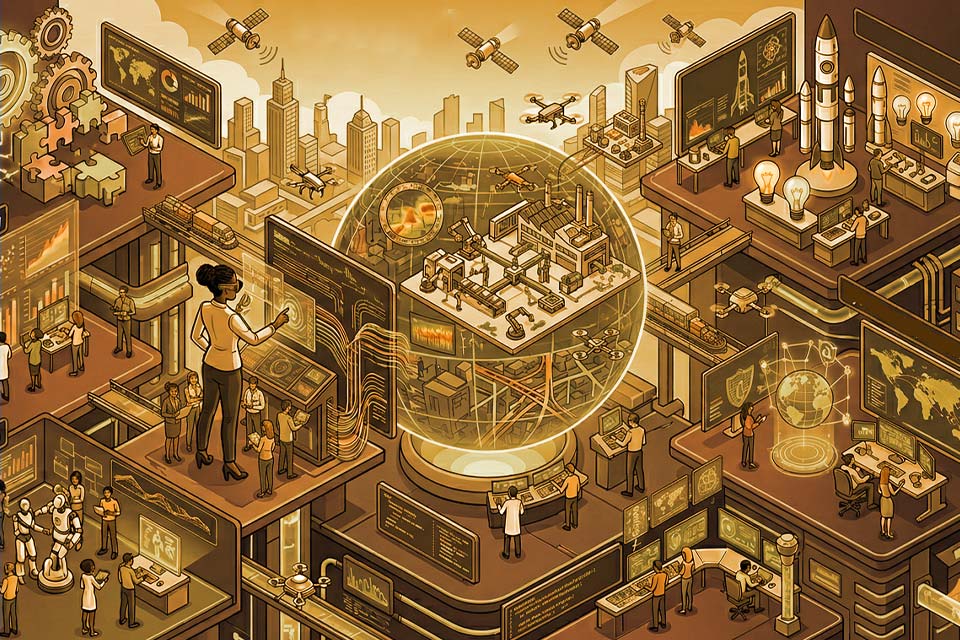
The concept of digital twins has evolved greatly over the last 10 years. Originally, digital twins were created for manufacturing and industrial use, helping to build virtual versions of physical assets, equipment, and production systems. With these digital twins, organizations could track performance, foresee maintenance needs, and enhance operational efficiency. But today, digital twin technology has gone far beyond its industrial roots.
The evolution of enterprise digital twins has been accelerated by the rise of AI, advanced analytics, cloud computing, and real-time data platforms. Today’s digital twins are not static models but dynamic, always-updated virtual environments that mirror the real-time state of an organization. These AI-powered replicas offer unprecedented visibility into business operations by unifying data from many systems, applications, and processes. This, in turn, enables organizations to gain more insight into performance, identify inefficiencies, simulate future scenarios, and make more informed strategic decisions.
Enterprise environments have grown more complex over the past few years. Organizations need to manage complex, interconnected systems, distributed workforces, global supply chains, evolving customer expectations, cybersecurity risks, and rapidly changing market conditions. This level of complexity is often not well handled by traditional management approaches. Organizations are looking for more effective ways to understand and manage their operations, and the need for predictive and simulation-based decision making is continuing to increase. Enterprise digital twins offer a powerful solution, enabling leaders to test scenarios, assess risks, and predict results in a virtual environment before effecting changes in the real world.
Another major factor behind digital twin adoption is the growth of real-time data ecosystems. Connected devices, cloud platforms, enterprise applications, and Internet of Things technologies generate massive volumes of operational data every second. Enterprise digital twins use this constant stream of information to keep an accurate digital representation of physical operations. This capability enables organizations to monitor performance in real-time, identify emerging problems, and respond proactively to changing conditions. Businesses can now make decisions based on live operational intelligence rather than simply relying on historical reporting.
As digital twins become strategic enterprise assets, CIO leadership is essential to drive adoption and integration. CIOs are increasingly being tasked to put in place the technology underpinnings to support digital twin initiatives such as data governance, cloud infrastructure, AI capabilities, and cybersecurity frameworks. Effective CIO leadership ensures enterprise digital twins are in sync with wider business goals and deliver measurable value throughout the organization.
Enterprise digital twins are also changing how organizations think about risk and innovation. Rather than reacting to issues after the fact, companies can use simulation environments to anticipate disruptions, compare options, and optimize outcomes. This shift from reactive management to simulation-driven operational intelligence is a major step forward for enterprise strategy. Strong CIO leadership can help organizations capitalize on digital twin capabilities to become more resilient, innovate faster, and operate more efficiently.
Digital twins are helping enterprises to bridge the gap between physical and digital operations. They give a wide view of how systems interact, how resources are used, and how a change in one spot might affect the bigger organization. Consequently, CIO leadership is increasingly emphasizing the potential of virtual enterprise environments to facilitate intelligent data-driven decision-making.
Enterprise digital twins are poised to become a core part of modern business strategy. As technologies mature, CIO leadership will have a more powerful role to play in leading organizations to become simulation-driven enterprises where operational intelligence, innovation, and strategic planning are fueled by continuously evolving digital twins of the business.
What are Enterprise Digital Twins?
Enterprise digital twins are virtual representations of the organization’s systems, processes, assets, and operational activities. Unlike traditional dashboards that offer static views of performance, enterprise digital twins establish dynamic digital environments that continuously mirror real-world business operations. These virtual clones combine data from various sources to present a complete, real-time view of how an enterprise functions across departments, technologies, and workflows.
The central idea of enterprise digital twins is the constant synchronization between physical and digital environments. As the business activities take place, data is fed into the digital twin to reflect the representation in real-time. This enables organizations to monitor operations, model scenarios, predict outcomes, and optimize performance, before acting in the physical world. As data-driven enterprises continue to grow, CIO leadership is becoming increasingly important in helping usher in digital twins across widespread business and technology initiatives.
Beyond Manufacturing
Digital twins were originally developed in the field of industrial engineering and product lifecycle management. Manufacturers used them to model physical assets, monitor equipment performance, and enhance maintenance planning. Advances in artificial intelligence, cloud computing, and analytics over the years have dramatically expanded their capabilities beyond factory settings.
Enterprise digital twins are being used today in supply chains, customer operations, workforce management, financial systems, and enterprise-wide business processes. Today, organizations can build virtual representations of entire operational ecosystems, not just individual machines or assets. This evolution has turned digital twins into strategic business tools that allow enterprises to understand complex interactions across multiple functions.
With adoption on the rise, CIO leadership is becoming increasingly important to help guide organizations through this transition. Technology leaders need to make sure that digital twins deliver business objectives and support scalability, security, and long-term innovation goals.
How Enterprise Digital Twins Work?
Enterprise digital twins do this by continuously collecting, integrating, and analyzing data from a variety of systems and sources. It aggregates data from enterprise apps, Internet of Things devices, cloud platforms, operational databases, customer systems, and workforce technology. This data then gets combined to create a living digital representation of the organization.
Advanced analytics and artificial intelligence facilitate dynamic modeling of enterprise operations. These models recreate real-world conditions to provide insights into performance, risks, and opportunities. Digital Twins allow organizations to predict outcomes, test business strategies, and evaluate the impact of potential changes before they are made.
Another important capability is continuous monitoring. Enterprise digital twins provide real-time operational visibility to help organizations identify inefficiencies, emerging risks, and optimize processes. With strong CIO leadership, organizations can harness these capabilities to shift from reactive management to predictive decision-making.
Fundamental Components of Enterprise Digital Twins
There are several technologies that work together to power enterprise digital twins. The core of it is a robust data infrastructure that can collect and integrate data from multiple sources throughout the organization. To provide meaningful insights, digital twins require real and reliable data.
The intelligence layer of the digital twin is artificial intelligence and analytics engines. These technologies recognize patterns, make predictions, and assist in advanced decision-making. Simulation models allow organizations to test different scenarios and see how changes could impact operations before they make a move.
Visualization and decision-support platforms give business leaders intuitive interfaces to probe data, track performance, and assess strategic alternatives. These tools convert complex operational information into actionable insights that enable enterprise-wide decision-making.
The strength of these elements often hinges on effective CIO leadership, which ensures technology investments are aligned with organizational priorities and business outcomes.
The Importance of Digital Twins for Modern Enterprises
Today’s business operates in a very complex environment, with interconnected systems, global operations, changing customer expectations, and rapidly changing market conditions. Traditional management practices often fail to provide the visibility and agility needed to manage this complexity effectively.
Operational real-time visibility and predictive decision-making are provided by enterprise digital twins to help address these challenges. Rather than just looking at the past, organizations can build models of what might happen in the future and predict the outcomes, which helps them decide on a strategy.
Another factor behind the rise of adoption is the greater demand for more rapid innovation. Companies are under pressure to constantly launch products, optimize operations, and respond quickly to market changes. Digital twins afford experimentation and innovation in a low-risk environment where organizations can test ideas in a virtual space before implementing them in the physical world.
As organizations look for a competitive edge via intelligence, agility, and resilience, CIO leadership is increasingly focused on leveraging digital twins to improve business performance. Enterprise digital twins are emerging as a critical asset for organizations gearing up for the next wave of digital transformation by merging real-time operational visibility with predictive analytics and simulation capabilities. Strong CIO leadership will be key to making sure these technologies deliver sustainable value and enable long-term business growth.
Technologies Behind Enterprise Digital Twins
Enterprise digital twins are enabled by an advanced technology ecosystem that allows companies to develop virtual models of business operations, synchronize them with real-world activities, and generate actionable intelligence. Combined, the technologies provide real-time visibility, predictive insights, and simulation capabilities that enable enterprise-wide decision making. CIO leadership is key to choosing, integrating, and managing the technologies that support these intelligent environments as digital twins become more and more important to business transformation.
1. Artificial Intelligence and Machine Learning
Enterprise digital twins are powered by the intelligence engines of artificial intelligence and machine learning. These technologies translate vast amounts of enterprise data into actionable insights that can aid in optimizing operations and informing strategic planning.
The key capabilities include:
- Predictive analytics and forecasting for future outcome prediction
- Enterprise systems and business process pattern recognition
- Real-time conditions-based automatic optimization recommendations
- Smart decision support for operational and strategic initiatives
Strong CIO leadership enables organizations to harness AI-powered digital twins to boost agility, cut uncertainty, and speed up innovation.
Also Read: CIO Influence Interview With Jake Mosey, Chief Product Officer at Recast
2. Internet of Things (IoT) and Connected Sensors
The Internet of Things provides the real-time data backbone that keeps enterprise digital twins aligned with physical operations. Connected devices and sensors are constantly measuring assets, facilities, equipment, and operational environments.
Important functions include:
- Real-time operational data collection
- Assets monitoring and performance tracking
- Ongoing environmental intelligence
- Increased transparency of enterprise activities
These capabilities allow organizations to have accurate digital representations of their operations while enabling proactive monitoring and management. Good CIO leadership ensures that IoT ecosystems are scalable, secure, and integrated across the enterprise.
3. Edge Infrastructure and Cloud Computing
Enterprise digital twins need lots of computing power to process, analyze, and display large amounts of data. The flexibility and scalability offered by cloud computing and edge infrastructure can meet such requirements.
Organizations benefit from:
- Digital twin environments that scale
- Ability to process in real time
- Collaborative enterprise intelligence
- Improved operational responsiveness
Cloud platforms allow enterprises to scale digital twin initiatives without major infrastructure constraints, while edge computing enables faster decision-making by processing data closer to the data source. As adoption grows, CIO leadership will be key to balancing performance, cost, and security considerations.
4. Big Data and Advanced Analytics
Digital twins produce and consume massive amounts of data from multiple enterprise systems. Big data technologies and advanced analytics platforms allow organizations to convert this data into usable operational intelligence.
Major contributions include:
- Enterprise-wide data integration
- Performance & Productivity Analysis
- Identify and assess risk
- Data-based decision support
Organizations get a holistic view of business performance by aggregating information across departments and functions. Strong CIO leadership enables analytics capabilities to be aligned with strategic objectives and enables enterprise-wide visibility.
5. Technologies of digital simulation and modeling
Simulation and modelling technologies are arguably the most valuable components of digital twins for enterprises. They enable organizations to simulate scenarios, assess possibilities, and anticipate results without disturbing real activities.
These technologies include:
- Scenario planning settings
- Simulation platforms for processes
- Enterprise behavior modeling
- Simulation of Business Strategies in a virtual
Simulation tools help organizations identify risks, optimize workflows, and evaluate the impact of possible modifications before they are put into practice. Simulation-driven management is quickly becoming the hallmark of 21st-century CIO leadership.
6. Visualization and Immersive Technologies
What makes enterprise digital twins valuable is their ability to provide insights to decision makers. Visualization and immersive technologies allow complex data to be translated into accessible and actionable information.
Typical capabilities include:
- Interactive dashboards
- 3D operational modeling
- Augmented reality integrations
- Virtual reality-enabled enterprise exploration
Such tools give leaders intuitive ways to understand enterprise performance, explore scenarios, and make informed decisions. As organizations move toward simulation-based business models, CIOs are focusing more on how visualization technologies can improve collaboration, decision-making, and strategic planning.
These technologies combine to form the basis of enterprise digital twins that allow organizations to bridge the gap between physical operations and digital intelligence. As digital twin adoption accelerates, CIO leadership will continue to be key to successful implementation, realizing business value, and steering enterprises to smarter, more resilient, and data-driven futures.
CIO Strategies for Digital Twin Adoption
As enterprise digital twins evolve from operational tools to strategic business assets, organizations need a structured approach for adoption and implementation. Successful deployment is not simply a matter of investing in technology but requires alignment with business objectives, data management, governance, organizational culture, and long-term transformation goals. CIO leadership is critical in this environment to ensure that digital twin initiatives deliver measurable business value and enable enterprise-wide innovation and resilience.
1. Developing an Enterprise Digital Twin Vision
A successful digital twin strategy starts with a clear vision that aligns technology initiatives with broader business priorities. Instead of simply adopting digital twins because it’s the technology of the moment, organizations need to determine how to leverage those capabilities to achieve operational excellence, drive innovation, and create competitive advantages.
The main priorities are:
- Aligning digital twin initiatives with organizational objectives and growth plans
- Identifying high-value use cases that drive measurable outcomes
- Creating long-term transformation roadmaps for adoption and scaling
- Concentrating on initiatives that boost operational efficiency and business agility
Strong CIO leadership ensures that digital twin investments are aligned with strategic goals and helps organizations to focus resources on areas that will deliver the greatest impact.
2. Building a Solid Data Foundation
Data quality, accuracy, and availability are critically important for enterprise digital twins. Without trusted data, digital twins cannot provide reliable insight or meaningful simulations.
Organizations should focus on:
- Developing strong data quality standards
- Creating enterprise-wide data governance frameworks
- Support real-time data integration solutions
- Building trusted and scalable data ecosystems
Enterprise digital twins typically aggregate data from many business functions, applications, and operational systems. Strong CIO leadership helps ensure this data is consistent across these environments and that it is transparent, accessible, and secure.
3. Integrating Digital Twins Into Enterprise Architecture
The best value of digital twins comes when they are integrated into wider enterprise technology ecosystems. By adding integration, organizations gain the ability to connect operational intelligence to strategic decision-making.
Important considerations include:
- Linking operational technology to business systems
- Facilitate cross-functional data sharing and collaboration
- Inter-departmental platform interoperability
- Designing architectures that can scale to meet future growth
As organizations continue to evolve their technology environments, CIO leadership will be necessary to architect digital twin platforms that are enterprise-wide intelligence platforms, not just point solutions.
4. Managing Change in Organizations
Digital twin adoption is not just a technology initiative; it is a major organizational transformation. Employees, managers, and executives need to understand how digital twins help in decision-making and operational improvement.
Efficient change management strategies are:
- Securing executive sponsorship and leadership commitment
- Digital twin literacy across the teams
- Fostering cultures of data-informed decision-making
- Workforce readiness and capacity building support
Successful digital twin adopters often talk about cultural transformation as well as technical implementation. With strong **CIO leadership**, organizations can promote wider use of simulation-based decision-making and collaboration across functions.
5. Governance and Security Frameworks
As the use of digital twins in enterprise operations increases, the need for governance and security also increases. These systems often work with sensitive business information and drive important decisions, so strong controls are a must.
Organizations should emphasize:
- Employ strong data privacy controls
- Creating digital twin governance policies
- Managing operational and cyber risks
- Supporting regulatory compliance needs
Good governance keeps digital twins trustworthy, secure, and aligned with business objectives. Effective CIO leadership is crucial to balancing innovation with prudent risk management.
6. Measuring Business Outcomes
Organizations need to build clear performance indicators and measurement frameworks for digital twin initiatives to justify continued investment.
Important metrics can include:
- Enhanced operational efficiency
- Cost-effectiveness and resource optimization
- Signs of acceleration of innovation
- Benchmarks for resilience and risk management
- Enhancements to customer experience
Continuous outcome assessment enables organizations to fine-tune strategies and maximize return on investment. Strong CIO leadership helps keep digital twin programs on track to deliver real business benefits.
Enterprise Digital Twin Business Use Cases
Enterprise digital twins are changing how companies operate, innovate, and react to shifting market conditions. They are useful across a broad spectrum of business functions, with the ability to simulate, monitor, and optimize complex environments.
1. Improving operational performance
One of the most important applications of enterprise digital twins is the improvement of operational performance. Organizations have visibility into business processes in real time and can identify optimization opportunities before performance is affected.
Main benefits include:
- Ongoing monitoring of enterprise operations
- Recognizing inefficiencies and bottlenecks
- Driving ongoing process improvement
- Better use of resources and productivity
Strong CIO leadership allows companies to leverage digital twins for proactive operational optimization, rather than reactive management.
2. Predictive Risk Management
Enterprise environments are more vulnerable than ever to technology disruptions, supply chain instability, cybersecurity threats, and market volatility. Digital twins enable organizations to anticipate and manage such risks before they grow.
Uses include:
- Prediction of operational disruption
- Identifying weaknesses in systems and processes
- Simulating scenarios of risk
- Strengthening organizational resilience
Using predictive intelligence, CIO leadership can assist enterprises in improving business continuity and risk preparedness.
3. Supply Chain and Logistics Management
Supply chains are increasingly complex and interconnected. Enterprise digital twins provide end-to-end visibility, enabling organizations to optimize logistics operations.
Organizations can leverage digital twins to:
- Thorough supply chain monitoring
- Disruption scenario planning
- Optimize inventory
- Improving logistics performance
These capabilities allow companies to operate more efficiently and with less uncertainty in the global marketplace.
4. Workforce and Human Capital Planning
The use of digital twins for workforce management and organizational planning is increasing. Modeling of the organization of workforce dynamics can enhance understanding of productivity patterns and resource needs.
The most important applications are:
- Workforce simulation modelling
- Activities for capacity planning
- Analysis of productivity and performance
- Optimization of talent distribution
By providing effective CIO leadership, organizations can embed workforce intelligence into their broader business planning strategies.
5. Operations and Customer Experience
Organizations are under pressure to deliver personalized and efficient experiences as customer expectations continue to evolve. Digital twins can model customer journeys and predict service results.
Advantages include:
- Map customer interactions across channels
- Forecasting customer behavior and preferences
- Enhancing service delivery
- Enhance approaches to improve engagement and satisfaction
These insights can help organizations strengthen relationships and improve customer-centric decision-making.
6. Innovation and Product Development
Digital twins are a safe space for experimentation and innovation. Organizations can test ideas, assess concepts, and refine products before they hit the market.
Applications:
- Testing environments (virtual)
- Speedier experimentation cycles
- Reduced innovation risk
- Speeded up product development processes
Strong CIO leadership fosters innovation by making sure that digital twins evolve into strategic platforms for ongoing improvement and business transformation.
7. Sustainability & ESG Management
Environmental performance and ESG goals are leading business priorities, and enterprise digital twins are helping organizations achieve them.
Organizations can use digital twins to:
- Track environmental performance
- Minimize resource consumption
- Assessment of sustainability initiatives
- Simulate environmental impacts of business decisions
With sustainability rising on the agenda, CIO leadership is allowing organizations to leverage digital twins to balance operational efficiency with environmental responsibility. Enterprise digital twins are emerging as powerful tools to drive sustainable growth and long-term business value by embedding real-time intelligence, predictive analytics, and simulation capabilities.
Challenges and Risks
Enterprise digital twins are quickly becoming a key part of modern business transformation strategies. Virtual representations of enterprise operations provide organizations with unprecedented insight into processes, assets, systems, and performance.
These capabilities drive predictive decision-making, operational optimization, and innovation at scale. But despite their enormous potential, enterprise digital twins also present a host of challenges and risks that organizations need to be mindful of. The more rapid the adoption, the more critical CIO leadership becomes in navigating the complexities of implementation, governance, security, and sustainability over the long term.
1. Data Quality and Integration Challenges
Data is the foundation of any enterprise digital twin. The value of simulations, predictions, and operational insights is wholly dependent on the quality, coherence, and completeness of the underlying data.
2. Fragmented Enterprise Data Sources
Most organizations operate across multiple business units, technology platforms, and data environments. Information is often stored in disparate systems that were never designed to work together.
Common challenges involve:
- Data silos within departments
- Inequitable access to operational data
- Poor interoperability between platforms
- Problems in establishing a single enterprise view
Strong CIO leadership is critical to breaking down these silos and creating integrated data ecosystems that enable enterprise-wide digital twin initiatives.
3. Inconsistent Data Standards
Inconsistent data definitions, formats, and quality standards are often a challenge for organizations. Inconsistent data leads to inaccuracies in digital twin environments and erodes decision confidence.
Without standardized governance frameworks, enterprises may face:
- Different performance metrics
- Incomplete or duplicate records
- Predictive models with lower accuracy
- Limited trust in digital twin outputs
4. Real-Time Synchronization Issues
Enterprise digital twins must be continuously synchronized to support physical and digital operations. As organizations scale, it becomes increasingly difficult to maintain this connection.
Difficulties include:
- Data latency problems
- Limits of network performance
- Complex integration needs
- Lack of operational visibility
Effective CIO leadership ensures data infrastructure supports real-time intelligence and enterprise-wide visibility.
The Complexities of Technology
Enterprise digital twins require complex technological ecosystems that integrate AI, analytics, IoT, cloud computing, and simulation platforms. This complexity presents substantial operational challenges.
1. Infrastructure Requirements
Digital twins require a lot of computing, storage, and networking power. Large-scale implementations often require heavy investments in technology infrastructure.
Organizations have to face:
- High-performance computing requirements
- Managing cloud resources
- Scalable storage environments
- Demands for ongoing system availability
2. Integration With Legacy Systems
Many enterprises continue to operate on legacy platforms that were not designed for modern digital twin architectures.
Key challenges include:
- Compatibility issues
- Legacy data structures
- Limited integration possibilities
- More difficult to implement
Strong CIO leadership is needed to successfully modernize enterprise architecture with minimal business disruption.
3. Scalability Challenges
Digital twin initiatives will become more common across many business functions, and organizations will need to ensure their systems remain scalable and responsive.
Scalability problems include:
- Increasing data volumes
- Simulation complexity increases
- Increased processing requirements
- Requirements for enterprise-wide roll-out
4. Cybersecurity and Privacy Risks
As more and more digital twins are integrated into business operations, security and privacy concerns are becoming more and more important.
5. Protecting Digital Twin Environments
The detailed operational data contained in digital twins for enterprises can make them attractive targets for cyber criminals.
Organizations need to secure:
- Digital twin platform
- IoT devices and sensors
- Data channel transmission
- Infrastructure as a cloud-based
Strong CIO leadership is essential to the development of security-first digital twin strategies.
6. Managing Sensitive Enterprise Data
Digital twins frequently handle sensitive business data, customer data, financial data, and operational intelligence.
Potential Risks are:
- Unauthorised access
- Data loss
- Threats from insiders
- Breach of compliance
7. Increasing Attack Surfaces
All interconnected systems create new points of vulnerability. As digital twin ecosystems grow, the number of possible attack entry points grows exponentially.
Organizations must watch constantly for:
- Endpoints consolidated
- Third-party integrations
- API security
- Infrastructure deficiencies
8. Governance and Accountability Issues
As enterprise digital twins grow in influence, critical questions emerge around governance and accountability.
9. Ownership of Digital Twin Initiatives
Knowing who owns digital twins can be difficult when they span multiple business functions.
Questions often involve:
- Who owns the digital twin?
- Who approves the data?
- Who is responsible for simulation-based decisions?
- How are performance results measured?
Strong CIO leadership helps set clear accountability structures and operational ownership models.
10. Data Governance Requirements
Enterprise digital twins need sound governance models around how data is collected, managed, and used.
Governance priorities are:
- Management of data quality
- Access control rules
- Guidelines for use
- Oversight of compliance
11. Regulatory Compliance Challenges
Cross-jurisdictional organizations face a more complex regulatory environment.
Key concerns include:
- Privacy laws
- Compliance requirements specific to the industry
- Cross-border data governance
- Developing standards for AI governance
Cost and Resource Constraints
Enterprise digital twins can provide significant benefits in the long term, but they also often require significant investment to implement.
1. Implementation Costs Upfront
Enterprises often underestimate the resources required for the rollout of digital twin initiatives across the organization.
Costs could be:
- Technology acquisition
- Infrastructure upgrades
- Integration projects
- Consulting and implementation services
Strong CIO leadership balances investment priorities and maximizes return on technology spend.
2. Talent Shortages
Digital twin environments require specialized expertise in data science, AI, analytics, cloud computing, and enterprise architecture.
Many organizations struggle with issues related to:
- Skill shortages
- Recruitment challenges
- Internal expertise is limited
- Digital talent is highly sought
3. Operational Costs – Ongoing
Once implemented, enterprises need to manage operational costs on an ongoing basis.
These are:
- Maintenance of infrastructure
- Software license
- Security Administration
- Continuous optimization work
Organizational Resistance
Technology transformation initiatives often face cultural and organizational barriers.
1. Cultural Barriers to Adoption
Employees and managers may be reluctant to adopt digital twins for fear of complexity, disruption, or impact on jobs.
Typical challenges include
- Resistance to change
- Simulation results have little confidence
- Anxiety about Automation
- Favors the traditional way of making decisions
2. Change Management Challenges
Successful digital twin integration requires extensive change management strategies.
Organizations should concentrate on:
- Training of staff
- Buy-in from leadership
- Stakeholder Communications
- Ongoing support programs
3. Absence of Digital Twin Skills
Many organizations are still in the process of developing the skills to fully exploit digital twin technologies. Enterprises might not achieve the full potential of their investments without the appropriate training and support. Good CIO leadership helps build organizational capabilities and a culture of innovation.
Future Outlook
But the future for enterprise digital twins is much more than operational monitoring. As artificial intelligence, analytics, and simulation technologies mature, digital twins will be expected to evolve into intelligent enterprise platforms that can make autonomous decisions and continuously optimize. This change will fundamentally alter the way businesses operate, strategize, and lead organizations. As these changes accelerate, CIO leadership will be more and more influential in guiding enterprises through the next phase of digital transformation.
1. AI-Powered Autonomous Enterprise Twins
The next generation of enterprise digital twins will include advanced AI capabilities that allow autonomous learning and adaptation.
2. Self-learning business models
Future digital twins will learn on an ongoing basis from operational data and improve their predictive capabilities over time.
Benefits can include:
- Better prediction accuracy
- Better operational insights
- Faster identification of new trends
- Ongoing performance optimization
3. Automated Operational Optimization
With the help of AI, digital twins will progressively recommend and execute operational improvements with minimal human engagement.
4. Continuous Decision Intelligence
Organizations will be able to access recommendations in real time to support both tactical and strategic decision-making. Strong CIO leadership will help ensure that these capabilities are aligned with business goals and governance requirements.
5. Real-Time Enterprise Simulation Environments
Simulation technologies will grow more sophisticated and integrated across the enterprise.
6. Enterprise-wide testing scenarios
Organizations will be able to test strategic business decisions simultaneously, across business functions.
7. Instant Operational Forecast
Future digital twins will enable near real-time predictions on operational performance, market conditions, and resource needs.
8. Predictive Business Planning
Instead of solely analyzing the past, companies will increasingly turn to simulations to inform their future planning and investment decisions.
Digital Twins as Strategic Command Centers
Digital twins are expected to become central platforms for enterprise management.
-
Unified Operational Visibility
Executives will have complete oversight of operations in a single digital environment.
-
Executive Decision Support Systems
Leadership teams will use digital twins to evaluate opportunities, assess risks, and support long-term strategic planning.
-
Business Orchestration in Real Time
Operations will be increasingly run by intelligent command centers driven by digital twin technologies. Good CIO leadership will leverage these capabilities into competitive advantages.
-
Physical and Digital Enterprises Converge
The distinction between physical operations and digital environments will continue to blur.
-
Physical and Virtual Environments Co-Exist
Organizations will have control over assets, processes, and operations through connected physical and digital systems.
Growing Use of Digital-First Management Approaches
Digital twins will be at the heart of planning, execution, and performance management processes.
-
Intelligent Enterprise Automation
Automation systems will work with digital twins to improve workflows and increase operational efficiency.
-
Industry-Specific Digital Twin Evolution
The use of digital twins will continue to grow across industries.
-
Financial Services Digital Twins
Banks and financial institutions will use digital twins for risk management, fraud detection, and operational optimization.
-
Healthcare Operational Twins
Healthcare providers will use digital twins to enhance patient care, resource management, and the operations of facilities.
-
Smart Manufacturing and Logistics Ecosystem
Manufacturers will continue to lead predictive maintenance, production optimization, and supply chain intelligence.
-
Public Sector Digital Government Applications
Governments will increasingly use digital twins to improve infrastructure management, urban planning, and public services.
The Expanding Role of CIO Leadership
As enterprise digital twins mature into strategic business platforms, the responsibilities of technology leaders will continue to grow.
-
CIOs Becoming Simulation-Driven Strategists
Future managers will lean more and more on simulation-based intelligence to inform organizational decision-making.
-
Driving Enterprise Intelligence Transformation
The implementation of AI, analytics, and digital twin ecosystems across the enterprise will be led by technology leaders.
-
Managing Innovation Through Virtual Enterprise Environments
Organizations will increasingly experiment, innovate, and optimize in digital environments before they roll out changes to their physical operations.
Strong CIO leadership will be a hallmark of enterprise success. The adoption of simulation-driven management models by organizations will see technology leaders play a critical role in balancing innovation, governance, operational efficiency, and business growth.
Conclusion
Enterprise digital twins are fast becoming more than specialized operational tools — they are comprehensive enterprise intelligence platforms. The ability to create real-time virtual representations of business operations is fundamentally changing how organizations manage performance, assess risk, and pursue innovation. As adoption increases, CIO leadership is becoming more central to the successful implementation and governance of these technologies. Technology leaders are transforming from caring for infrastructure to designing intelligent organizations powered by simulation that can adapt to shifting business landscapes more quickly and accurately than ever before.
Simulation-driven intelligence is one of the most significant transformations to enterprise decision-making in decades. In the past, organizations were dependent on previous reporting and reactive management. Enterprise digital twins bring a new paradigm — predictive insights, scenario simulations, and real-time intelligence for proactive decision-making. Strong CIO leadership allows the business to test strategies prior to implementation, identify vulnerabilities before disruption, and optimize operations continuously. The change reduces uncertainty and allows for faster, more informed decision-making across the enterprise.
The future enterprise will probably live in both physical and digital realities at the same time. Digital twins will be increasingly integrated into day-to-day business operations, offering ongoing insights into operations, customers, supply chains, workforce behavior, and financial results. Organizations will be able to run AI-powered simulations to explore myriad possibilities and assess outcomes before investing resources in them. This means businesses will be more resilient, agile, and innovative. Strong CIO leadership will be critical to manage this convergence and ensure digital environments are secure, trusted, and strategically aligned.
The growing significance of enterprise digital twins is part of a larger shift in the character of technology leadership. The next generation of leaders will be responsible for building cohesive enterprise ecosystems that integrate artificial intelligence, advanced analytics, cloud infrastructure, and simulation technologies. CIO leadership will increasingly focus on enabling intelligence-driven operations, innovation, and creating sustainable competitive advantages through digital transformation. Technology leaders will play a key role in balancing operational efficiency, governance needs, cybersecurity considerations, and business growth objectives.
Ultimately, enterprise digital twins are not simply a technological innovation; they are a new operating model for modern organizations. Those companies that can leverage these capabilities will be more visible, more resilient, more innovative, faster, and better able to make decisions. The winners of the future will be those companies that can blend the physical with smart digital environments.
As this change accelerates, CIO leadership will continue to be at the heart of enterprise strategy, leading organizations into a future where virtual intelligence, predictive analytics, and real-time simulation will be critical to business success. As the world gets more digital, future-ready enterprises will rely on these capabilities more and more to manage complexity, realize new opportunities, and drive sustainable growth.
Catch more CIO Insights: CIOs as Ecosystem Architects: Designing Partnerships, APIs, And Digital Platforms
[To share your insights with us, please write to psen@itechseries.com ]
