

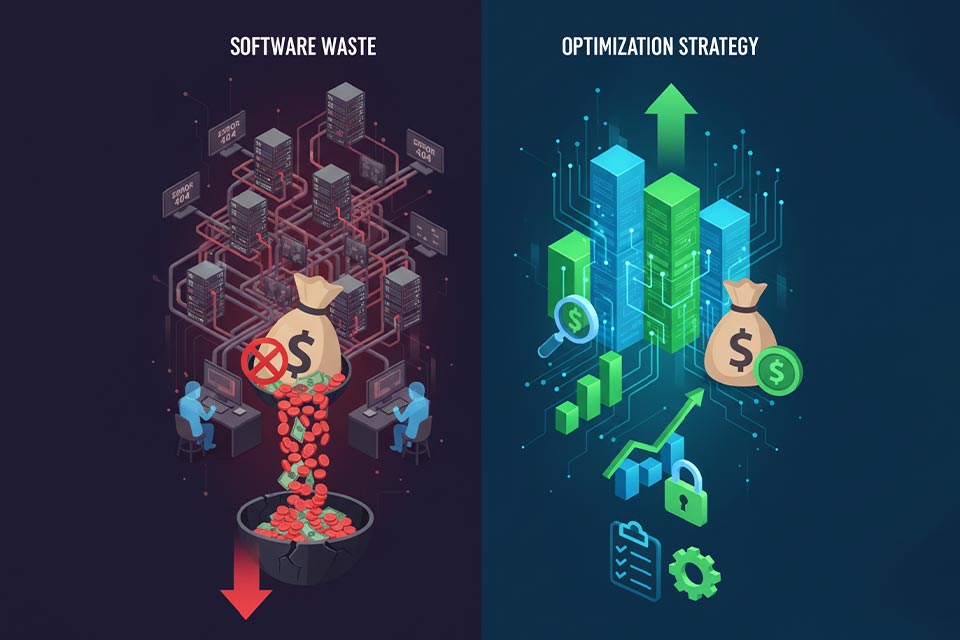
Your cloud migration probably held the promise of efficiency, flexibility and cost savings. But when you glance at your monthly bills, you find they’re suddenly rising with no obvious reason. And the jumble of “cloud chaos” is a familiar problem. However, without a well-planned approach these can similarly scale out of control and leave you paying more than anticipated; counteracting the potential cost savings of adoption.
Bringing this spending under control is eminently doable, but it isn’t hoisted on us by nature. It needs a sustained emphasis throughout the organization on fiscal responsibility and technical excellence. You need to establish a plan that’s as much about managing expenses as it is about delivering new capabilities. This disciplined process is referred to as cloud cost optimization.
Why Do “Lift and Shift” Migrations Increase Costs?
A lift-and-shift migration is one of the primary contributors to sticker shock when it comes to cloud bills. This is when you shift your on-premise applications to the cloud, without refactoring them for a cloud-native architecture. You’re essentially treating cloud servers as if they were the physical hardware in your old data center, just leaving them on all the time.
This approach fails to capitalize on the cloud’s most significant financial advantage: the ability to pay only for the resources you actually consume. Instead of scaling up and down with demand, you are paying for peak capacity all the time. This is the opposite of effective cloud cost optimization. To see real savings, you must think differently and architect your applications to be dynamic and efficient in their new environment.
What Are the Pillars of a Strong Cost Strategy?
A successful cloud cost optimization strategy is built on a foundation of several key principles that work together to provide visibility, accountability, and continuous improvement.
-
Complete Visibility:
You must gain a clear and detailed view of where every single dollar is going across all cloud services.
-
Team Accountability:
Assign cost ownership directly to the engineering and business teams that are consuming the resources.
-
Continuous Optimization:
Constantly work to right-size resources, eliminate waste, and adopt more cost-effective services.
-
Centralized Governance:
Establish clear policies, budgets, and guardrails to prevent overspending before it happens.
What Is the Role of FinOps in Your Organization?
FinOps (or Cloud Financial Operations) is really a cultural change rather than a technological one. It’s the practice of uniting your finance, tech, and business teams to make data-driven spending decisions together. The idea is to have the cloud cost be a shared responsibility for everyone in the whole organisation, and not just an issue for finance to deal with.
This collective model helps ensure that your engineers make architectural decisions in a financially responsible manner. And it helps your finance teams understand the business value that cloud investments are delivering. Cultivate a FinOps culture by creating habits that enforce accountability by building bias-free financial considerations right into your operational practices, which is central to reaching long-term sustainability in cloud cost optimization.
What Are Some Practical Ways to Save Money Now?
While building a new culture takes time, there are immediate technical steps you can take as part of your cloud cost optimization efforts to see a quick reduction in your bill.
-
Right-Sizing Instances:
Analyze performance data to identify and downgrade oversized virtual machines that are provisioned for more capacity than they actually need.
-
Deleting Idle Resources:
Find and eliminate unattached storage volumes, old data snapshots, and idle load balancers that accumulate costs while providing no value.
-
Leveraging Reserved Instances:
For your predictable, long-term workloads, commit to one or three-year terms with cloud providers to receive significant discounts.
-
Implementing Auto-scaling:
Automatically adjust the number of active servers based on real-time user demand, ensuring you only pay for compute power when you need it.
How Can Automation Enforce Cost Controls?
Manually tracking expenses across a complex cloud environment is not scalable or efficient. Automation is essential for making cloud cost optimization an ongoing and effortless practice.
- Set up automated alerts to notify team leads when their spending exceeds preset budgets.
- Run scheduled scripts to automatically shut down development and testing resources overnight and on weekends.
- Use “infrastructure as code” templates to enforce the use of cost-effective configurations for all new deployments.
- Automatically apply resource tags upon creation to ensure proper cost allocation and reporting from day one.
Making Cost an Integral Part of Your Cloud Strategy
Uncontrolled cloud spending is not a prescribed byproduct of cloud use, but when there’s no plan in place, it often is the natural consequence. By pairing a cultural change in FinOps with pragmatic technical controls, you can turn your cloud from a risk to an asset. Real cloud cost optimization is not just about spending less; rather, it is the ability to spend your cloud dollars more effectively, so that each dollar drives maximum value for your business.
Catch more CIO Insights: The CIO as AI Ethics Architect: Building Trust In The Algorithmic Enterprise
[To share your insights with us, please write to psen@itechseries.com ]
