


Technology has become imperative for all types of business, two roles are the most talked about today;
- Chief Information Officer (CIO)
- Chief Technology Officer (CTO)
Both of these roles play an instrumental role in driving success for your organization. Though their roles often overlap, their focus and impact diverge in meaningful ways. Clarifying what makes each unique, and where they collaborate, helps organizations structure their leadership for strategic advantage.
What a CIO and CTO do for your organization?
At the highest level, both CIOs and CTOs align technology with business objectives. They oversee teams, budgets, and strategy, working to drive digital transformation. However:
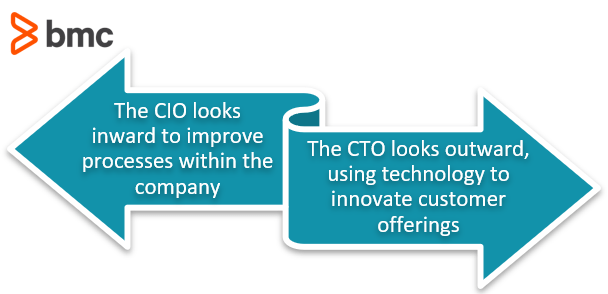
- CIOs focus internally: optimizing IT operations, managing infrastructure, and serving as a custodian of data, security, and internal workflows.
- CTOs look outward: exploring new technologies, building external-facing products, and ensuring the company remains competitive on the tech frontier.
Broadly speaking, a chief information officer focuses on internal technology, and a chief technology officer keeps a tab on latest technologies and product strategy.
Responsibilities of a CIO and CTO, Broken Down
CIO – Operational Excellence
The CIO ensures reliable, secure, and efficient IT systems. They manage enterprise apps like ERP, finance, and employee collaboration tools. It has been noted that CIOs 45% of their time on cybersecurity and governance. In a nutshell, they check and maintain systems for efficiency and better collaboration.
CIOs evaluate vendor solutions (e.g., ServiceNow, Workday, Salesforce) and integrate them into existing systems. Their concern is reliability, compliance, and ROI for internal users.
CTO – Product Innovation
The CTO drives product development, technical architecture, and innovation. They lead the creation of customer-facing solutions, from APIs to flagship apps. Companies like Zoom or Slack rely heavily on forward-thinking CTOs to win tech-first markets.
CTOs explore emerging trends like AI, blockchain, quantum computing, or edge computing. They run pilots, build proof-of-concepts, and create prototype products for future competitiveness.
Where are CIOs and CTOs placed in an organization?
Titles vary by organization. Some place both executives at C-level, while others elevate only one. In large enterprises, here’s a typical structure:
CEO
├─ CIO (IT Ops, Security, Governance)
└─ CTO (Product Dev, R&D, Innovation Labs)
Collaboration is essential. For example, when a CIO implements AI responsibly, a CTO must refine it into external products.
Differences and similarities between CIO and CTO
| Skill/Attribute | CIO | CTO |
| Strategic Vision | A CIO focuses on operational efficiency and IT governance | A CTO imagines future products and technological innovation |
| People & Budget Management | Leads IT teams, vendor relationships | Manages R&D teams, innovation investment |
| Tech Literacy | Deep knowledge of enterprise systems, cloud, and security | Proficiency in software development, APIs, architecture |
| Risk & Compliance | GDPR, HIPAA, operational risk | IP protection, scalable product security |
| Communication | Translates tech needs into business terms | Bridges technical vision with market demand |
CIOs and CTOs moving towards a unified future
The role of both CIOs and CTOs carries distinct responsibilities, but there is an increasing overlap too. With AI initiatives present at each level of organizations, a CIO and CTO work together to reach a combined decision. The roles become intertwined to satisfy the larger objectives and business strategy.
They both must work together to ensure that tech initiatives are not only in sync with business objectives but also enhance the organization’s overall operational efficiency. As we navigate 2025, CTOs and CIOs must join hands to bring in newer AI initiatives to add value to the organization at large. Both of them have a responsibility to engage with the team’s tech stack, product offering, and cybersecurity measures.
Why both roles matter
1. Efficiency vs. Innovation Balance
-
- CIOs ensure smooth operations and compliance.
- CTOs create forward-thinking product strategy and differentiation.
2. Internal vs. External Focus
-
- CIOs serve employees and internal users.
- CTOs serve customers, partners, and new markets.
3. Short-Term vs. Long-Term Vision
-
- CIOs focus on this quarter’s needs.
- CTOs invest in tomorrow’s technology and market positioning.
Role of an organization in reducing the drift between CIOs and CTOs
-
Define Responsibilities Clearly
-
- CIOs own internal systems, integration, and efficiency.
- CTOs drive outward-facing innovation and product delivery.
-
Foster Collaboration
-
- Ensure joint governance over platforms like AI or cloud that span internal operations and external product usage.
-
Adjust as You Grow
-
- Small firms might combine roles in a “CTIO.” Larger companies typically need distinct leadership under a Chief Digital Officer (CDO).
In modern enterprises, both CIOs and CTOs are vital, but distinct pillars of tech leadership. The CIO is the guardian of internal capability and resilience; the CTO is the architect of innovation and market value. Effective organizations understand their distinct mandates, foster collaboration, and balance innovation with operational excellence. In 2025 and beyond, distinguishing and empowering both roles is key to strategic agility and technological leadership.
Catch more CIO Insights: The CIO as AI Ethics Architect: Building Trust In The Algorithmic Enterprise
[To share your insights with us, please write to psen@itechseries.com ]
