

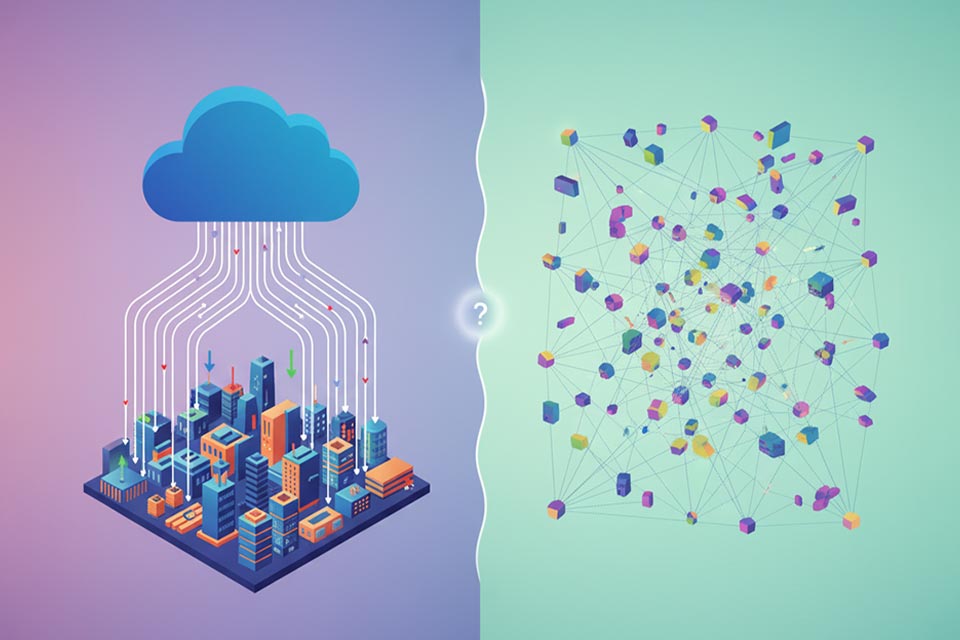
As we are swiftly moving from the monolithic platforms to microservices, cloud native and decentralized cloud have a crucial role to play in this shift. Cloud native applications can take microservices to the next level, creating decentralized solutions that offers business the kind of scalability they need to grow.
Cloud computing has been a way of delivery IT services for a few decades now. It is a model that allows business to utilize resources on demand without any need to invest in heavy infrastructure. Software as a Service (SaaS), infrastructure as a service (IaaS), and platform as a service (PaaS) are examples of cloud computing.
The key advantage of anything as a service is scalability. With such infrastructure less systems, businesses pay only for what they use and they can easily scale up and down as per the need. The decentralization nature of the cloud allows employees to share and access information from anywhere.
Today, we will talk in detail about cloud native and decentralized cloud, the pros and cons, followed by things to keep in mind while adapting to it.
Understanding cloud native application
Simply put, a cloud native application is the one that is designed to run on the cloud. The application makes use of the cloud computing model and is designed leveraging microservices architecture. Applications of cloud native are scalable, fault-tolerant, and easy to deploy. They are designed using open-source technologies and run on commodity hardware.
Decentralized cloud, on the other hand, shifts the paradigm from relying on a few centralized cloud providers (like AWS, Azure, or Google Cloud) to a distributed network of smaller nodes. This could include edge devices, independent servers, and peer-to-peer resources. The decentralized model reduces single points of failure and often improves performance by bringing services closer to the end user.
Together, these concepts enable applications that are not only cloud-optimized but also location-agnostic, secure, and autonomously scalable.
The core building blocks of these technologies are:
-
Microservices:
These are small, independent services that communicate through APIs. Each service handles a specific function, making the system more modular and easier to scale or update. Think of microservices like Lego blocks, each has its own purpose where each can be assembled in countless ways to build powerful structures.
-
Containers:
Containers package up code and dependencies into isolated units that can run reliably across different environments — enhancing portability and consistency.
-
Orchestration tools:
Tools such as Kubernetes manage containerized applications, handling scaling, deployment, and load balancing, allowing decentralized cloud apps to remain efficient and resilient.
The primary goal of cloud native is decentralization where each component of the application runs independently. Every aspect of the application can be scaled up and down as needed without affecting the other components. It holds true for both hardware and software.
Benefits of cloud native and decentralized cloud
Cloud native and decentralized cloud are here to make our lives easier. Here are some of the benefits of developing and using apps in a decentralized cloud:
- Resilience – The main advantage of using microservices is that when one service fails, others still continue to work, it reduces downtime.
- Scalability – Applications on cloud native and decentralized cloud can be scaled easily. You can scale up or down any component of the app without affecting the entire system.
- Cost efficiency – You need to pay for what you use. It reduces the burden of overhead costs to install heavy infrastructure.
- Data privacy & sovereignty – Decentralized cloud allows data to stay local, helping meet regulatory and compliance needs (e.g., GDPR).
Real-world applications of cloud native and decentralized cloud
-
Netflix:
A pioneer of cloud-native architecture. It uses microservices and containerization to manage personalized user experiences across the globe with zero downtime.
-
Filecoin & Storj:
Decentralized storage solutions where users can rent out unused space, offering a decentralized alternative to Dropbox or Google Drive.
-
Cloudflare Workers:
A serverless platform that runs code at the edge, bringing cloud-native capabilities closer to the user.
The challenges in cloud native and decentralized cloud
While a decentralized cloud makes things easier for us, there are certain challenges that may pull your steps back. Let’s have a look at them:
- Technical risks including the potential for data loss or corruption, security breaches, and service outages.
- Cultural risks, where your team faces clashes between traditional and cloud native organizations that pops up demands for more training and skill development.
- Financial risk, which may include increased costs, limited margins, and the need to re-invest in the legacy systems.
As businesses continue their digital evolution, the fusion of cloud native and decentralized cloud architectures offers the ideal foundation for building scalable, flexible, and future-ready applications. But like all technologies, the real value lies in thoughtful implementation — where agility doesn’t come at the cost of complexity or security. The future of cloud is not just centralized, but intelligently distributed.
Catch more CIO Insights: The CIO as AI Ethics Architect: Building Trust In The Algorithmic Enterprise
[To share your insights with us, please write to psen@itechseries.com ]
