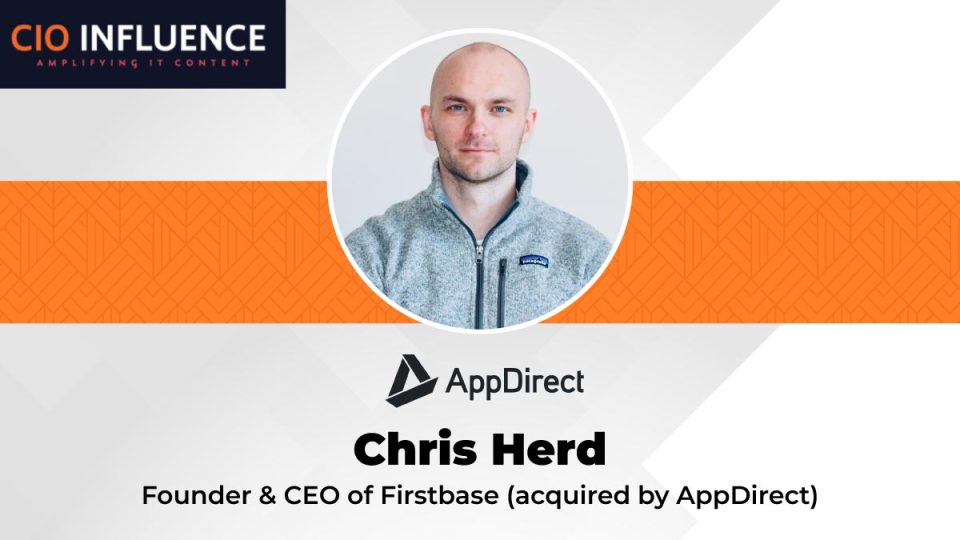
Chris Herd the Founder & CEO of Firstbase (acquired by AppDirect), chats about the pitfalls of replicating office workstyles in remote setups, and integration of Firstbase into AppDirect’s platform, the advantages of remote work with the need for in-person collaboration, and more in this Q&A:
———
Hi Chris, please share your professional journey and what inspired you to create a platform like Firstbase that focuses on remote-first solutions.
I graduated university with an Architecture degree and stayed in Aberdeen while I continued to play semi-pro soccer, so naturally I started working in the oil and gas industry. I did that for a few years, before I became interested in the Open Banking initiatives that were happening in the UK. That led me to founding my first startup, Nexves—an asymmetrical information product that plugged into your bank account, analysed your data, and tried to switch you to a better deal and save you money. We built that business remotely around the world, because we knew we had to hire the best people and we understood they could be anywhere.
Early on, we encountered significant challenges, particularly around equipment. We saw how hard it was to buy, and things didn’t arrive on time, leading to a bad first experience. When things broke, they were hard to fix, and when employees left, it was nearly impossible to recover the equipment. It became such a big problem that we started trying to solve it for ourselves, and we eventually realized that all our friends building remote companies were struggling with the same thing—so we pivoted to solve that problem instead.
Firstbase was born in September 2019, and since then we’ve become the go-to technology management platform for the world’s most innovative companies like Spotify, Wise and UiPath.
Also Read: How AI Copilots Are Transforming Threat Detection and Response
You’ve often highlighted the pitfalls of replicating office workstyles in remote setups. What do you see as the biggest missed opportunities in the current approach to remote work?
The synchronous work style of in-office work, and what’s required to make that successful, is still difficult to replicate remotely. We’ve made massive advances in video communication in terms of clarity, but I’m not convinced instant communication platforms are the solution for day-to-day effectiveness. For many jobs, it increasingly feels like communicating on an instant communication platform, like Teams or Slack, has become the job vs. doing the actual job and having impact. Even worse, the job still must be done, and the overhead of instant communication simply slows them down and that’s a bottleneck to impact.
This is before we even consider the black hole that instant communication platforms are. Many companies struggle to track things that are thrown over the fence on instant communication platforms. There’s no acknowledgment that the work has been accepted, and too many balls get dropped. I thought we would see more platforms solve these challenges, and there has been some degree of evolution with platforms like Roam, which removes some of the friction, but I think this remains the biggest missed opportunity in the current approach to remote work.
What does the integration of Firstbase into AppDirect’s platform mean for the future of IT asset management?
The thing I’m most excited about is the acceleration of our mission to give IT leaders access to a B2B everything store. By joining forces with AppDirect, we have the opportunity to solve all the major problems the biggest companies and most innovative CIOs face across software, hardware, and beyond.
In the enterprise, leaders rely on trusting advisors more than ever and we don’t see that changing any time soon. If anything, with the rise of AI, this has become more critical. When you consider everything that we’ve pulled together on one platform, IT leaders are now able to do many things for the first time. They can supply equipment globally to their team wherever they are in the world and have only one vendor, and it will eventually be possible to do the same thing across hardware.
Collectively, our combined clients are some of the fastest-growing, most respected, and most admired companies in the world, and we’re incredibly fortunate that they give us very clear feedback on what would make their lives easier. At Firstbase, we always approached that through the lens of what it would take to turn an IT leader into a superhero. What we’ve brought together by joining forces with AppDirect is the biggest collection of superpowers ever put in the hands of an IT leader through one platform.
With hybrid work models gaining traction, how can companies effectively blend the advantages of remote work with the need for in-person collaboration?
This is the real challenge, and there has been a lot of evolution in my thinking here. I don’t think anyone disputes that time together is valuable. The question continues to be how much time is appropriate to maximize benefit and that’s the hardest question to answer. How much time does a junior sales employee need to learn from seasoned veterans? By how much can you reduce distractions for an engineering team to allow them to do deep focused work?
I don’t think compromises are the answer, either, because they acknowledge some level of negative impact. In my mind, the best way is to continue to experiment. Companies get stuck in their ways and refuse to move as quickly as they should, even when it becomes obvious they’re doing the wrong thing. The reality is, we were all thrust into a massive remote work experiment with Covid. We settled on many things that were imperfect because we had to, but the world has changed a lot since then.
The most successful companies I’ve seen are the ones who see that as a major opportunity. They continue to refine what work is and they’ve stopped thinking about it in terms of labels. Work is ultimately just work at the end of the day, and every company should be striving to do the best work possible, whatever that means for them. Most would benefit from a more flexible approach that focuses on what it takes to allow people to do the best work of their lives.
Also Read: 2025: The Year of Machine Identity Security
Firstbase revolutionized IT asset management for remote workers. How has the platform helped organizations streamline operations and improve employee experience?
The most interesting thing for us here is how much our customers pulled us towards a better future. We were 100% focused on remote work, but our customers realized that the employee experience of remote workers—being able to choose the equipment they needed to do their best work, having it arrive before their first day, by ordering on Firstbase—was so much better than their in-office work situation that they started hacking our platform to allow their in-office workers to choose as well.
Eventually, we built out the offering such that organizations now use Firstbase for in-office, hybrid, and fully remote workers. The benefit to the employee experience is obvious. Employees have more choice and a simpler process to get the tools they need to do their best work.
For companies, it’s about the benefit of integration. They plug us into their HR platform or ITSM, and instead of tickets going to company IT or HR staff to take action, they come to Firstbase. This gives companies massive efficiency gains, allowing them to operate at a 1:1000s ratio of IT workers to employees, instead of the historical ratio of about 1:100. Firstbase then tracks who has it, where each product has been, when it needs to be upgraded, and automates everything that needs to happen related to those things inside the company.
Before we close, if you could make one prediction about how technology will redefine the way we work in the next decade, what would it be?
Unquestionably, it’s going to be the arrival of AI agents inside the enterprise. For the last 100 years, the way in which every company was able to do more, was largely on the back of hiring more people. That is about to fundamentally change. Every company will increasingly leverage AI agents to handle repetitive tasks, and by linking business systems, they will be able to do more and more important work.
What I expect that to mean, is that in the same way every company has an HR platform like Workday to track and manage their human resources, there will be an IT “HR” platform that every company uses to track and manage their IT agents. As a consequence, IT will grow to become one of, if not the most important function in every enterprise, because they control the deployment, training, and efficiency of these agents.
This will shift CIOs from being a fringe player at the executive table, to driving massive progress in every business. The challenge for CIOs is acquiring the skills needed to be an AI-first CIO vs. being a more reactive player who isn’t able to provide their organization leverage.
Thank you, Chris, for sharing your insights with us.
[To share your insights with us as part of editorial or sponsored content, please write to psen@itechseries.com]
Chris Herd is the Founder & CEO of Firstbase (acquired by AppDirect), a single platform to equip teams & manage assets globally. Over the last 6 years, he built Firstbase to 8 figures of revenue, oversaw Firstbase becoming the go-to Technology Management Platform at the world’s most innovative companies like Spotify, Wise and UiPath. Following the acquisition, Chris is continuing his work with AppDirect as the GM of Firstbase.
AppDirect is a B2B subscription commerce platform company that brings together technology providers, advisors, and businesses to simplify how they buy, sell, and manage technology. More than 1,000 providers, 10,000 advisors, and 5 million subscribers rely on the AppDirect ecosystem of subscription marketplaces to power their innovation, growth, and success.
Firstbase is a single platform to equip teams and manage assets globally. Our platform lets companies automate the full asset lifecycle by getting equipment to & from employees wherever they are in the world, providing a full history of actions taken on every device, and ensuring the right person has the right equipment from procurement to end of life.